

Lorentzian Einstein–Rosen Bridges and Two-Boundary States
The maximally extended neutral AdS black hole has two exterior regions. A spacelike slice can connect their asymptotic boundaries through an Einstein–Rosen bridge, even though no future-directed causal curve can travel from one boundary to the other. In a controlled semiclassical holographic regime, the standard two-boundary state is the thermofield double (TFD) of two noninteracting boundary theories.
Three qualifications are essential. The TFD and its thermal marginals are exact Hilbert-space statements, whereas the smooth eternal geometry requires a dominant, weakly curved bulk saddle. Boundary times select a relationally anchored bridge slice; the slice and its regulated volume are not intrinsic, slicing-independent sizes of a wormhole. Finally, one-sided thermal density matrices do not determine the purification, its cross-boundary correlations, or a unique interior.
Required background. Two-Sided Black Holes and Thermofield-Double States supplies the thermal state preparation. Relational, Boundary, and Asymptotic Observables supplies the observable standard.
Helpful background. Reflected Entropy and Canonical Purifications gives a purification comparison. Relational Bulk Observables and Dressing Choices explains why gravitational localization requires dressing.
From a simple horizon to four Kruskal regions
Section titled “From a simple horizon to four Kruskal regions”Use the site convention and restrict the construction to a neutral, nonrotating, nonextremal Schwarzschild–AdS-like solution,
Here has normalized curvature or . Let be the largest simple root,
The ordinary chart fails at , but the geometry need not. Define the tortoise and null coordinates
Near a simple horizon,
In the right exterior choose
Then , and the radial metric becomes
Because has a finite nonzero horizon limit, and are regular null horizons rather than curvature singularities. Analytic continuation gives four sign regions:
| Region | Signs | Interpretation |
|---|---|---|
| Right exterior | , | Right asymptotic boundary and exterior |
| Left exterior | , | Left asymptotic boundary and exterior |
| Future region | , | Black-hole interior ending at the future singularity |
| Past region | , | White-hole interior beginning at the past singularity |
The bifurcation surface is the codimension-two surface . Compact coordinates such as and place infinity at finite coordinate distance while preserving null directions. This produces the Penrose diagram below. The conformal drawing is schematic, but the incidences—two timelike boundaries, four horizon branches, two spacelike singularities, and four regions—are causal data Maldacena 2003, § 2, Figures 1–3 and eqs. (2.1)–(2.6).
The stationary Killing field is
Let and both increase toward the physical future of their respective boundary theories. The same bulk vector then has opposite orientation in the exteriors,
It becomes spacelike behind the horizons. This sign reversal is the source of the two different Hamiltonian combinations below; it is not a convention that can be silently dropped.
The bridge is codimension-one spatial connectivity on a chosen spacelike slice. By contrast, is codimension two and is minimal on the reflection-symmetric slice. No future-directed causal curve connects the two conformal boundaries: after crossing either future event horizon, such a curve terminates at the future spacelike singularity instead of emerging through the opposite exterior. “Spacelike connected” therefore does not mean “causally connected.”
The thermofield double fixes the clock convention
Section titled “The thermofield double fixes the clock convention”The prerequisite page develops the Euclidean half-circle preparation and thermal trace in detail. Here only the state identity needed for the Lorentzian geometry is recalled. Let be the antiunitary map that identifies the two copies and write . For matched spectra,
Both reduced density matrices are exactly thermal, and
Time evolution with both physical boundary clocks future-directed gives
Thus the state depends on
whereas the shift is generated by and leaves both and the TFD unchanged. The figure makes this distinction visible. Inspect the two boundary-time arrows separately from the dashed Killing arrows, and compare the unarrowed spacelike slices with the causal curve that ends at the singularity.
On a narrow screen, swipe or use the Left and Right arrow keys to pan across the figure. Home and End move to its edges. A full-size link is also available.
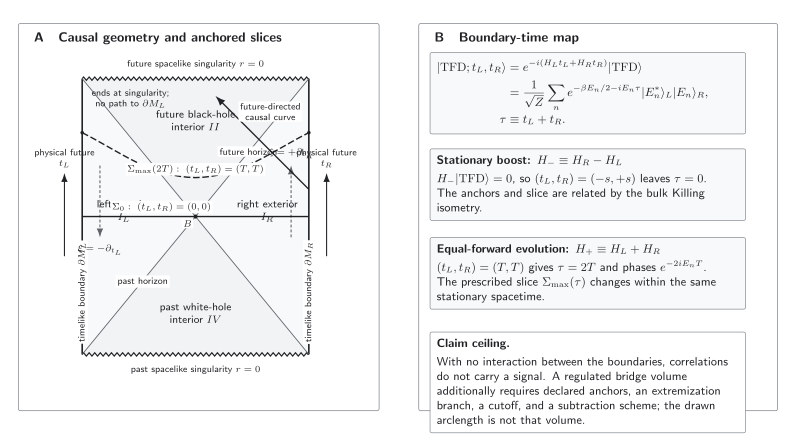
Schematic radial Penrose diagram of a nonextremal, uncharged, nonrotating eternal AdS black hole, with angular directions suppressed. Both physical boundary times increase toward the future, while the stationary Killing field satisfies . Consequently leaves the TFD invariant, whereas equal-forward evolution by changes and the maximal spacelike slice anchored at those times. In the uncoupled geometry, a causal curve entering a future horizon ends at the future singularity rather than reaching the opposite boundary. The bridge is slice-dependent spatial connectivity, not a timelike tube; the drawn curve length does not represent , which requires a declared extremization and renormalization prescription. Not to scale. Accessible figure data (JSON)
The same content in linear form is:
| Evolution | Future-directed anchors | Effect on the TFD | Bulk interpretation | Licensed conclusion |
|---|---|---|---|---|
| Reference | No relative phase | crosses | Standard nontraversable two-sided saddle, in its controlled regime | |
| Stationary boost | State invariant | Anchors and slice are related by a Killing isometry | No physical bridge-growth inference | |
| Equal-forward | Phase | A different in the same stationary spacetime | Its regulated maximal volume may change within the declared prescription | |
| No interboundary coupling | Any anchors | Marginals remain local thermal states | Future causal curves that enter the hole hit the singularity | Correlation does not imply traversability |
For a Hermitian, CPT-even scalar, a safe operator convention is
The opposite-side Wightman function is then
The dependence is on , as the state calculation requires. Charged, spinning, or CPT-odd operators need their own transpose, dagger, and charge-conjugation conventions; the scalar formula should not be reused blindly.
Boundary anchors define the bridge slice
Section titled “Boundary anchors define the bridge slice”Fix a radial cutoff and the boundary cross-sections at . Among an explicitly stated class of spacelike codimension-one surfaces joining those anchors, define
An interior extremum satisfies the maximal-slice equation , where is the trace of the extrinsic curvature. If several extrema exist, the branch choice is part of the prescription. The asymptotic volume diverges, so a finite comparison also requires counterterms or a reference subtraction,
Stationarity implies . In a classical nonextremal Schwarzschild–AdS saddle, the late-time result after transients has the form
For a planar or otherwise noncompact horizon, this is a volume density unless a transverse regulator is supplied. This calculation establishes growth of a prescribed classical geometric functional. It does not establish a local diffeomorphism-invariant observable, an exact finite- boundary operator, or an indefinitely growing exact quantity past entropy-scale saturation and recurrence physics. The proposal that boundary circuit complexity is proportional to this volume is treated separately in Complexity Equals Volume Proposals and remains a conjecture Stanford and Susskind 2014, §§ 2.1–2.2, eqs. (2.4)–(2.11).
A quantitative BTZ check
Section titled “A quantitative BTZ check”There is a particularly transparent check in the noncompact BTZ geometry. For a scalar primary of dimension at equal spatial position, in the classical saddle and the leading heavy-operator geodesic approximation,
Using gives
At this becomes . The calculation links the decay of a specified two-sided correlator to the growth of a specified boundary-anchored geodesic. It is not a proof that geodesic length or bridge volume is an exact invariant observable. Compact BTZ also requires the angular image sum; the simple expression is the noncompact result or the principal-image, high-temperature approximation Maldacena 2003, § 2, especially eqs. (2.5)–(2.6).
Fixed thermal marginals do not fix the interior
Section titled “Fixed thermal marginals do not fix the interior”Now hold all one-sided data fixed while changing the purification:
The phase disappears from either partial trace,
Therefore every one-sided expectation value, the Schmidt spectrum, and the entanglement entropy are identical for all . Cross-boundary observables are not. In matched bases,
The phase family contains three logically different cases:
| Phase pattern | Exact state relation | What it licenses |
|---|---|---|
| The original TFD up to an overall phase | The usual TFD claim, subject to the bulk regime | |
| An ordinary time-shifted TFD | A standard smooth saddle with different boundary-clock anchoring can remain valid | |
| Non-affine | Not generated by a boundary time translation | The thermal marginals no longer select the standard Euclidean TFD preparation or a unique interior |
This immediately blocks the incorrect inference “different phases destroy the bridge.” Linear energy phases are a control that changes the anchoring while preserving the standard smooth interpretation. Generic phases instead make the geometry underdetermined from the marginals.
A further statistical assumption is needed even to claim dephasing. If the are independent and uniform, phase averaging gives
Under this independent-phase ensemble, only the coherent off-diagonal part vanishes automatically; the diagonal contribution remains. For deterministic time dephasing, degeneracies can preserve off-diagonal terms, while phase-matched probes and atypical phase choices also block any unconditional suppression claim. With degenerate energies, unitaries within each degenerate block give still more fixed-marginal purifications.
A two-level calculation—and why it is not enough
Section titled “A two-level calculation—and why it is not enough”For beginners, take
Both marginals are , but with Pauli operators and ,
The amount of entanglement is fixed while the two-sided correlation vector rotates. However, any phase assignment on only two distinct energies is energy-affine: two points always fit . To exhibit a genuinely non-time-shifted purification, use three equally spaced levels and
The first two phases would require modulo , which predicts the same phase increment from level 1 to level 2; the actual increment is . No affine fits all three. Even then, the correct conclusion is not “there is no interior.” It is that identical thermal marginals do not license the original Kruskal bridge or any unique alternative without additional state-sensitive evidence.
| Quantity | Preserved for every diagonal phase? | Consequence |
|---|---|---|
| , , and all one-sided expectations | Yes | One-sided thermal data survive exactly |
| Schmidt spectrum and entanglement entropy | Yes | The amount of entanglement is insufficient |
| Simple cross-boundary correlators | No | Purification-sensitive gluing data can change |
| Standard half-circle TFD preparation | Only for the appropriate phase pattern | Non-affine phases require different preparation data |
| Smooth bridge and detailed interior | Undetermined | Neither existence nor nonexistence follows from marginals alone |
| Traversability in the decoupled setup | No change | There is still no signaling channel |
Correlation is not a signal
Section titled “Correlation is not a signal”In the uncoupled tensor-product theory, left and right operators commute,
More generally, let be any trace-preserving local channel with Kraus operators . The unconditional right state is
A selective measurement can steer a conditioned right state, but the measurement outcome must be communicated by an ordinary channel before the right observer can use that conditioning. A nonzero Wightman correlator or mutual information is therefore evidence of correlation, not a response function permitting transmission.
Creating a controlled traversable window requires changing the dynamics. In the standard Gao–Jafferis–Wall construction, a deliberately timed interboundary coupling produces the negative averaged null energy and time advance needed for passage Gao, Jafferis, and Wall 2017, § 5. That mechanism belongs to Traversable Wormholes, Couplings, and Energy Conditions.
What the results establish
Section titled “What the results establish”Evidence checked 29 August 2026. The exact identities on this page are ordinary quantum mechanics. The causal diagram and maximal-slice equations are classical statements about the specified eternal Schwarzschild–AdS solution. The identification of the TFD with a single smooth two-sided saddle additionally requires large or large central charge, a weakly curved bulk with controlled string and quantum corrections, an appropriate semiclassical code sector, and saddle dominance. On a compact boundary the exact TFD exists at every temperature, but in the standard spherical case the connected black-hole saddle need not dominate below the Hawking–Page transition; Euclidean Saddles and Hawking–Page develops that comparison.
| Statement | Status | Required assumptions | Strongest licensed conclusion |
|---|---|---|---|
| Each TFD marginal is thermal | Exact Hilbert-space identity | Specified tensor-product and antiunitary identification | No bulk conclusion by itself |
| A local left channel cannot signal to the right | Exact quantum-information result | Dynamically decoupled factors; unconditional right state | Correlation is not a channel |
| The maximally extended solution is nontraversable | Classical geometric result | The specified neutral, nonrotating, nonextremal solution | Does not cover deformed matter or interboundary couplings |
| The TFD has a smooth eternal-black-hole interpretation | Controlled holographic inference | Semiclassical bulk, appropriate spectrum, corrections controlled, saddle dominance | Standard two-sided geometry within that regime |
| Anchored maximal volume grows at late classical times | Background-dependent geometric diagnostic | Fixed anchors, surface class, extremization branch, regulator, subtraction | Not a local invariant or a proved exact complexity observable |
| Generic fixed-marginal phases have no smooth interior | Open; not established | Would require state-sensitive nonperturbative control | The marginals alone leave the interior underdetermined |
Assumption-dependent arguments based on generic equilibrium states challenge smooth state-independent interiors, but they do not prove that every fixed-marginal phase state lacks an interior Marolf and Polchinski 2013, §§ III–IV. Conversely, current nonperturbative results are sharply model-specific. In JT gravity, an explicitly constructed bulk Hilbert space supports a bridge-length operator and exhibits nonperturbative late-time spreading on scales of order ; this is valuable evidence against extrapolating one classical slice forever, not a theorem for higher-dimensional AdS/CFT Iliesiu et al. 2024, §§ 1 and 5. A 2026 review likewise treats the interiors of generic candidate states as an open classification problem rather than a solved entanglement criterion Sasieta 2026, §§ 2–3.
The safe synthesis is:
In a controlled semiclassical holographic regime, the TFD has the standard smooth, nontraversable two-sided-black-hole interpretation, and prescribed bridge diagnostics depend on the boundary anchoring times. Exact one-sided thermal marginals do not determine the purification, cross-boundary correlations, or a unique interior; after non-affine phase deformations, the standard smooth-bridge interpretation is underdetermined rather than disproved.
Common pitfalls
Section titled “Common pitfalls”Entanglement alone implies a smooth wormhole. It does not. The TFD’s special correlations, preparation, large- structure, and controlled saddle are additional input.
A two-sided correlator is a traversable channel. A Wightman correlator measures correlation. Signaling is controlled by response and by whether the dynamics couples the two factors.
Both future boundary clocks generate the stationary symmetry. Equal-forward evolution uses and changes . The stationary boost uses .
Every phase deformation destroys the bridge. Energy-affine phases are ordinary time shifts of the TFD. Non-affine phases make the standard geometric inference underdetermined; they do not prove singularity.
A drawn slice length is the wormhole volume. The relevant classical diagnostic is a boundary-anchored extremal volume with a specified branch, cutoff, and subtraction. The line length in a conformal diagram has no such meaning.
Lorentzian, Euclidean, and traversable wormholes are interchangeable. They answer different questions. Euclidean Wormholes and Connected Boundary Amplitudes treats connected Euclidean saddles; the next page treats traversability.
Exercises
Section titled “Exercises”1. Horizon regularity and time orientation
Section titled “1. Horizon regularity and time orientation”Starting from the near-horizon expansion of , show that and that is finite. Derive .
Solution
Integrating gives . Therefore for a positive constant fixed by the additive constant in . Hence , finite and nonzero.
At fixed , . From and , and , so . It is future-directed in and past-directed relative to the physical left clock in .
2. Which boundary-time combination matters?
Section titled “2. Which boundary-time combination matters?”Act with on the TFD. Show that the state depends only on and is invariant under .
Solution
Each term has energy in both factors, so it acquires . The opposite shift leaves this sum unchanged. Infinitesimally, its generator is , and equal matched energies give . Either local unitary leaves the corresponding thermal eigenvalues—and hence both marginal density matrices—unchanged.
3. Fixed marginals and a genuinely non-affine phase
Section titled “3. Fixed marginals and a genuinely non-affine phase”For , compute both reduced states, , and . Then explain why three equally spaced levels with phases cannot be an ordinary time shift.
Solution
The cross terms vanish under either partial trace, giving . Since exchanges and , its expectation is . With and , the second expectation is .
For equally spaced energies, an affine phase has a constant increment modulo . The first increment in is zero and the second is , so no fits all three. The marginals remain fixed, but the standard time-shifted-TFD interpretation no longer follows.
4. No signaling despite correlation
Section titled “4. No signaling despite correlation”Prove that any trace-preserving channel on leaves the unconditional right density matrix unchanged. Why can a selective measurement still appear to change a conditioned right state?
Solution
Write with . Cyclicity of the partial trace for operators acting only on gives
Conditioning on one outcome replaces the trace-preserving channel by a single non-trace-preserving branch and can steer the right ensemble. The right observer cannot know which branch occurred until the outcome is communicated, so this does not permit superluminal or through-the-bridge signaling.
5. The late-time BTZ check
Section titled “5. The late-time BTZ check”Starting from and , derive the late-time geodesic growth. List two reasons this does not prove an exact complexity observable.
Solution
Taking logarithms gives . Since , the leading growth is .
The result uses a classical BTZ saddle and the heavy-operator geodesic approximation, and its additive constant depends on renormalization. Moreover, geodesic length is not maximal codimension-one volume, while complexity requires an independently specified boundary task, gate set, reference state, and normalization.
The chapter overview compares these assumptions and limitations.
For the chapter-wide comparison of assumptions, counterevidence, falsifiers, and claim ceilings, see the claim-domain table.
References
Section titled “References”- Gao, P., Jafferis, D. L., and Wall, A. C. “Traversable Wormholes via a Double Trace Deformation.” Journal of High Energy Physics 2017, 12 (2017): 151. DOI.
- Hartman, T., and Maldacena, J. “Time Evolution of Entanglement Entropy from Black Hole Interiors.” Journal of High Energy Physics 2013, 5 (2013): 014. DOI.
- Iliesiu, L. V., Levine, A., Lin, H. W., Maxfield, H., and Mezei, M. “On the Non-Perturbative Bulk Hilbert Space of JT Gravity.” Journal of High Energy Physics 2024, 10 (2024): 220. DOI.
- Maldacena, J. “Eternal Black Holes in Anti-de Sitter.” Journal of High Energy Physics 2003, 4 (2003): 021. DOI.
- Marolf, D., and Polchinski, J. “Gauge–Gravity Duality and the Black Hole Interior.” Physical Review Letters 111 (2013): 171301. DOI.
- Sasieta, M. “Interior Microstates and Black Hole Entropy.” Entropy 28, 4 (2026): 408. DOI.
- Stanford, D., and Susskind, L. “Complexity and Shock Wave Geometries.” Physical Review D 90 (2014): 126007. DOI.
Further reading
Section titled “Further reading”- Van Raamsdonk, M. “Building Up Spacetime with Quantum Entanglement.” General Relativity and Gravitation 42 (2010): 2323–2329. DOI. A concise motivation for the entanglement–geometry program; it should not be read as a theorem that arbitrary entanglement produces a smooth bridge.