

Semiclassical Gravitational Replicas
A gravitational replica calculation begins with a concrete boundary-value problem at a positive integer . One prepares density-matrix kernels, cyclically sews the chosen boundary subsystem, declares the gravitational integration domain, and only then evaluates the admitted geometries. A replica-symmetric saddle may have a useful quotient with a conical locus, but neither that symmetry nor a continuation to noninteger follows from the sewing itself. This page builds the construction in that order and keeps exact identities separate from semiclassical and continuation assumptions.
Required background. Replica Constructions on Fixed and Semiclassical Backgrounds distinguishes matter replicas from metric integration. Euclidean Gravitational Path Integrals, Topology Sums, and Boundary Conditions supplies the topology, contour, gauge, and renormalization data that define a gravitational amplitude.
Helpful background. Analytic Continuation: Uniqueness and Failure Modes develops the moment and growth conditions. Replica Derivations and Cosmic Branes develops the entropy and extremality derivations that are only summarized here.
Scope and conventions. The subsystem is a regulated algebra on a fixed asymptotic boundary, an entire nongravitating boundary factor, or a region in a nongravitating bath. A genuinely gravitating subregion requires an additional algebra, edge-mode, or factorization prescription and is not silently assumed. All replicas use identical boundary sources, regulator, gauge convention, action, boundary terms, counterterms, topology policy, and parent integration cycle. The worked benchmark uses Euclidean two-derivative Einstein gravity coupled to matter; the quotient tension below is not a higher-derivative formula. Evidence and frontier claims are reviewed through 29 August 2026.
Cyclic sewing defines the boundary data
Section titled “Cyclic sewing defines the boundary data”Start with an unnormalized reduced density-matrix kernel
where and are field configurations on the lower and upper banks of the cut along . The complement has already been closed between the two sides of the preparation. Define
This notation prevents a common normalization mistake: is the path-integral kernel, whereas is the unit-trace state.
Kernel multiplication gives the second unnormalized moment directly,
For general integer ,
In the cut geometry this is the identification
Thus the sheet permutation is the cycle on and the identity on its complement. The normalized moment and Rényi entropy are
These are algebraic identities in the regulated theory. They do not choose a bulk topology, saddle, contour, or analytic function of noninteger . The two “boundaries” of the kernel are its upper and lower banks; they should not be mistaken for two asymptotic universes. For a proper subregion, the boundary branch locus is . For an entire boundary factor, is empty and sewing instead lengthens the Euclidean preparation circle, as in the thermal benchmark below. A bulk fixed surface, when one exists, is a different object that can end on in a holographic subregion construction.
The n = 3 boundary problem sheet by sheet
Section titled “The n = 3 boundary problem sheet by sheet”For three copies, the nontrivial sewing is
Crossing the cut advances the sheet label ; crossing the complement leaves it unchanged. Three crossings return a field to its starting sheet. This elementary check is valuable because a mistaken transposition or same-copy closure computes a different observable.
Call the resulting marked boundary datum . It includes more than the topology of a branched cover: every sheet carries the same fixed metric and sources, the cut banks retain their orientation, and the cyclic labels remain part of the boundary condition. More generally, is invariant under the boundary permutation
provided the sheet sources are identical. This is a symmetry of the boundary problem. Whether an individual bulk solution preserves it is a later dynamical question.
The following data are fixed before solving, while the remaining entries are outputs of the gravitational problem.
| Datum | Fixed input or solved output? | Why it matters |
|---|---|---|
| Cut and bank orientations | Fixed input | They specify which operator moment is computed. |
| Cyclic permutation on and identity on | Fixed input | They define at integer . |
| Boundary metrics, sources, and their sheet dependence | Fixed input | Unequal sources can explicitly remove . |
| Topology and bundle sectors admitted in the sum | Fixed input | Sewing alone does not admit every bulk filling. |
| Parent integration cycle and normalization | Fixed input | A formal saddle can have zero contour coefficient. |
| Bulk metric, matter fields, and possible fixed set | Solved output | They must obey the declared boundary data and field equations. |
| Replica symmetry of a saddle | Solved output | It licenses, or forbids, the full quotient. |
| Action, determinant, and dominance | Solved output | They determine the contribution at the stated approximation order. |
Gravity integrates over fillings of the sewn boundary
Section titled “Gravity integrates over fillings of the sewn boundary”Once is fixed, a schematic gravitational definition is
Here denotes the complete prescription. The set contains the admitted manifolds and field bundles; is the inherited integration cycle; consists of gauge transformations connected to the identity and acting trivially on the marked boundary data; and includes the boundary terms and counterterms. Discrete automorphisms preserving those data, zero modes, moduli, and any sum over spin or gauge sectors must also be treated. The cyclic sheet permutation remains a global symmetry of the boundary problem rather than an element silently divided out here. None of these choices is supplied by the symbol .
A semiclassical expansion is therefore a sum, not the declaration of one preferred picture:
The contour coefficient may vanish or carry a phase. The determinant includes gauge fixing and removes zero modes that are instead integrated as collective coordinates. A physical negative mode requires a descent prescription rather than an assumed positive Gaussian. Comparisons of with are meaningful only in the same scheme.
This page permits the topology policy to be stated but does not decide which topology dominates. In particular, cyclic boundary sewing neither creates a replica wormhole nor excludes one. The connected-versus-disconnected action comparison belongs to Replica Wormholes and Saddle Competition.
A thermal density-matrix benchmark
Section titled “A thermal density-matrix benchmark”An entire side of the thermofield-double state gives a particularly transparent two-bank kernel. For a Hamiltonian with a regulated thermal trace,
This Euclidean preparation and its two-sided interpretation are reviewed in Maldacena 2003, §2, Eqs. (2.3)–(2.4).
The right density matrix is represented by a Euclidean strip of length with two open banks. Sewing kernels end to end produces one thermal boundary circle of length , so
For , this is a boundary circle of circumference with the order-three translation . In a holographic theory, one must now choose the admitted bulk fillings of that circle. Suppose one branch is a regular Euclidean black-hole filling that actually preserves this order-three translation. Its thermal circle is contractible at the Euclidean horizon, and smoothness makes the extended action a rotation about that fixed set. Another admitted filling can have a noncontractible thermal circle and no fixed set at all. The boundary sewing is the same in both cases; the bulk answer is not.
Before gravity is invoked, the normalization supplies an independent check:
which is the ordinary thermal entropy. This derivative presumes that the microscopic is defined near the required temperatures. In a saddle approximation, each relevant gravitational branch must be continued before its contributions are compared. Holographic Rényi phase transitions provide explicit examples of branch exchange Belin, Maloney, and Matsuura 2013, §§3–5.
A smooth cover gives a cone only after quotienting
Section titled “A smooth cover gives a cone only after quotienting”Now assume that an admitted saddle is regular and preserves the full action, as in the conditional construction of Lewkowycz and Maldacena 2013, §§4.1–4.3. Near one codimension-two component of its fixed set, choose transverse polar coordinates on the full cover:
The replica generator acts as
The metric is smooth at ; the radial sectors are fundamental-domain guides, not singular seams. Form the quotient
Its angular range is . Equivalently, with and ,
A small circle therefore has circumference , giving opening angle and deficit
For the explicit construction, and . A free action has no fixed set and hence no local cone. Several fixed components produce several quotient loci; the sewing does not select their number.
The diagram makes the logical order visible. First inspect the bank-by-bank boundary identifications, then compare the regular full disk with the conditional quotient. The dashed exit is equally important: it is the route taken when a saddle breaks the boundary replica symmetry.
On a narrow screen, swipe or use the Left and Right arrow keys to pan across the figure. Home and End move to its edges. A full-size link is also available.
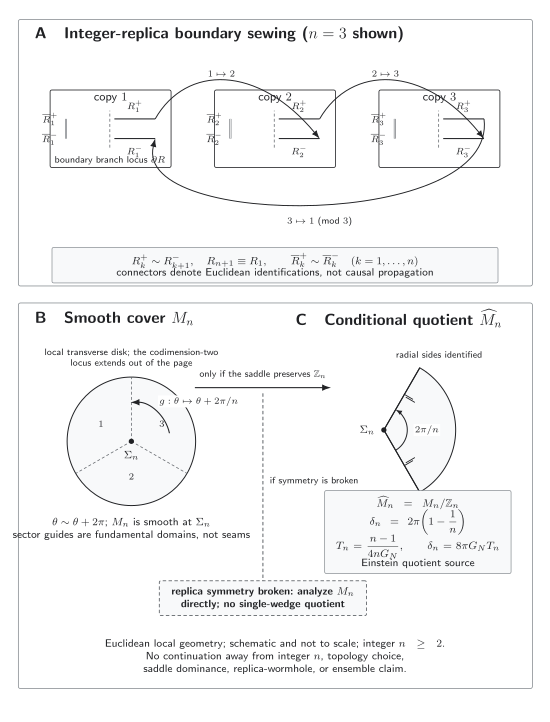
For , the upper bank of on copy is identified with the lower bank on copy , while the complement closes within each copy. If an admitted regular gravitational saddle preserves the resulting permutation, its smooth transverse disk may be quotiented to a fundamental wedge of opening angle and deficit ; in Einstein gravity the same quotient can be represented by the stated auxiliary cosmic-brane tension. Replica-symmetry-breaking saddles have no such single-wedge description. Euclidean schematic; not to scale. Accessible figure data (JSON)
The local relationships have the following semantic equivalent.
| Stage | Object | Exact relation | Required assumption | Not implied |
|---|---|---|---|---|
| Boundary preparation | cut kernels | Integer | Regulated boundary algebra and state | A bulk topology or saddle |
| Sewing on | Sheet cycle | Common bank orientation | Causal propagation between copies | |
| Sewing on | Same-copy closure | The complement is traced within each kernel | A cycle on | |
| Bulk problem | Fillings of | Sum over the declared domain | Topology, contour, gauge, and renormalization data | Existence or dominance of any drawn filling |
| Regular symmetric cover | near | Full angle and | Smooth fixed set and unbroken | A conical singularity in |
| Conditional quotient | Opening and deficit | The saddle preserves full | A quotient for a symmetry-breaking saddle | |
| Einstein dictionary | Auxiliary cosmic brane | Two-derivative Einstein gravity | A physical brane in the original theory | |
| Continuation | Neighborhood of | Not fixed by a finite integer sample | Physical growth, branch, and saddle control | A unique entropy derivative from sewing alone |
The auxiliary brane and action normalization
Section titled “The auxiliary brane and action normalization”In two-derivative Einstein gravity, the quotient defect can be generated while solving the equations by an auxiliary pure-tension codimension-two brane satisfying
For , this gives and . The algebraic control gives zero deficit and zero tension. At noninteger , however, there is no literal group ; the brane defines an analytic geometric prescription whose physical continuation still needs justification.
There is a bookkeeping distinction that prevents double counting. One may vary
to solve for the backreacted quotient and the brane embedding. But the holographic Rényi action is evaluated with the bulk action of the quotient, excluding the auxiliary brane action Dong 2016, §III, Eqs. (14)–(18). The brane is a device for generating the conical boundary condition, not an extra matter source in the smooth cover.
On a smooth replica-symmetric saddle branch , write
The quotient action is defined by an excised-tip regulator with the ordinary asymptotic boundary terms and counterterms. The zero-radius limit adds no localized tip term, auxiliary-brane action, or inner-tip Gibbons–Hawking–York term; the thin-tube term that appears when this on-shell action is varied is a different object. Let be the smooth endpoint of this branch, so . Its branch-normalized action is
If branch controls the numerator and its endpoint controls the physical denominator in the same approximation, then up to the retained determinants, subdominant saddles, and higher orders. Otherwise is only a branch contribution, not the physical Rényi answer. Under the stated dominance and endpoint conditions,
This form displays the cancellation of the extensive term. It also fixes the sign. In classical Einstein holography, Dong’s refined Rényi relation is
on the specified contributing branch. The ordinary finite- is not simply . The derivation of extremality, higher-derivative entropy functionals, and the renormalized one-loop bulk-entropy correction belongs to Replica Derivations and Cosmic Branes and Quantum Corrections and Generalized Entropy. In particular, comes from replicated fluctuation determinants together with the required local terms and counterterms; it is not another classical conical contribution Faulkner, Lewkowycz, and Maldacena 2013, §§1–2.
Boundary symmetry does not force saddle symmetry
Section titled “Boundary symmetry does not force saddle symmetry”The boundary datum is -invariant when its sheet sources agree. An individual saddle need not be. If its stabilizer is a subgroup , the boundary symmetry generates an orbit with
equal-action saddles. When the contour and measure preserve the boundary symmetry, the complete orbit restores it in the finite- sum. Choosing one orbit member only after a semiclassical limit is the spontaneous-symmetry-breaking statement.
A representative can at most be quotiented by its actual stabilizer . Quotienting it by the full would identify inequivalent points and manufacture a false cone. One must instead evaluate the full saddle, its determinant and contour coefficient, and the other members of its orbit. Camps and Kelly showed that replica-breaking terms can be compatible with the local field equations and that the local extremality constraint can survive under weaker assumptions; they did not show that a replica-breaking saddle universally dominates ordinary density-matrix moments Camps and Kelly 2015, §§3–5.
As a concrete count, take and a saddle preserved only by . Its orbit contains saddles. Their sum can respect the boundary symmetry even though neither member admits a single fundamental-wedge description.
What integer moments do and do not determine
Section titled “What integer moments do and do not determine”Let
For a regulated positive density matrix with eigenvalues ,
Moreover,
The exact positive-integer moments therefore form a Hausdorff moment sequence. The complete exact sequence determines the measure uniquely and hence determines
when ; see Analytic Continuation: Uniqueness and Failure Modes for the moment-problem hypotheses. This is why a sine deformation is not automatically a second physical density-matrix continuation. Adding directly to generally violates its boundedness and moment positivity. Adding it to instead produces the candidate , which must pass the same physical growth and positivity tests and generally does not.
The gravitational difficulty is narrower. In practice one often knows only finitely many integer saddles, a truncated expansion, or the branch that dominates at a few integers. That approximate information need not determine . Suppose values are available only at . Then
is analytic for and vanishes at every sampled integer, while
It shifts the inferred entropy by . This function is an adversarial interpolation, not a claimed physical moment function. Its role is to expose the missing hypothesis: a microscopic spectral measure, a suitable uniqueness theorem and growth bound, or a controlled saddle family in a neighborhood of .
Saddle dominance creates a separate hazard. If branches and cross, the strict semiclassical pointwise minimum can be nonanalytic even when each branch is smooth. Continuing “the dominant saddle at ” is therefore not a prescription. Continue each licensed branch, retain its contour coefficient and corrections, and compare the sum near the target value. The exact finite-parameter observable may smooth a transition that becomes sharp only after the large- or limit.
Recent fixed-area and holographic-code analysis derives a diagonal approximation and, for Rényi index above one, recovers the original cosmic-brane prescription without taking unbroken bulk replica symmetry as a primitive assumption, at leading semiclassical accuracy up to the stated corrections Penington and Rath 2024, abstract and §§II–IV. This is important evidence in that framework, not a theorem that every gravitational saddle is symmetric; it does not establish uniform control as or the complete entropy correction. For index below one and competing extremal surfaces, a modified prescription can differ at leading order Dong, Kudler-Flam, and Rath 2024, §§2–4. That result does not directly contradict the present integer- or right-hand construction, but it does expose continuation and order-of-limits sensitivity.
Claim status and failure tests
Section titled “Claim status and failure tests”| Statement | Status | Required control | Failure or downgrade |
|---|---|---|---|
| Kernel sewing and | Exact regulated identity | State, algebra, cut orientation, normalization | A different permutation computes a different moment. |
| Gravitational | Definition conditional on | Topology, bundles, contour, gauge, action, counterterms | Changing changes the theory or observable. |
| Saddle contribution | Asymptotic semiclassical result | Existence, contour coefficient, modes, determinant, complete same-order sum | A formal geometry may contribute zero or have unresolved phase. |
| Quotient opening | Exact local integer- geometry | Smooth fixed set and unbroken | Free action gives no cone; broken symmetry forbids the full quotient. |
| Classical Einstein dictionary | Auxiliary quotient brane and two-derivative action | Not universal in higher-derivative gravity. | |
| Refined-Rényi area | Leading classical branch result | Correct action bookkeeping, contribution, and -family | Does not make ordinary equal to area. |
| Entropy from | Conditional inference | Physical continuation, branch control, common scheme | Finite samples or a selected dominant branch do not fix the derivative. |
| Replica-breaking saddle | Allowed possibility | Model-specific solution, orbit, contour, and competition | Permission by local equations is not evidence of dominance. |
| Replica wormhole, ensemble, or unitarity claim | Not established here | Independent topology, averaging, and microscopic arguments | Integer sewing and a quotient cone imply none of them. |
The strongest statement surviving all tests is deliberately conditional: a declared gravitational replica problem has exact integer boundary data; an admitted, contributing, smooth -symmetric saddle has the quotient geometry derived above; and an entropy follows only from a physically controlled family near . Every stronger conclusion needs additional evidence.
Common pitfalls
Section titled “Common pitfalls”Putting the cone on the full cover. The regular has transverse angle . The opening belongs to .
Treating boundary symmetry as a bulk boundary condition. Equal replica sources make symmetric. They do not require every filling or dominant saddle to be symmetric.
Adding the auxiliary brane action to the Rényi answer. Its variation generates the quotient defect. The bulk quotient action used in the entropy formula excludes that auxiliary term.
Using finite- area as ordinary Rényi entropy. The simple area law applies to the refined Rényi quantity in classical Einstein gravity. Recover by integrating with the correct normalization.
Calling any analytic interpolant physical. A density-matrix moment function obeys positivity and growth constraints. An adversarial interpolant only demonstrates what the sampled or approximate data fail to determine.
Exercises
Section titled “Exercises”1. Sew the second moment
Section titled “1. Sew the second moment”Starting from , derive the kernel formula for and identify the two bank pairings.
Solution
The trace of the squared operator inserts one complete configuration between the two kernels and then closes the remaining indices:
Thus the upper bank of copy 1 meets the lower bank of copy 2, and the upper bank of copy 2 meets the lower bank of copy 1. The complement was already closed within each reduced-density-matrix kernel.
2. Check the thermal normalization
Section titled “2. Check the thermal normalization”For , derive and show that its derivative at one gives the thermal entropy.
Solution
Multiplication gives , hence
Therefore
This is in the canonical ensemble. The denominator is essential.
3. Derive the quotient deficit
Section titled “3. Derive the quotient deficit”Starting from a smooth disk with and generator , derive the quotient metric and check .
Solution
One quotient fundamental domain has angular range . Rescale it to a -periodic coordinate . Then
The proper circumference is , so . For , the opening and deficit are both . Einstein’s relation then gives .
4. Count a broken-symmetry orbit
Section titled “4. Count a broken-symmetry orbit”A -invariant boundary problem admits a saddle whose stabilizer is . How many symmetry-related saddles exist, and why is a full quotient unavailable?
Solution
The orbit-stabilizer theorem gives saddles. The exact boundary symmetry maps one to the other, so their complete sum can be -invariant. A single member is invariant only under ; quotienting it by the missing transformations would identify distinct configurations and is not licensed.
5. Stress-test a finite replica sample
Section titled “5. Stress-test a finite replica sample”Take in . Verify that it vanishes at , compute the entropy shift, and explain what the example does not prove.
Solution
Here
so all three sampled values vanish. Only the derivative of contributes at one:
Since , the inferred entropy shifts by . The deformation proves that three values do not fix the derivative. It does not prove that both continuations are spectra of positive density matrices; those obey additional moment and growth conditions.
6. Diagnose a change of gravitational prescription
Section titled “6. Diagnose a change of gravitational prescription”Classify the strongest statement when (a) a smooth replica-symmetric geometry is excluded by the topology policy, (b) it has zero contour coefficient, (c) the group action is free, or (d) the dominant integer saddle changes before .
Solution
In (a), the geometry is a formal solution outside the declared sum and contributes zero by definition. In (b), it is admitted but contributes zero on that parent cycle. In (c), its quotient has no conical fixed locus, though the global quotient can still exist. In (d), the integer-dominant branch alone does not determine the entropy: continue all licensed branches with their coefficients and compare them near one. None of these cases invalidates the exact boundary sewing.
Continue to Replica Wormholes and Saddle Competition to compare topology-changing saddles. That next step still does not supply an ensemble interpretation; fixed-theory, ensemble, and superselection claims require the independent tests developed in Fixed-Theory, Ensemble, and Superselection Claims.
The chapter overview compares these assumptions and limitations.
For the chapter-wide comparison of assumptions, counterevidence, falsifiers, and claim ceilings, see the claim-domain table.
References
Section titled “References”- Belin, Alexandre, Alexander Maloney, and Shunji Matsuura. “Holographic Phases of Rényi Entropies.” Journal of High Energy Physics 2013, 12 (2013): 050. DOI; arXiv:1306.2640.
- Camps, Joan, and William R. Kelly. “Generalized Gravitational Entropy without Replica Symmetry.” Journal of High Energy Physics 2015, 3 (2015): 061. DOI; arXiv:1412.4093.
- Dong, Xi. “The Gravity Dual of Rényi Entropy.” Nature Communications 7 (2016): 12472. DOI; arXiv:1601.06788.
- Dong, Xi, Jonah Kudler-Flam, and Pratik Rath. “A Modified Cosmic Brane Proposal for Holographic Rényi Entropy.” Journal of High Energy Physics 2024, 6 (2024): 120. DOI; arXiv:2312.04625.
- Faulkner, Thomas, Aitor Lewkowycz, and Juan Maldacena. “Quantum Corrections to Holographic Entanglement Entropy.” Journal of High Energy Physics 2013, 11 (2013): 074. DOI; arXiv:1307.2892.
- Lewkowycz, Aitor, and Juan Maldacena. “Generalized Gravitational Entropy.” Journal of High Energy Physics 2013, 8 (2013): 090. DOI; arXiv:1304.4926.
- Maldacena, Juan. “Eternal Black Holes in Anti-de Sitter.” Journal of High Energy Physics 2003, 4 (2003): 021. DOI; arXiv:hep-th/0106112.
- Penington, Geoff, and Pratik Rath. “The Diagonal Approximation for Holographic Rényi Entropies.” arXiv preprint (2024). arXiv:2412.03670.