Symmetry and Gauge Structure
Symmetry and gauge structure begins with a typing question: what acts on which physical data? A physical symmetry acts on states, observables, operators, sectors, or defects; a gauge redundancy identifies descriptions of the same physical configuration; a background field probes a symmetry; gauging promotes that probe to new dynamical data; and an anomaly is an obstruction that survives the allowed local-counterterm test. Boundaries, global form, regulators, extended operators, and topological sectors are not decorations on this answer. In the calculations where they matter, they are part of the theory being specified.
Use this volume as a router rather than a single compulsory sequence. Begin with the physical question, follow only the preparation that question needs, and stop at the chapter that owns the desired calculation. The ordinary symmetry, gauge, realization, and defect routes meet in anomaly and topological questions, but none of those meetings turns the thirteen chapters into one linear prerequisite chain.
Physical action, redundancy, and global data
Section titled “Physical action, redundancy, and global data”The quickest reliable diagnosis is to identify the operation before naming it. The same-looking transformation law can mean a faithful action on the Hilbert space, a quotient of field descriptions, a change of duality frame, or covariance of a family of theories. The decisive evidence therefore lives in the acted-on object and in an observable consequence, not merely in an invariant Lagrangian.
| Starting datum | Question that decides the meaning | Evidence or construction required | First owner |
|---|---|---|---|
| A transformation of fields or operators | Does it act faithfully on physical states, observables, sectors, or correlators? | Kernel, faithful quotient, implementation type, and a physical invariant | Symmetry, Actions, and Redundancy |
| A continuous one-parameter action | Does a conserved quantum generator exist on the declared domain? | Current, hypersurface charge, boundary flux, contact terms, and regulator status | Currents, Charges, and Quantum Ward Identities |
| A nondynamical source | Is it only probing the theory, or is it being summed to construct another theory? | Background transformation law versus dynamical measure, quotient, sectors, and counterterms | Background Fields and Gauging |
| A gauge potential or Lie algebra | Which global group, matter, bundles, lines, boundaries, and sectors complete it? | Orbit and constraint data, global form, genuine observables, and admissible transformations | Gauge Structure, Global Form, and Observables |
| A failed quantum Ward identity | Is the failure explicit, removable, a gauge inconsistency, or a global symmetry obstruction? | Allowed counterterms, local and global detectors, inflow, and complete infrared matching | Anomalies, Inflow, and Matching |
| A line, surface, wall, or topological defect | What are its support, endpoints, fusion, junctions, screening, and linking action? | Global-form data, deformation invariance, degree dictionary, and dimensional scope | Extended Operators and Defects |
| A metric-independent density or phase | Is it globally defined, invertible, dynamical, and compatible with cutting and gluing? | Exponentiated action, quantization, spin or framing, state spaces, bordism maps, and boundaries | Topological Terms and Invertible Responses |
The physical-action and current viewpoint is developed systematically in Weinberg 1995, §§ 2.2 and 7.3, pp. 50–55 and 306–314, while the localized change-of-variables argument used for Ward identities is presented in Schwartz 2014, § 14.8, pp. 277–282. The later chapters add global, boundary, cohomological, defect, and topological data that those first local tests do not determine by themselves.
Choose a route by the question
Section titled “Choose a route by the question”The arrows below are purposeful reading choices. They are not a replacement for the hard prerequisites stated on each chapter and leaf page.
| Question | Suggested route | Leave able to |
|---|---|---|
| Is the proposed map a symmetry, redundancy, duality, or transformed family? | Symmetry and redundancy; add currents and charges only for a continuous action | Name the acted-on data, faithful quotient, implementation, and decisive observable |
| How do I derive a Ward identity or background response? | Currents and Ward identities → backgrounds and gauging | Separate operator variation, divergence, contacts, boundaries, measure or action variation, and source normalization |
| What data specify the gauged theory? | Backgrounds and gauging → global form and observables | List dynamical fields, measure, quotient, bundles, counterterms, anomaly test, lines, and residual symmetry |
| Is the symmetry broken, and which Goldstone or Higgs statement is valid? | Symmetry realization and breaking; add gauge structure for gauge systems | Order limits, state theorem hypotheses, and replace gauge-variant diagnostics by physical ones |
| Does an allowed gauge transformation carry a boundary charge? | Gauge structure → boundary symmetry and surface charges | Test admissibility, differentiability, integrability, ambiguity, flux, and algebra |
| When may I use Faddeev–Popov, BRST, or BV? | Gauge structure → Gauge Fixing, BRST, and BV | State the local patch, grading, closure, reducibility, regulator, anomaly assumptions, and global limitation |
| Which anomaly is present, and what does it constrain? | Ward identities + backgrounds → anomalies, inflow, and matching | Separate removable representatives, gauge inconsistency, ’t Hooft obstruction, local detection, global detection, and matching |
| How do lines, defects, or generalized symmetries act? | Global form → extended operators → higher symmetries; add non-invertible symmetry when fusion has no inverse | Specify support, screening, junctions, linking, degree data, fusion, and framework limits |
| Is this a topological term, response, TQFT, or SymTFT construction? | Topological terms and responses → topological gauge theories and SymTFT | Test global definition, quantization, state-and-gluing data, relative boundaries, and the classification ceiling |
Check your preparation
Section titled “Check your preparation”There is no hard prerequisite for using this overview. Each row tests an independent capability; repair only the one that blocks the route you chose.
| Capability | Successful check | Repair | Unlocks |
|---|---|---|---|
| Actions and quotients | For a group action, distinguish its kernel, a stabilizer, and the faithful quotient | Groups, Actions, Quotients, and Covers | Physical symmetry and realization |
| Generators and representations | Differentiate a one-parameter representation, preserve the Lie brackets, and identify an invariant or intertwiner | Lie Groups and Lie Algebras; Representations and Invariants | Charges, multiplets, and anomaly traces |
| Localized variation | Promote a constant parameter to $\alpha(x)$ and separate the derivative term, equations of motion, explicit breaking, and boundary term | Classical Symmetries, Currents, and Stress Tensors | Ward identities, gauging, breaking, and anomaly |
| Forms and Stokes | Check degrees and orientations and apply $\int_M\mathrm d\omega=\int_{\partial M}\omega$ in a bounded example | Differential Forms, Integration, Orientation, and Stokes Theorem | Backgrounds, inflow, higher-form symmetry, and topological actions |
| Gauge geometry | Explain why a local potential is not the whole bundle, transform the curvature covariantly, and identify the Maxwell Gauss constraint | Connections and Curvature; Principal Bundles; The Free Maxwell Field and Gauge Redundancy | Gauge structure, boundaries, BRST/BV, and line operators |
| Periods and characteristic data | Distinguish closed, exact, and integrally quantized data and state what a characteristic number cannot detect | de Rham Cohomology, Periods, and Duality; Characteristic Classes and Chern–Weil Theory | Global anomalies, higher symmetries, quantized responses, and TQFT |
Four trunks meet in a topological synthesis
Section titled “Four trunks meet in a topological synthesis”The volume has four useful entry trunks. The symmetry trunk moves from a physical action to charges, Ward identities, and backgrounds. The realization trunk asks how that action appears in states and phases. The gauge trunk adds orbits, global form, boundaries, and cohomological gauge fixing. The defect trunk begins with extended observables and develops higher-form, higher-group, and non-invertible actions. Anomalies couple the symmetry and gauge trunks; topological terms couple anomaly, global form, and generalized symmetry; the final topological-gauge chapter is the synthesis.
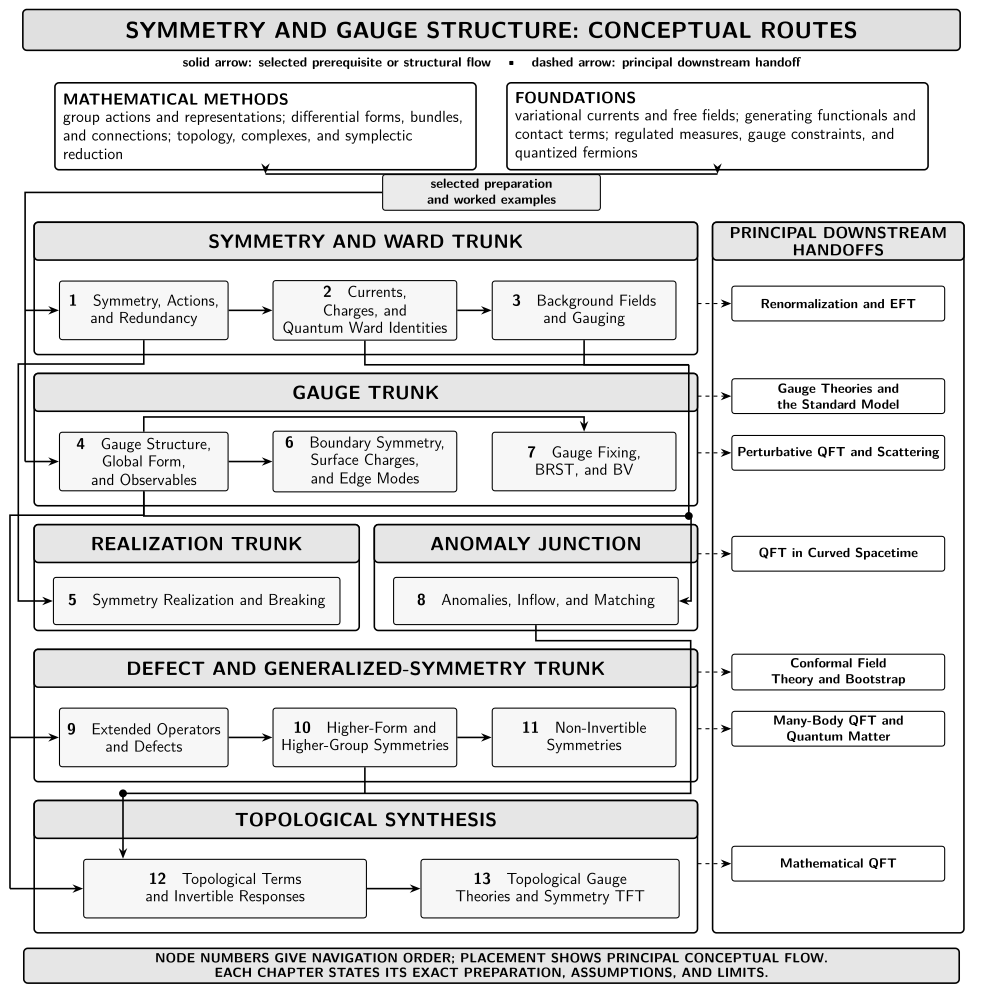
The exact hard-prerequisite graph remains on the chapter and leaf pages. The map here shows common conceptual continuations and typed external interfaces, not thirteen compulsory semesters of prerequisites.
Inspect the four shaded trunks first, then follow their solid joins through the anomaly junction and topological synthesis. Dashed arrows leave the volume rather than adding internal prerequisites.
The thirteen chapters are numbered in navigation order, while placement shows selected prerequisite and structural flow. Solid arrows connect preparation, the four trunks, the anomaly junction, and the topological synthesis; dashed arrows mark volume-level handoffs. The map is schematic and intentionally nonexhaustive: each chapter states its exact preparation, assumptions, and limits.
The preparation diagnostic and route tables above, together with the exact chapter map below, provide the same relationships without relying on the figure. The dashed handoffs map the symmetry-and-Ward trunk to Renormalization and EFT; the gauge trunk to Gauge Theories and the Standard Model and to Perturbative QFT and Scattering; the anomaly junction to QFT in Curved Spacetime; the defect-and-generalized-symmetry trunk to Conformal Field Theory and Bootstrap and to Many-Body QFT and Quantum Matter; and the topological synthesis to Mathematical QFT. They are handoffs, not prerequisites.
Exact chapter map
Section titled “Exact chapter map”Every chapter appears once below and in sidebar order. “Stop before” names a common scientific overclaim to avoid.
| Chapter | Enter when | Leave able to | Stop before |
|---|---|---|---|
| 1. Symmetry, Actions, and Redundancy | You need to decide what counts as physical symmetry | Name the acted-on data, faithful quotient, implementation, invariants, and selection rules | Equating Lagrangian invariance with a faithful physical action |
| 2. Currents, Charges, and Quantum Ward Identities | You need a generator, current, charge, or distributional identity | Derive Ward identities with contacts, improvements, flux, and domains explicit | Assuming every symmetry has a conserved local current |
| 3. Background Fields and Gauging | You need to probe or gauge a symmetry | Separate a fixed source from a new dynamical sum and track residual symmetry | Calling background coupling “gauging” without measure, quotient, sectors, and anomaly freedom |
| 4. Gauge Structure, Global Form, and Observables | A Lie algebra or local connection no longer specifies the question | State the global group, matter, bundles, sectors, lines, boundaries, and observables | Treating disconnected or boundary-nonvanishing transformations as automatically redundant |
| 5. Symmetry Realization and Breaking | You need a phase, order parameter, Goldstone, coset, or Higgs statement | Order limits, state hypotheses and exceptions, and phrase Higgs physics gauge invariantly | Inferring spontaneous breaking from a finite-volume symmetric state or gauge-variant vacuum expectation value |
| 6. Boundary Symmetry, Surface Charges, and Edge Modes | A boundary or asymptotic region changes the gauge quotient | Test differentiability, integrability, ambiguity, flux, charge algebra, and factorization choices | Presenting edge extensions or surface charges without boundary conditions and a phase-space prescription |
| 7. Gauge Fixing, BRST, and BV | You need a local gauge-fixed description or cohomological control | Use Faddeev–Popov, BRST, and BV with grading, closure, reducibility, and regulator assumptions explicit | Claiming a perturbative slice or BRST complex solves the global nonperturbative quotient |
| 8. Anomalies, Inflow, and Matching | A quantum transformation law or gauging test fails | Classify the obstruction by role and detector, compute controlled representatives, and match the full infrared system | Using a Jacobian or local polynomial as the definition or complete detector of anomaly |
| 9. Extended Operators and Defects | Support, endpoints, screening, junctions, or linking matter | Specify Wilson and disorder operators, genuine lines, fusion spaces, braiding, and framing | Calling every extended insertion genuine or every defect topological |
| 10. Higher-Form and Higher-Group Symmetries | Topological operators act on extended charges or backgrounds mix | Track degrees, linking actions, gauging, breaking, and coupled background transformations | Inferring a higher group from two coexisting symmetry groups without extension data |
| 11. Non-Invertible Symmetries | A topological defect has no two-sided fusion inverse | Require a fusion rule, operator action, construction, and anomaly or RG consequences in a declared framework | Using exotic terminology in place of an actual defect and fusion calculation |
| 12. Topological Terms and Invertible Responses | You need to test a theta, Chern–Simons, Wess–Zumino, BF, or response term | Check global definition, quantization, orientation, spin or framing, boundary variation, and invertibility | Identifying a local topological density with a completed dynamical TQFT |
| 13. Topological Gauge Theories and Symmetry TFT | You need exact state, gluing, line, boundary, or one-higher-dimensional symmetry data | Compute bounded Abelian and finite models and use a qualified relative or SymTFT description | Claiming a universal fully extended classification or reconstruction of boundary dynamics |
Suggested paths
Section titled “Suggested paths”These are optional reading routes selected by the calculation at hand. Their arrows are recommended conceptual continuations; the linked chapter and leaf pages remain authoritative for hard prerequisites.
| Path | Sequence | Why the transitions help | Stop or branch when |
|---|---|---|---|
| First symmetry course | 1 Symmetry → 2 Currents → 3 Backgrounds → 5 Realization → selected 8 Anomalies | Moves from action to local constraints, probing, realization, and quantum obstruction | Stop after 3 for source calculus; add 5 for phases and 8 for consistency or RG questions |
| Gauge-theory preparation | Foundations Maxwell → 4 Gauge structure → 7 BRST/BV → gauge branch of 8 Anomalies | Adds global theory data before local gauge fixing and anomaly tests | Branch to 6 when boundaries, not gauge fixing, are the main issue |
| Boundary and infrared interface | 2 Currents → 4 Gauge structure → 6 Boundaries | Connects local conservation to admissible transformations, charges, flux, and factorization | Continue to scattering only when soft or asymptotic observables are required |
| Generalized symmetry | 1 Symmetry → 3 Backgrounds → 4 Gauge structure → 9 Defects → 10 Higher symmetries → 11 Non-invertible | Builds the operator and global data before generalizing the symmetry action | Stop at 10 if all relevant fusion operators remain invertible |
| Topological structure | 4 Gauge structure → 8 Anomalies → 9 Defects → 10 Higher symmetries → 12 Topological terms → 13 TQFT/SymTFT | Joins global form, anomaly, defects, quantized actions, and exact topological models | Stop at 12 for a fixed response; enter 13 only for dynamical state-and-gluing data |
| Mathematical bridge | 4 Gauge structure → 7 BRST/BV → 8 Anomalies → 9 Defects → 12 Topological terms → physical TQFT orientation in 13 TQFT/SymTFT | Collects the physical hypotheses and examples needed for theorem-first formulations | The exact BRST, anomaly, higher-category, bordism, and cobordism-hypothesis treatment belongs to Mathematical QFT |
Six examples to carry through the volume
Section titled “Six examples to carry through the volume”Recurring examples are useful only when their conventions and limits survive the transition. Each thread below names the stable check and the point where the example must stop.
| Example | Route | Stable checks | Limit |
|---|---|---|---|
| Complex scalar U(1) | Action → charge and Ward identity → background and gauging → finite-volume realization → Goldstone, coset, and explicit-breaking questions | Charge sign, current improvement, source normalization, and order of limits | One controlled relativistic scalar family, not a universal model of realization |
| Maxwell and Yang–Mills | Connection and orbit → Gauss constraint → global configurations → proper versus improper boundary transformations → integrable surface charge and edge-mode choice → Faddeev–Popov and BRST/BV | Gauge-invariant curvature, Gauss law, boundary generator, and $s^2=0$ in its stated domain | Local perturbative gauge fixing does not construct the global quotient |
| Chiral fermions | Regulated Jacobian → representation trace → consistent or covariant representative → Wess–Zumino consistency → descent and inflow → global detector → matching | Chirality, trace normalization, allowed counterterms, and local-versus-global detection | The anomaly polynomial does not detect every torsion or global anomaly |
| Line operators and generalized symmetry | Wilson and disorder lines → charge lattice and global form → screening, fusion, and linking → one-form symmetry → explicit-breaking diagnostic → gauging and higher-group mixing | Genuine status, support dimension, mutual locality, linking phase, and framing | Dimension, matter, global form, and admitted operators remain part of the result |
| Finite gauging and non-invertible defects | Finite background → groupoid sum, projection, and twisted sectors → emergent dual symmetry and operator action → finite topological model → duality or condensation interface → non-invertible fusion → anomaly and RG consequences | Groupoid or sector normalization, projection, reverse fusion, and the actual failure of an inverse | Finite semisimple controls do not imply a universal higher-dimensional formula |
| Topological actions, gauge theories, and SymTFT | Global action test → Chern–Simons, Wess–Zumino, and BF quantization → states and lines → relative boundaries → qualified SymTFT sandwich encoding admissible anomaly and gauging relations | $\exp(iS)$, level or periodicity, spin or framing, trace and gluing, and boundary pairing | Bounded physical models and a framework, not a universal classification theorem |
Convention card
Section titled “Convention card”The volume inherits the site metric , natural units, Lorentzian weight , Fourier kernel , and Hermitian generator basis. The default gauge convention is
Only the choices that affect a result are repeated locally.
| Domain | Declare before using a formula | Invariant check |
|---|---|---|
| Symmetry action | Active or passive action, inverse placement, faithful quotient, unitary or antiunitary implementation | Recover the same transformation of a physical matrix element or correlator |
| Currents and charges | Hypersurface orientation, domain, improvement, boundary flux, and conservation conditions | Recover the localized Ward identity including contact and boundary terms |
| Gauge theory | Global group, representations, charge normalization, coupling placement, bundles, sectors, genuine lines, and boundary quotient | Compare gauge-invariant holonomies, line mutual locality, or physical spectra |
| BRST and BV | Ghost number, parity, derivative side, antibracket order, closure, reducibility, regulator, and anomaly status | Check nilpotency, the master-equation residual, and the stated local patch |
| Anomaly | Chirality, trace, orientation, regulator, allowed counterterms, consistent or covariant representative, and global background category | Compare the counterterm class and then test any independent global phase |
| Extended and higher symmetry | Support dimension, codimension, orientation, framing, endpoints, surfaces, fusion order, current and background degrees | Recover the linking action, fusion multiplicity, or charge-selection rule |
| Topological action or theory | Manifold and boundary class, exponentiated normalization, level or periodicity, extension, spin or framing, and whether fields are fixed or summed | Check large transformations, orientation conjugation, gluing, or a state-space trace |
For a -form symmetry in dimensions, the charged object has dimension , the topological symmetry operator has dimension and codimension , and the background has degree . This degree bookkeeping and the topological-operator definition are developed in Gaiotto, Kapustin, Seiberg, and Willett 2015, §§ 1 and 3, arXiv v2, printed pp. 2–4 and 11–14, PDF. A finite symmetry need not admit an infinitesimal current, so the degree card does not turn every generalized symmetry into a Noether-current problem.
Interfaces and stopping points
Section titled “Interfaces and stopping points”Mathematical Methods supplies actions, representations, forms, connections, bundles, cohomology, characteristic classes, constraints, and presymplectic geometry. Foundations supplies the free-model Noether, scalar, regulated measure, and Maxwell calculations. This volume owns the physical synthesis: what those inputs mean for quantum symmetry, gauging, anomaly, boundaries, defects, and topological data.
At the gauge-theory interface, the Lie algebra alone is not enough. Global form, matter representations, genuine line operators, and discrete theta data can distinguish theories with the same local equations; a controlled four-dimensional treatment appears in Aharony, Seiberg, and Tachikawa 2013, Introduction and § 2, arXiv v5, printed pp. 1–5 and 12–16, PDF. At a boundary, the phase space and allowed variations must be chosen before a surface charge is declared; Harlow and Wu 2020, §§ 2.1–2.4, pp. 7–23, Open PDF give a boundary-capable covariant framework.
Use these substantive exits when the physical calculation changes owner:
- For soft and infrared consequences of charges, continue to Soft Theorems, Eikonal Approximation and Wilson Lines, or Dressed States and Infrared-Finite Scattering.
- For renormalized currents and symmetry-preserving counterterms, continue to Symmetry-Protected Operators, Currents, and Improvement or Symmetry and Counterterms.
- For interacting gauge dynamics and phenomenology, continue to Dynamical Gauge Fields and Matter, Standard Model Anomaly Cancellation, or Electroweak Breaking and the Higgs Doublet.
- For duality applications of global form and defects, continue to Electric–Magnetic Charge Lattices and Global Form or BPS Boundaries and Surface Defects.
Nonperturbative phase dynamics, lattice implementations, conformal specializations, quantum-matter phases, information-theoretic applications, curved-spacetime and gravitational charges, and holographic dictionaries remain with their named volumes. Theorem-first BRST/BV, anomaly, defect, higher-category, differential-cohomological, and bordism classifications belong to Mathematical QFT. Those owners are named here without sending the reader to empty routes.
What a chosen route enables
Section titled “What a chosen route enables”After completing the route relevant to the question—not necessarily the whole volume—you should be able to:
- identify what a proposed transformation acts on and distinguish physical symmetry, redundancy, duality, spurionic covariance, breaking, emergence, and anomaly;
- derive a current or background Ward identity with contact, boundary, regulator, and anomaly terms visible;
- state what gauging adds and specify a gauge theory beyond its Lie algebra;
- use Faddeev–Popov, BRST, and BV within a declared local, graded, and regulator-aware domain;
- classify an anomaly by role and detector and use inflow or matching without selecting an infrared phase by assertion;
- work with line, surface, wall, higher-form, higher-group, and non-invertible symmetry data without erasing their dimension or fusion assumptions; and
- distinguish a topological density, a globally defined response, an invertible theory, a dynamical TQFT, microscopic topological order, and a qualified SymTFT construction.
The common standard is not vocabulary but a reproducible decision: name the objects, domain, conventions, global and boundary data, transformation or sum, invariant check, and the conclusion that actually follows.
References
Section titled “References”- Aharony, Ofer, Nathan Seiberg, and Yuji Tachikawa. “Reading between the Lines of Four-Dimensional Gauge Theories.” Journal of High Energy Physics 2013, no. 8 (2013): 115. DOI. Open PDF, arXiv v5.
- Gaiotto, Davide, Anton Kapustin, Nathan Seiberg, and Brian Willett. “Generalized Global Symmetries.” Journal of High Energy Physics 2015, no. 2 (2015): 172. DOI. Open PDF, arXiv v2.
- Harlow, Daniel, and Jie-qiang Wu. “Covariant Phase Space with Boundaries.” Journal of High Energy Physics 2020, no. 10 (2020): 146. DOI. Open PDF, arXiv v4.
- Schwartz, Matthew D. Quantum Field Theory and the Standard Model. Cambridge: Cambridge University Press, 2014. DOI.
- Weinberg, Steven. The Quantum Theory of Fields. Volume I: Foundations. Cambridge: Cambridge University Press, 1995. DOI.
Further reading
Section titled “Further reading”- Atiyah, Michael F. “Topological Quantum Field Theory.” Publications Mathématiques de l’IHÉS 68 (1988): 175–186. DOI. Official PDF.
- Barnich, Glenn, Friedemann Brandt, and Marc Henneaux. “Local BRST Cohomology in Gauge Theories.” Physics Reports 338, no. 5 (2000): 439–569. DOI. Open PDF, arXiv v3.
- Bhardwaj, Lakshya, Lea E. Bottini, Ludovic Fraser-Taliente, Liam Gladden, Dewi S. W. Gould, Arthur Platschorre, and Hannah Tillim. “Lectures on Generalized Symmetries.” Physics Reports 1051 (2024): 1–87. DOI. Open PDF, arXiv v2.
- Schäfer-Nameki, Sakura. “ICTP Lectures on (Non-)Invertible Generalized Symmetries.” Physics Reports 1063 (2024): 1–55. DOI. Open PDF, arXiv v2.