

Global, Poincaré, and AdS-Rindler Patches
Global, Poincaré, and AdS-Rindler coordinates describe overlapping regions of the same pure AdS geometry, but they organize different boundary domains and different time generators. Global coordinates cover the universal cover, the Poincaré chart ends on one Minkowski conformal patch, and an AdS-Rindler chart is adapted to the causal development of a boundary ball. A patch horizon is smooth in pure AdS; it limits the chart and the associated observable algebra, not the spacetime curvature.
Required background. Anti-de Sitter geometry and its conformal boundary supplies the embedding, compactified cylinder, and site-specific curvature signs. Helpful background. Causal, Killing, trapping, and apparent horizons distinguishes a coordinate Killing horizon from invariant singular or trapped structure.
Three charts, three boundary domains
Section titled “Three charts, three boundary domains”Throughout, the Lorentzian signature is , the AdS radius is , and . The exception is stated below rather than hidden inside formulas that use a boundary sphere or ball. The essential comparison is:
| Chart | Boundary representative and domain | Time generator | Interior edge of the chart |
|---|---|---|---|
| global | ℝτ × Sd−1, the full boundary cylinder | ∂τ, conjugate to cylinder energy | none on the universal cover |
| Poincaré | ℝ1,d−1, one conformal diamond of the cylinder | ∂t, conjugate to Minkowski energy | the null Poincaré horizon |
| AdS-Rindler | ℝη × Hd−1, conformal to a ball’s causal diamond | ∂η, the hyperbolic-time generator | a bifurcate Killing horizon |
The entries in the last two rows are coordinate boundaries, not curvature singularities. State preparation and boundary conditions still have to be supplied before a mode basis becomes a quantum vacuum or a thermal ensemble.
The coverage map makes both restrictions visible. Read its upper row from left to right: a cylinder diamond becomes the full Minkowski representative, then a ball diamond becomes the full hyperbolic cylinder. Its lower row records the matching bulk condition, time generator, and smooth inner edge. The signed angle in the figure runs along a boundary great circle; it is not the bulk radial coordinate used later.
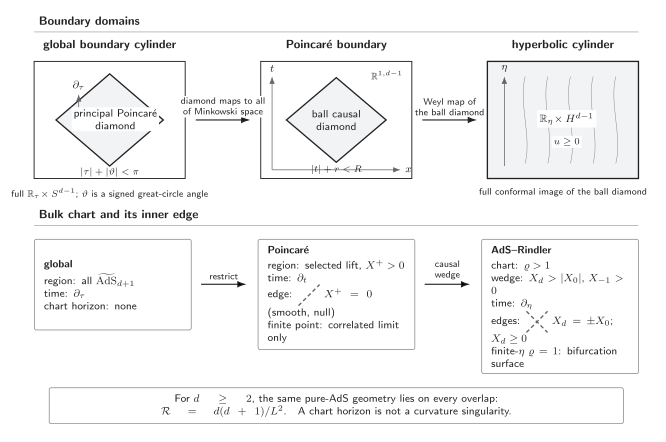
For pure AdS with , the principal Poincaré diamond on the boundary cylinder maps to all finite points of one Minkowski representative, while a centered ball’s causal diamond maps to . The displayed time generators are , , and . In the bulk the selected lift has , while the AdS-Rindler chart has and covers the causal wedge , . Its invariant edges are for the Poincaré chart and with for the AdS-Rindler chart; at finite is only the latter pair’s bifurcation surface. These are smooth null horizons of the same spacetime with in the site convention. The figure suppresses transverse directions and is schematic, not to scale.
From the global hyperboloid to a Poincaré patch
Section titled “From the global hyperboloid to a Poincaré patch”Global coordinates give
They cover the entire universal cover, with conformal boundary . To isolate a Poincaré patch, define the null ambient combination
and restrict to . This notation avoids confusing the ambient null component with the projective boundary vector used on the prerequisite page. With and , set
where . The inverse map is
Substitution into the ambient metric gives
On the universal cover, the embedding coordinates repeat under , so has infinitely many connected lifts that the tuple does not distinguish. Here and below, “the Poincaré patch” means the connected lift containing the slice. The hypersurface is its Minkowski representative of the conformal boundary.
The bulk chart horizon is the invariant null surface . Reaching a finite point of it requires a correlated limit: as , both and must approach finite values. At fixed , by contrast, approaches the compactified spatial-infinity corner of the Minkowski representative. Thus “” alone does not identify a unique horizon point. Every curvature scalar remains at its pure-AdS value across the extended surface Aharony et al. 2000, §2.2.1, eqs. (2.26)–(2.28).
The boundary coverage can be seen without guessing. Choose a polar angle on the global so that . At the boundary,
with and . This is one diamond on the global cylinder. The open future and past edges map to and ; its future and past tips map to and , and the remaining corner maps to spatial infinity . None is an additional finite point of .
AdS exception. When , the global boundary has two timelike components rather than a spatial sphere carrying a diamond, and its one-dimensional boundary metric has no null edges. The selected Poincaré chart reaches one component with for . The spherical-ball modular construction used below also degenerates because is a point, so this page’s remaining ball and hyperbolic formulas are stated only for .
An explicit global mode in Poincaré coordinates
Section titled “An explicit global mode in Poincaré coordinates”For a free Klein–Gordon field obeying , let
Assume the Breitenlohner–Freedman stability bound , so is real Aharony et al. 2000, §2.2.2, eq. (2.42). With standard quantization, regular reflecting boundary conditions, and , the stable global normal modes have dimensionless frequencies Aharony et al. 2000, §2.2.2, eq. (2.41)
The lowest spherically symmetric mode may be written, up to normalization, as
Because
the coordinate map gives the exact expression on the Poincaré overlap,
Near , this standard-quantization solution has the expansion
where the normalizable coefficient is
For noninteger , these equalities are defined on the chosen lift with the branch inherited continuously from on . Moving to the lift shifted by multiplies the global mode by ; the bare coordinates do not remember that phase. The same inherited branch is used in , so no independent Poincaré prescription has been introduced.
This calculation does more than relabel the metric. A single global-energy eigenmode becomes a wavepacket—a continuous superposition of Poincaré-energy eigenmodes—because and are different generators. The classical field agrees point by point on the overlap, while its spectral decomposition and accessible boundary support change.
Different generators do not automatically imply different invariant vacua. For this free field on fixed AdS, the -invariant Fock vacuum is one state expressed in different regional mode bases. Holographically, it is the bulk representative of the cylinder CFT vacuum, whose conformal image is the ordinary Minkowski vacuum. What changes here is the mode basis and domain. A vacuum defined only by an unrelated positive-frequency prescription would require a separate state comparison.
AdS-Rindler coordinates and a boundary ball
Section titled “AdS-Rindler coordinates and a boundary ball”The AdS-Rindler chart can be derived directly from the same embedding. Let be a unit vector on and set
For and , these coordinates cover the connected wedge
On the universal cover these ambient inequalities recur on different global-time lifts. Here “the AdS-Rindler wedge” means the component containing the slice, matching the Poincaré lift fixed above.
Substitution into the ambient metric gives
The boost in the plane is the chart’s time translation:
It is timelike inside the wedge and null on its boundary. The future and past branches are
The coordinate value at finite gives only their bifurcation surface , which is isometric to . Points away from that surface are reached by sending and together while keeping the appropriate product finite. This distinction prevents the collapsed static coordinate from being mistaken for the whole horizon.
Regularity is also explicit. Writing gives
Near , the part is ordinary Rindler space, . Define
Then : the apparently degenerate static coordinates are simply one Minkowski wedge, and gives its smooth null extension. In addition,
remains finite and constant. The horizon is therefore a coordinate Killing horizon, not a curvature singularity. With the dimensionless generator , its surface gravity is ; normalizing the boundary physical time as gives surface gravity .
Its conformal boundary is . To connect the bulk wedge to a boundary ball, write
and define
The embedding-to-Poincaré map then becomes
The direct embedding has ; an arbitrary ball radius follows from the Poincaré dilation . Taking gives the boundary map
For the radial null coordinates ,
Both ratios lie strictly between and , so the image is exactly the ball’s causal diamond . The metric relation is
On the diamond, the same flow is generated by the conformal Killing field
whose norm factorizes as
It is timelike precisely inside the diamond and null on its boundary. Thus AdS-Rindler time is adapted to a ball-preserving conformal flow, not to global or Minkowski time translation Casini, Huerta, and Myers 2011, §2.2, eqs. (27)–(33).
Now specify the state. With a UV regulator that supplies a type-I factorization, the CFT vacuum reduced to the ball has modular Hamiltonian
where fixes Casini, Huerta, and Myers 2011, §2.1, eq. (22). Let denote the conformal identification of the ball diamond with the hyperbolic cylinder, and let generate translations of the dimensionless coordinate . Then
with in that regulated description. Since for physical hyperbolic time , the inverse temperature is and
The sign of geometric modular flow must be declared. With the site convention
and , one has . With the site’s positive-upper-strip convention, the vacuum is Kubo–Martin–Schwinger (KMS) at inverse temperature for the geometric flow . Equivalently, it is unit-temperature KMS for the inverse modular group .
In continuum QFT, the local algebra is generally type III, so a canonical Hilbert-space tensor factor for the ball, a trace-class , and are regulator-dependent shorthand Witten 2018, §§2.5 and 6.4–6.5. The intrinsic statement is that the vacuum restricted to the ball algebra has the modular/KMS flow above Witten 2018, §§3 and 4.2. The site’s rigorous modular-dynamics treatment fixes the represented algebra and sign convention. A faithful normal state determines a modular group; with the convention declared here, its positive-strip KMS dynamics is the inverse modular group. The special claim for the vacuum is thermality under the fixed geometric -flow generated by . A generic excited state need not have that geometric KMS property merely because the chart has a Killing horizon.
The wedge is the causal wedge of the boundary diamond in pure AdS. Its complement contains bulk points that cannot both send a signal to and receive a signal from that diamond. Hamilton et al. give an explicit free-scalar reconstruction in AdS Rindler coordinates and discuss its implications Hamilton et al. 2006, §§4–5. Higher-dimensional or interacting reconstruction requires separately stated field, boundary, state, and code-sector hypotheses.
Coverage, completeness, and regularity checks
Section titled “Coverage, completeness, and regularity checks”| Proposed conclusion | Check that must be performed | Strongest conclusion if the check passes |
|---|---|---|
| “the chart ends at a singularity” | evaluate a curvature invariant and extend the embedding coordinates | only the coordinate chart ends at a smooth null surface |
| “these modes are complete” | name the region, function space, inner product, and boundary or horizon condition | completeness for that declared regional problem |
| “the wedge algebra determines the global state” | compare correlations with the complementary diamond and specify any reconstruction theorem | generally only the restricted state is fixed |
| “the horizon makes the state thermal” | verify the KMS condition for the chosen state, algebra, and Killing flow | thermality relative to that generator and algebra |
| “a patch source fixes a global solution” | supply regularity, analyticity, or data on the omitted boundary region | a continuation under those additional hypotheses |
These tests separate three questions that are often conflated: whether coordinates are regular, whether a mode expansion is complete for a regional boundary problem, and whether a chosen quantum state is thermal with respect to the chart’s Hamiltonian.
Common pitfalls
Section titled “Common pitfalls”Calling every limit the Poincaré horizon—or a singularity. The invariant bulk edge is , and finite horizon points require the correlated scaling stated above. Fixed instead approaches the compactified corner. Neither limit creates a curvature singularity in pure AdS.
Promoting a regional mode basis to global completeness. The Poincaré and AdS-Rindler bases solve problems on smaller domains. Extending them globally requires the missing boundary, horizon, and state data.
Inferring thermality from geometry alone. The vacuum restricted to a ball has the special KMS property above for the geometric -flow. The same wedge chart can be used for excited states that are not KMS with respect to that fixed flow. A faithful normal state still determines its own modular group; under the site convention the corresponding positive-strip KMS dynamics is the inverse modular group.
Exercises
Section titled “Exercises”Locate the Minkowski patch on the cylinder
Section titled “Locate the Minkowski patch on the cylinder”Use the boundary map to show that the denominator is positive precisely inside one conformal diamond, and that its zero set is null in the cylinder metric.
Solution: cylinder diamond
On the principal interval with ,
Both factors are positive when . The equations and give the future and past branches of the principal diamond; their translates bound the other lifts. Radial curves obey , so on these edges: they are null. Their open segments map to , while the vertices map to , , and .
Check the transformed ground mode
Section titled “Check the transformed ground mode”On the connected lift containing , substitute the inverse Poincaré map into and recover the displayed . Explain why it is not a single eigenmode of , and state what changes on the lift shifted by .
Solution: transformed global mode
The inverse map gives
Since on the branch continuously inherited from , the Poincaré expression follows immediately. Acting with differentiates a nonexponential rational power, so the result is not a constant times . Its Fourier representation is therefore a superposition of Poincaré energies. On the lift , the global factor contributes the phase , which is not encoded by alone.
Derive the AdS-Rindler wedge and its boundary diamond
Section titled “Derive the AdS-Rindler wedge and its boundary diamond”Starting from the AdS-Rindler embedding, verify the hyperbolic metric and . Then take the boundary limit of the bulk Poincaré map, derive , and recover both the Weyl factor and the domain . Finally, explain why is not a curvature singularity.
Solution: ball diamond and smooth horizon
Differentiating the four embedding expressions and using and gives
The ambient boost generator is , so its norm is . At the boundary, put . The identities
give
Hence , which is equivalent to . Direct differentiation yields
Finally, gives near the horizon. With and , this is , so the chart extends smoothly across . The constant invariant independently rules out a curvature singularity.
Separate a chart horizon from a thermal state
Section titled “Separate a chart horizon from a thermal state”Keep the same AdS-Rindler wedge but replace the vacuum by a generic excited CFT state. Which statements on this page remain geometric, and what must be checked before calling the restricted state thermal?
Solution: geometry versus state
The embedding domain, metric, conformal boundary, Killing field, bifurcate horizon, ball-preserving conformal flow, and constant curvature are unchanged. Thermality with respect to the fixed geometric -flow is not. One must specify the regional algebra and state and verify the KMS strip condition for the evolution. A regulated density matrix may then be compared with ; in continuum QFT, with the site convention above, the intrinsic test compares the state’s inverse modular group with the positive geometric flow rather than assuming a trace-class reduced density matrix.
Timelike-Boundary Causality and Boundary-Value Problems now fixes the boundary data needed for evolution. Later, bulk reconstruction and locality asks what boundary region can reconstruct which bulk observables.
The chapter overview compares these assumptions and limitations.
For the chapter-wide comparison of assumptions, counterevidence, falsifiers, and claim ceilings, see the claim-domain table.
References
Section titled “References”- Aharony, Ofer, Steven S. Gubser, Juan Maldacena, Hirosi Ooguri, and Yaron Oz. “Large N Field Theories, String Theory and Gravity.” Physics Reports 323 (2000): 183–386. arXiv. DOI.
- Casini, Horacio, Marina Huerta, and Robert C. Myers. “Towards a Derivation of Holographic Entanglement Entropy.” Journal of High Energy Physics 2011, 036 (2011). arXiv. DOI.
- Hamilton, Alex, Daniel Kabat, Gilad Lifschytz, and David A. Lowe. “Holographic Representation of Local Bulk Operators.” Physical Review D 74 (2006): 066009. arXiv. DOI.
- Witten, Edward. “Notes on Some Entanglement Properties of Quantum Field Theory.” Reviews of Modern Physics 90 (2018): 045003. arXiv. DOI.