

Analytic Continuation: Uniqueness and Failure Modes
Replica continuation can fail even when every computed integer moment is correct. Nonuniqueness from sparse data, nearby complex singularities, branch choices, saddle exchange, and nonuniform limits affect the derivative at much more strongly than they affect values at . The standard CFT construction in Calabrese and Cardy 2004, § 3 works because an analytic answer is available; it does not turn finite integer samples into a general uniqueness theorem. A responsible analysis identifies these instabilities and reports the strongest quantity the data actually determine.
Required background. Use Rényi entropies and replica analytic continuation. Helpful background. Twist operators and replica defects make the integer- normalization and permutation data explicit.
Four distinct failure mechanisms
Section titled “Four distinct failure mechanisms”Finite-sample nonuniqueness. Given moments at finitely many integers, infinitely many analytic functions interpolate them. Positivity and convexity narrow the family but rarely select one continuation by themselves.
Branch sensitivity. Zeros or branch points of make path dependent. A continuation must state its cut and the connected domain linking the sampled points to .
Saddle exchange. In a large-volume, large-central-charge, or semiclassical limit, one often approximates by the dominant of several saddles. If dominance changes at , the limiting function can be nonanalytic even though the finite-system partition function is analytic. Continuing the dominant integer saddle past can select the wrong branch near one. The replica-symmetry and smooth-continuation assumptions are especially explicit in Lewkowycz and Maldacena 2013, §§ 2–3; their gravitational setting is an example, not a general QFT uniqueness theorem.
Nonuniform extrapolation. A fit can reproduce accurately at sampled integers while producing an unstable derivative at one. Numerical covariance, truncation, and finite-volume corrections are then amplified by extrapolation.
These mechanisms require different remedies. Adding more integer points helps interpolation but does not cross an unknown branch cut. Finite-size calculations may smooth a saddle exchange but need a controlled scaling analysis. A claimed uniqueness theorem helps only if its growth and domain hypotheses have been verified.
The structural map places Analytic Continuation: Uniqueness and Failure Modes on the route from a regulated subsystem to integer moments, spectral checks, analytic continuation, and a continuum claim.
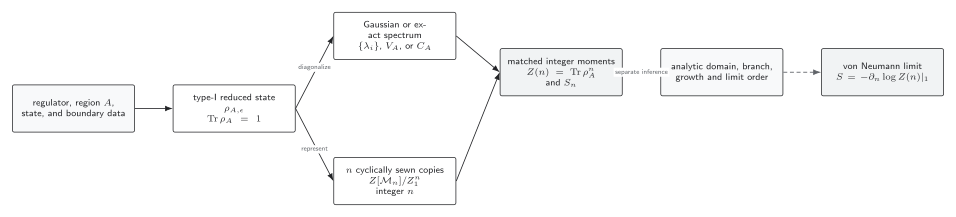
The spectral and replica routes must agree on matched integer moments at fixed regulator. Continuation from those moments to is logically separate and must state its analytic domain, branch, growth conditions, and order of limits. Schematic.
A synthetic adversarial test
Section titled “A synthetic adversarial test”Choose a known regulated spectrum and form
Sample at with a realistic covariance matrix. Fit those data with several constrained families, then add a deformation
where lies outside the declared analytic domain. The deformation vanishes at every integer but alters . Vary toward the domain boundary and determine when the inferred entropy becomes unstable. The exercise separates goodness of fit at the data from control of the desired derivative.
The deformation is not itself evidence for a physical alternative. It is an adversarial diagnostic: unless spectral information, a uniqueness theorem, or additional noninteger data exclude it, the integer samples alone do not.
What to report
Section titled “What to report”Report integer Rényi entropies as primary results when they are directly computed. For a continued entropy, also report:
- the analytic domain and branch;
- every imposed growth, positivity, and convexity condition;
- sampled values and their full covariance;
- the fit or continuation families considered;
- sensitivity to point removal, fit range, and nearby singularities;
- any finite-volume or large-parameter limit taken before continuation.
If alternative admissible continuations give materially different derivatives, quote their spread or a bound rather than selecting one exact-looking number. If a saddle crossing separates the integers from , the correct conclusion may stop at the integer moments.
Common pitfalls
Section titled “Common pitfalls”Treating replica symmetry as automatic. A symmetric saddle is a hypothesis about the dominant contribution, not a consequence of introducing replicas. Check competing saddles and the parameter range in which symmetry is stable.
Using agreement between related fits as independence. Polynomial, rational, and spline fits built from the same sparse points can share the same bias. A spectral calculation or a noninteger observable provides a stronger cross-check.
Before exporting this calculation, use the validity map to check normalization, infrared data, spectral or continuation control, and matched continuum scaling independently.
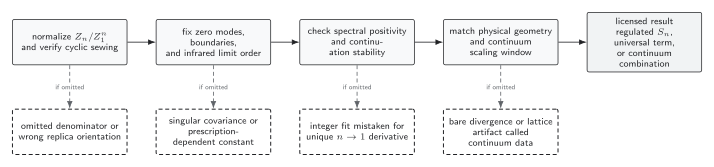
Normalization and sewing establish the intended integer moment; zero-mode and boundary control establish the infrared state; spectral and continuation checks control ; geometry matching and a scaling window establish the continuum target. Omitting any stage licenses only a weaker conclusion. Schematic.
References
Section titled “References”- Calabrese, Pasquale, and John Cardy. “Entanglement Entropy and Quantum Field Theory.” Journal of Statistical Mechanics: Theory and Experiment 2004 (2004): P06002. arXiv; DOI.
- Lewkowycz, Aitor, and Juan Maldacena. “Generalized Gravitational Entropy.” Journal of High Energy Physics 2013, no. 8 (2013): 090. arXiv; DOI.