

Replica Constructions on Fixed and Semiclassical Backgrounds
Replica methods compute entropy from a family of partition functions, but the family is part of the answer. On a fixed background only matter is replicated; in a gravitational path integral the metric, topology, boundary conditions, saddles, and possible replica symmetry must also be specified.
Required background. Generalized-entropy renormalization fixes the finite functional; Noether-charge entropy supplies its geometric term; branched geometries supplies integer replicas; Rényi continuation supplies the limit; and continuation failure modes states why integer data are insufficient. Helpful background. Review heat kernels with cones and anomaly-induced actions.
Fixed-background and gravitational replicas
Section titled “Fixed-background and gravitational replicas”For a normalized reduced state ,
Writing gives the equivalent and sign-sensitive formula
Equivalently, define the normalized replica action . Then and . This form is a useful normalization check: any extensive bulk contribution that is simply copies of the original geometry cancels, leaving the response associated with gluing, defects, or a change of saddle. Boundary sources must be held fixed in the same physical normalization while differentiating; varying temperature, charge potential, or asymptotic geometry with computes a different thermodynamic derivative.
On a fixed background, is a matter path integral on the -fold cover obtained by cyclically gluing fields across the cut. The background metric is not varied, so the result is an entropy of QFT degrees of freedom relative to the chosen algebra and regulator.
In semiclassical gravity,
and a saddle expansion sums geometries consistent with replica boundary data . A replica-symmetric saddle may be quotiented by ; the quotient has a codimension-two fixed set with opening angle (or its reciprocal under an alternative quotient convention). Regularity of the unquotiented cover constrains the fixed surface. Replica symmetry, topology, and saddle dominance are assumptions to be checked, not consequences of writing Lewkowycz and Maldacena 2013, §§2–3.
First application: differentiate a conical family
Section titled “First application: differentiate a conical family”Choose an integer-replica family with fixed asymptotic sources and a smooth -fold cover. Renormalize using the same bulk, boundary, and defect counterterms for all . Near , write
Then
For a two-derivative gravitational saddle, the localized variation gives after translating from the Euclidean/source curvature convention to the site’s Lorentzian convention. Matter determinants add . Higher-curvature actions produce the appropriate Noether/Dong-type surface functional under their own stationarity and regularity conditions. Thus the derivative yields only when the action, state, algebra, counterterms, and saddle family have been matched.
Loop order is another type check. The classical saddle action is order , a one-loop matter determinant is order , and the saddle displacement caused by that determinant contributes at the corresponding perturbative order only after the equations of motion are expanded consistently. Mixing a corrected surface with an uncorrected action double counts some terms and omits others.
The structure map shows the replica construction as a route to, rather than a definition of, a gravitational entropy claim. Inspect the separate fixed-background and metric-integrated branches.

Replica entropy requires declared gluing, boundary data, action, counterterms, topology, saddle set, and continuation; gravitational integration adds assumptions absent on a fixed background. Schematic; not to scale.
Domain and failure conditions
Section titled “Domain and failure conditions”The chapter’s domain table compares replica calculations with horizon theorems and QES stationarity. Record whether the result is exact at integer , perturbative near , or dependent on a semiclassical saddle.
Adversarial test. Two analytic functions can agree at every positive integer and have different derivatives at after adding a function proportional to with suitable growth. Therefore integer replica values do not uniquely determine von Neumann entropy. A uniqueness theorem, growth bound, independently controlled neighborhood of , or physical saddle prescription is required. If competing saddles exchange dominance, continue each branch before minimizing; differentiating the pointwise minimum can be invalid.
The failure map marks continuation ambiguity and saddle switching as distinct obstacles.
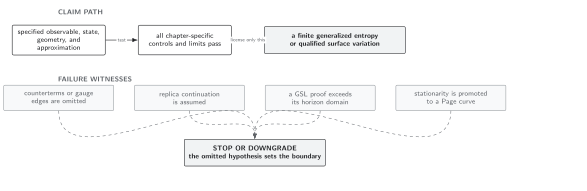
Agreement at integer replica number does not guarantee a unique entropy derivative, and saddle dominance must be analyzed branch by branch. Schematic; not to scale.
References
Section titled “References”- Lewkowycz, A., and J. Maldacena, “Generalized Gravitational Entropy,” Journal of High Energy Physics 2013, 090 (2013), doi:10.1007/JHEP08(2013)090.