

Confinement Definitions and Their Non-Equivalence
“Confinement” is not one proposition. An area law for a specified genuine line, an asymptotically linear static-source energy, a long-lived flux tube, the absence of colored asymptotic particles, and a positive gauge-invariant spectral gap are different statements. Several are expected to align in the canonical setting of zero-temperature pure Yang–Mills with simply connected gauge group, but their logical independence remains: dynamical matter, global form, dimension, temperature, and the order of limits can separate them.
Required background. Regimes, observables, and control supplies the claim–observable discipline used here. Wilson lines and loops supplies their gauge-invariant definition and renormalization.
Helpful background. Anomaly and generalized-symmetry constraints explains why an exact one-form symmetry can constrain, but does not uniquely select, infrared physics.
A confinement statement begins with theory data
Section titled “A confinement statement begins with theory data”Before applying a diagnostic, specify
Here is spacetime dimension, is the global form rather than only the Lie algebra, and are the representations and masses of dynamical matter, and the probe includes its electric and magnetic charges. The distinction matters immediately: a fundamental Wilson loop is a genuine line in Yang–Mills, but not in a theory whose gauge group is . Fundamental dynamical matter screens a fundamental external source and explicitly removes the corresponding electric one-form symmetry.
For a genuine loop , an asymptotic area law means
after local perimeter and cusp renormalization. In a theory with an exact one-form symmetry, area-law behavior for a charged genuine loop diagnoses an unbroken subgroup; perimeter or Coulomb behavior diagnoses spontaneous breaking, with the dimensional qualifications explained by Gaiotto, Kapustin, Seiberg, and Willett 2015, §§4.2 and 5, pp. 17–31. The words genuine, charged, and exact are hypotheses, not decoration.
Wilson’s original lattice formulation establishes how the loop distinguishes an area term from local boundary terms Wilson 1974, §§IV–V, pp. 2450–2456.
Confinement diagnostic and counterexample map
Section titled “Confinement diagnostic and counterexample map”The map below keeps each observable attached to the hypotheses that make it meaningful. Read outward from the declared theory data; a gray counterexample box blocks an invalid implication rather than contradicting the diagnostic in its proper domain.
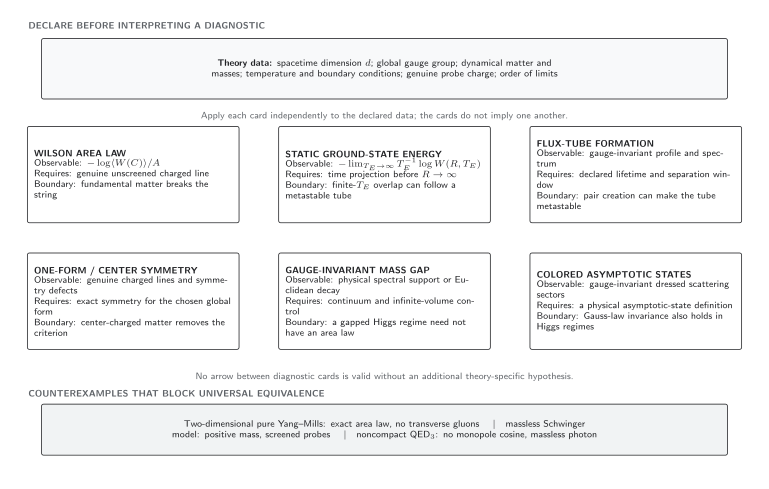
Confinement diagnostics are conditionally related, not interchangeable. The diagram is schematic: it records theory-data hypotheses and failure boundaries, not numerical strengths of evidence.
Five separations are especially important.
- Area law versus screening. With dynamical fundamental matter, a sufficiently long string breaks into two screened heavy–light states. The true asymptotic Wilson loop is not area-law even though isolated colored particles need not occur.
- Flux tube versus order parameter. A flux tube can be metastable and physically useful over a wide distance window. Its profile does not by itself define an asymptotic phase.
- Physical spectrum versus “colored states.” Gauss’s law makes the physical Hilbert space gauge invariant in Higgs, Coulomb, and confining regimes. Therefore “only gauge-invariant states are physical” is not sufficient to distinguish them.
- Mass gap versus area law. A Higgs regime may have a positive gauge-invariant gap and screened Wilson lines. Conversely, two-dimensional pure Yang–Mills has an exact area law but no local propagating gluon modes.
- Thermal center symmetry versus spatial confinement. At nonzero temperature, the temporal Polyakov loop and a large spatial Wilson loop probe different symmetries and free energies. Their behaviors need not track one another.
The classic lattice gauge–Higgs result provides a particularly sharp warning: with a fixed-length fundamental Higgs field, parts of the Higgs-like and confinement-like regions are analytically connected rather than separated by a thermodynamic boundary Fradkin and Shenker 1979, abstract and pp. 3682–3697. This does not say that all observables are identical; it says that a universal phase boundary cannot be inferred from those labels alone.
Confinement claim and evidence comparison
Section titled “Confinement claim and evidence comparison”The table separates what is claimed from how it is observed and from why it might occur. “Mechanism” is deliberately its own column: explaining a result in a controlled model is stronger than a metaphor, but it is not automatically a proof in another theory.
| Claim | Theory data required | Observable | What establishes it | Counterexample or failure boundary | Mechanism status | Continue with |
|---|---|---|---|---|---|---|
| Wilson area law | Dimension, global form, genuine probe charge, matter screening, temperature, infinite-loop limit | −log ⟨W(C)⟩ divided by minimal area after local line renormalization | A positive asymptotic coefficient σ for a charged genuine loop | Fundamental matter breaks the string; a non-genuine line cannot serve as the order parameter | Observable statement; it does not identify the microscopic cause | Line operators and screening |
| Linear static energy | Static representation, self-energy subtraction, Euclidean-time limit before large separation | Lowest energy in a static source–antisource sector | V(R) = σR + o(R) over the declared asymptotic regime | Finite-time Wilson data can follow an excited flux tube beyond the true string-breaking crossing | Compatible with several mechanisms | Static energies and effective strings |
| Flux-tube formation | Probe, state preparation, separation, and lifetime | Gauge-invariant field-energy profile or string excitation spectrum | A localized tube with a resolved width, tension, and decay boundary | A metastable tube may decay by pair creation and need not define an asymptotic phase | Tests a mechanism more specifically than a static energy alone | Mechanisms and discriminating observables |
| Unbroken electric one-form symmetry | Exact symmetry group and its charged genuine lines | Large-loop behavior and symmetry defects | Area law for lines charged under the unbroken subgroup | Center-charged matter explicitly removes the symmetry; global form changes the genuine lines | Infrared constraint, not a unique microscopic explanation | Charge-lattice test |
| Absence of colored asymptotic particles | Physical Hilbert space, asymptotic-state definition, and dressing prescription | Gauge-invariant scattering or spectral sectors | No isolated asymptotic state carrying the proposed unscreened charge | Gauss-law invariance is shared by Higgs and confining regimes and is not sufficient by itself | Needs additional diagnostic data | Gauge-invariant spectrum |
| Positive mass gap | Continuum and infinite-volume limits, vacuum sector, gauge-invariant operator class | Physical spectral support or connected Euclidean correlator | A strictly positive threshold above the vacuum with exponential clustering | A gapped Higgs theory can screen; a gauge-fixed propagator scale is not the physical gap | Independent spectral claim | Spectral definition |
| Compact-U(1) confinement in 2+1 dimensions | Compact gauge field, allowed monopoles, weak coupling, dilute gas, zero temperature | Dual-photon pole, Wilson-loop kink, and string tension | Controlled semiclassical sine-Gordon derivation | Noncompact Maxwell theory has no monopole fugacity and retains a massless photon | Derived mechanism within the stated model | Monopole plasma |
| Four-dimensional pure Yang–Mills mass gap and confinement | Compact simple group, continuum theory on four-dimensional spacetime, infinite volume | Gauge-invariant spectrum plus a separately specified confinement diagnostic | Regulated numerical evidence supports the physics; the requested construction and proof remain open | Lower-dimensional or small-circle results do not establish the undeformed four-dimensional theorem | No universal controlled analytic mechanism is established | Evidence and open problems |
Worked comparison: pure Yang–Mills and fundamental matter
Section titled “Worked comparison: pure Yang–Mills and fundamental matter”Consider four-dimensional zero-temperature gauge theory. In pure Yang–Mills, the center is an exact electric one-form symmetry and the fundamental Wilson loop is genuine. An area law for that loop is therefore a meaningful symmetry diagnostic and gives a linearly rising static energy when the large-Euclidean-time limit is taken first.
Add a dynamical field in the fundamental representation with finite mass. The field can terminate the center-charged flux tube, explicitly breaks the electric one-form symmetry, and permits string breaking. The asymptotic static ground-state energy approaches twice the appropriate heavy–light binding energy rather than growing forever. None of this implies freely propagating colored asymptotic particles. The correct conclusion is screening of the chosen probe, not “deconfinement” without qualification.
This example supplies a reusable rejection test: whenever an argument moves from one diagnostic to another, ask which entry of makes the implication valid. If no such hypothesis is stated, the implication has not been established.
Exercises
Section titled “Exercises”1. A gapped counterexample. Explain why a gauge theory with a fundamental Higgs field can have a positive gauge-invariant mass gap while a fundamental Wilson loop has perimeter behavior.
Solution
The Higgs mechanism can make all gauge-invariant connected correlators decay exponentially, so the physical spectrum is gapped. Fundamental dynamical fields can screen an external fundamental source, however, so no stable asymptotic flux tube is required and the Wilson loop can have perimeter behavior. The spectral and line-operator claims concern different observables.
2. Order of limits. Why does measuring a nearly linear Wilson-loop energy at fixed, finite Euclidean time not prove an asymptotic area law in a string-breaking theory?
Solution
At fixed time the Wilson operator can have much larger overlap with a flux-tube excited state than with the screened ground state. Only projects onto the lowest energy at each fixed ; taking large first can preserve the metastable branch. A variational basis containing both string and two-hadron operators is needed to resolve the avoided crossing reliably.
References
Section titled “References”- Fradkin, Eduardo, and Stephen H. Shenker. “Phase Diagrams of Lattice Gauge Theories with Higgs Fields.” Physical Review D 19 (1979): 3682–3697. DOI.
- Gaiotto, Davide, Anton Kapustin, Nathan Seiberg, and Brian Willett. “Generalized Global Symmetries.” Journal of High Energy Physics 2015, no. 2 (2015): 172. DOI. Open PDF.
- Wilson, Kenneth G. “Confinement of Quarks.” Physical Review D 10 (1974): 2445–2459. DOI.