

Fermion Zero Modes, Index Data, and Selection Rules
An instanton can contribute to a fermionic correlation function only when its Dirac zero modes are saturated. The index fixes the net chiral count, normalizable solutions identify the actual modes, and Grassmann integration turns that count into a selection rule. This chain can produce an effective multi-fermion vertex, but it does not by itself establish a condensate or a mass gap.
Required background. Gauge instantons, topological charge, and moduli fixes and the BPST orientation. Fredholm and Dirac index theorems supplies the analytic index under the stated boundary hypotheses. Regulated Jacobians and measure variation supplies the anomalous axial measure transformation.
Helpful background. Instanton measures, zero modes, and determinants explains where fermion zero modes are removed from the nonzero-mode determinant.
Chirality and the index convention
Section titled “Chirality and the index convention”Work in oriented Euclidean four-space with . Choose Hermitian gamma matrices and the site’s continuation from mostly-minus Lorentzian signature,
Normalize representation generators by
so for the fundamental of . On the compactified instanton background with the boundary conditions needed for a Fredholm problem, use
For a self-dual instanton, the normalizable modes have right chirality in this convention. An anti-instanton reverses both and chirality. Some references choose the opposite sign for Euclidean chirality or for ; translating both is essential before comparing labels. The index gives a difference; the additional vanishing theorem for a self-dual background is what excludes zero modes of the opposite chirality.
Two checks follow immediately for :
The fundamental count is one complex Weyl zero mode per flavor. The adjoint count is four. These are representation-sensitive statements; multiplying the fundamental result by the representation dimension would be wrong.
From the index to a nonzero correlator
Section titled “From the index to a nonzero correlator”In Euclidean signature, and are independent Grassmann fields. For one Dirac flavor with a right-handed zero wavefunction , write schematically
The zero-mode part of the measure is . Since
the vacuum integral in a massless one-instanton background vanishes. An insertion contributes and saturates the pair. A small mass term does the same after spacetime integration; for , the dimensionless one-instanton weight acquires .
The logical sequence, including the result that must not be inferred from it, is shown below.
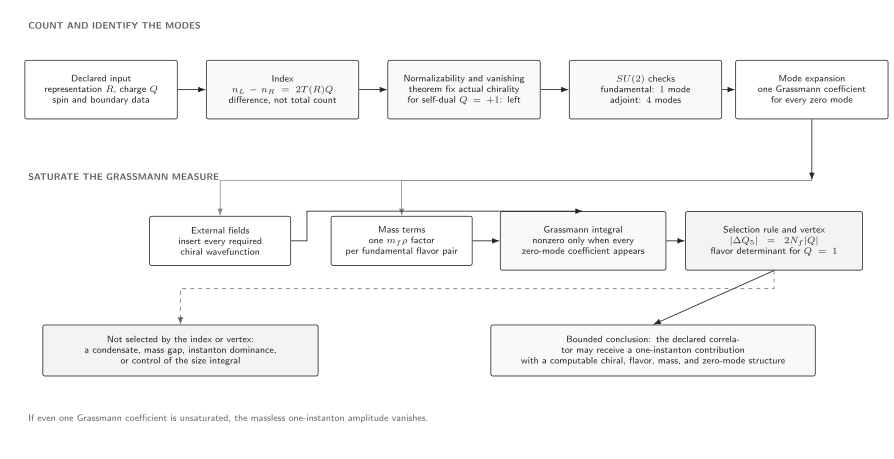
From index data to a nonzero correlation function (schematic). With , a self-dual instanton has right-handed zero wavefunctions. Each Dirac zero wavefunction produces independent and integrations, so an external-field or mass insertion must saturate both. The resulting vertex constrains a declared correlator; it does not by itself prove a condensate, mass gap, or instanton dominance.
The instanton–bounce boundary and mode comparison keeps these fermion modes distinct from bosonic translation modes and the bounce’s negative mode.
The multi-flavor effective vertex
Section titled “The multi-flavor effective vertex”For massless Dirac fermions in the fundamental representation and , there is one and one Grassmann coefficient for each flavor. A nonzero local low-momentum amplitude therefore requires fermion fields. For ordinary QCD-like theories, after integrating the instanton’s bosonic moduli, its chiral flavor structure is schematically
with an anti-instanton term
The determinant enforces the flavor antisymmetry produced by the zero-mode integrations. Spin and color contractions are suppressed, and the displayed expressions are local low-momentum forms; the microscopic vertex contains zero-mode wavefunctions and is nonlocal on distances comparable to . For with fundamental fermions, pseudoreality enlarges the flavor symmetry and the fully orientation-averaged interaction can also be organized in Pfaffian or diquark structures, so the determinant above should not be read as its complete tensor decomposition.
Under an axial rotation, each bilinear carries two units of axial charge in magnitude. Hence a charge- background permits
for fundamental Dirac fermions. The sign tracks the instanton orientation and the convention for . This is the same anomalous selection rule obtained from the regulated fermion-measure Jacobian of Fujikawa 1979, pp. 1195–1198. The original one-instanton calculation and its fermionic vertex are developed in ‘t Hooft 1976, §§ VI–VII, pp. 3443–3449.
If the correlator contains no external fermions, masses can saturate the modes:
Therefore a massless flavor makes the one-instanton vacuum amplitude vanish, even though correlation functions with the required insertions can remain nonzero.
What follows, and what does not
Section titled “What follows, and what does not”The derivation establishes three things:
- which correlators can receive a one-instanton contribution;
- the chiral and flavor tensor structure of that contribution;
- the mass factors required when external insertions are absent.
It does not establish that the induced operator condenses, that instantons dominate the vacuum, or that an infrared mass scale is calculable. Those claims require integrating the size distribution and understanding the interacting ensemble. On , the relevant integral can enter strong coupling. In compactified theories, holonomy can redistribute zero modes among monopole constituents, but only after the circle boundary condition and global data are declared.
The index-to-selection-rule relation is a standard application of the Atiyah–Singer theorem; see Atiyah and Singer 1968, pp. 484–530. A mode-expansion derivation of the axial Jacobian and the zero-mode saturation statement appears in Mariño 2015, § 5.4, pp. 183–188.
Common pitfalls
Section titled “Common pitfalls”Using the index as the total count without a vanishing theorem. In the declared convention the index is . Self-duality plus the relevant positivity argument is what sets the opposite-chirality count to zero in the BPST case.
Leaving zero modes inside . A massless determinant with an exact zero eigenvalue vanishes. The useful procedure is to remove the zero modes, integrate their Grassmann coefficients explicitly, and state how they are saturated.
Inferring a condensate from an allowed vertex. A selection rule says which amplitude is not forced to vanish. The magnitude and vacuum realization are infrared dynamical questions.
Exercises
Section titled “Exercises”- Count the zero modes for a background for one fundamental Dirac fermion and one adjoint Weyl fermion.
Solution
For the fundamental, , so there are two right-handed zero modes for the Dirac field and two conjugate Grassmann coefficients in . For the adjoint, , so the adjoint Weyl operator has eight right-handed zero modes. The counts assume the same self-dual background and boundary conditions used in the vanishing theorem.
- Explain why a one-instanton contribution to the massless vacuum amplitude vanishes but a four-fermion correlator can be nonzero.
Solution
There are two and two zero-mode variables. With no insertions, integrating over any one of them gives zero. A correlator containing the flavor-determinant combination
contains every Grassmann coefficient once and saturates the measure.
References
Section titled “References”- Atiyah, Michael F., and Isadore M. Singer. “The Index of Elliptic Operators: I.” Annals of Mathematics 87 (1968): 484–530. DOI.
- Fujikawa, Kazuo. “Path-Integral Measure for Gauge-Invariant Fermion Theories.” Physical Review Letters 42 (1979): 1195–1198. DOI.
- ‘t Hooft, Gerard. “Computation of the Quantum Effects Due to a Four-Dimensional Pseudoparticle.” Physical Review D 14 (1976): 3432–3450; erratum 18 (1978): 2199. DOI.
- Mariño, Marcos. Instantons and Large N: An Introduction to Non-Perturbative Methods in Quantum Field Theory. Cambridge: Cambridge University Press, 2015. DOI.