

The CP(N-1) Model
The model turns a constrained complex vector into a projective field by identifying its local phase. That redundancy produces a composite connection, quantized flux on suitable closed Euclidean spacetimes, and a theta angle. At large the connection and the constraint multiplier become useful independent integration variables, but their saddle parameters must still be translated into gauge-invariant observables. Claims about the phase at depend on , global structure, boundary conditions, and the controlled regime.
Required background. Sigma-model target geometry and control supplies the quotient construction, while gauge fields, redundancy, and observables distinguishes a redundant phase from a physical symmetry. Helpful background. Theta terms and vacuum sectors fixes the general periodicity question, and large-N normalizations fixes the order of limits.
Projective field and emergent connection
Section titled “Projective field and emergent connection”Let
with the local equivalence
The physical field is the rank-one projector
which is invariant under the redundant phase. Define
Then and . The two-derivative Euclidean action is
The overall factor is a convention; here it is chosen so that the large- gap equation below has the same integral normalization as the chapter’s example. The faithful continuous global symmetry acting on local gauge-invariant fields is , not an extra copy of the redundant .
Varying the action with respect to an independent algebraic gives
so the gauge-like presentation is exactly equivalent to the projective kinetic term at this classical level. Quantum mechanically it is often more useful to integrate over and impose the constraint with a multiplier. A Maxwell term is then generated by matter fluctuations even though none was present in the original two-derivative action.
Flux and topological charge
Section titled “Flux and topological charge”The curvature of the composite connection is
On an oriented closed Euclidean two-manifold with no nontrivial background bundle, when the projective field defines an ordinary smooth line bundle and the gauge transformations have the standard periods,
Therefore in the ordinary-background Euclidean path-integral weight is -periodic in . This statement has two important global qualifications. On a manifold with boundary, the bulk integral need not be an integer by itself; boundary conditions, edge degrees of freedom, or a boundary counterterm must be specified. In a non-liftable background bundle , the flux is correlated with the obstruction class . Then shifts a quantized background counterterm rather than leaving pointwise unchanged. Center-twisted compactifications can likewise contain semiclassical events of charge , even though the ordinary-background partition function retains its period. The background-bundle statement and its anomaly consequence are derived in Gaiotto et al. 2017, § 1.1, pp. 3–5.
For , , and the charge agrees with the degree of the corresponding sigma-model map after matching orientations and action normalizations. This special equivalence should not be extrapolated to arbitrary .
Large-N auxiliary saddle
Section titled “Large-N auxiliary saddle”Set and rescale , so . A useful regulated action is
Choosing the multiplier contour through a real positive saddle and integrating the complex components gives, at ,
The translation-invariant saddle , obeys
Remove the cutoff at fixed
At leading this gives
Thus the large- saddle is asymptotically free and replaces a dimensionless coupling by an RG-invariant scale. Finite- corrections begin beyond this leading saddle and depend on the coupling convention. The derivation and its normalization are reviewed in Mariño 2015, § 6.3, pp. 201–215, while the large- theta branches are developed in Witten 1979, §§ 2–3. The scale and projector round trips are reproduced in the chapter’s benchmark.
It is not automatically the pole mass of a physical particle. The field is gauge-charged under the redundant and cannot create an isolated gauge-invariant asymptotic state. The saddle controls a gauge-dependent inverse range in the charged propagator after gauge fixing and the threshold entering the induced effective action. Physical masses must be extracted from gauge-invariant operators such as
or from finite-volume energy levels. At leading large , integrating out also generates a Maxwell term for ; its long-distance dynamics and the constraint field reorganize the gauge-invariant spectrum.
Dual variables and their conditions
Section titled “Dual variables and their conditions”The figure collects three transformations used in this chapter. None is an unconditional identification of elementary particles: every arrow carries a constraint, measure, anomaly, or boundary condition, and the round trip is checked on observables.
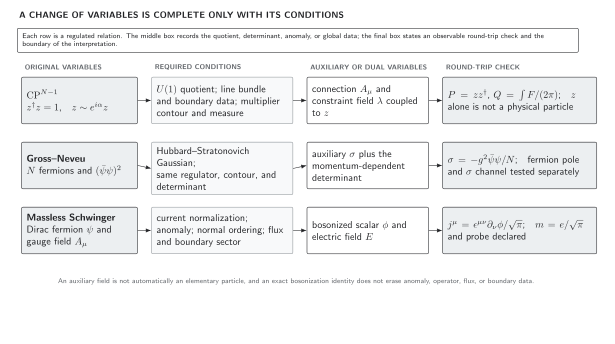
Dual and auxiliary variables expose otherwise hidden dynamics, but they do not erase the definition of the theory. In the quotient and bundle data accompany the connection; in Gross–Neveu the Hubbard–Stratonovich field is fixed by its equation of motion and determinant; in the Schwinger model the current normalization, anomaly, flux sector, and external-probe definition accompany bosonization. The diagram is schematic rather than a spectrum plot.
The model’s position relative to the other strong-coupling examples is summarized by the laboratory map and its regime table.
Theta claims require a regime
Section titled “Theta claims require a regime”Three statements are often conflated:
- Exact kinematics: integer under the stated global conditions implies periodicity of the partition function.
- Large N: the vacuum energy is organized into branches whose envelope restores periodicity; a branch crossing can occur at .
- Semiclassics: on a specified weakly coupled compactification, dilute integer or fractional events can generate a calculable theta-dependent potential.
Agreement of periodicity and anomalies is a cross-check, but the functional form of the vacuum energy and the infrared phase are dynamical. In particular, the familiar gapless behavior of is not a universal result for every model. The detailed separation is developed in Theta Terms and Topological Effects in Sigma Models.
Common pitfalls
Section titled “Common pitfalls”Treating A as a new microscopic photon. In the minimal projective action, begins as an algebraic composite or auxiliary variable. Its kinetic term and range are induced and depend on the fields that have been integrated out.
Calling z a physical particle. The local phase is redundant, so an isolated operator is not gauge invariant. A physical mass statement must name a gauge-invariant correlator or a state in a properly dressed Hilbert space.
Assuming integer charge without global conditions. The flux integral is integer on a suitable closed manifold with the standard line-bundle quantization. Boundaries, twists, and quotient backgrounds change the intermediate description and must be included explicitly.
Exercises
Section titled “Exercises”- Show that eliminating the algebraic connection from gives
Solution
Expanding with gives
Since , stationarity gives . Substitution yields the stated projector onto directions orthogonal to the redundant phase.
- Cover with north and south patches and suppose on the equator. Show that equals the winding of .
Solution
Stokes’ theorem on the two patches gives
Single-valuedness of the transition function implies with . Hence . The argument also shows exactly which bundle and closed-manifold assumptions produce integrality.
- Derive the leading beta function for from its subtraction formula and verify that is RG invariant.
Solution
At fixed bare data,
Since ,
Therefore
This proves RG invariance at the same leading order as the saddle. It does not prove that is a gauge-invariant one-particle pole, because that question depends on the operator spectrum rather than on running alone.
- Assess the following claim: “Fractional topological charge in a twisted calculation proves that the original partition function has period and a particle of mass .” Identify every missing assumption or invalid step.
Solution
The twisted background or compactification must first be specified. Fractional constituent events can coexist with a -periodic ordinary-background partition function because branches or background counterterms transform together. A non-liftable background can instead make a shift change a quantized background counterterm, so one must state which generating functional is being compared. Separately, is gauge charged: a pole in its gauge-fixed propagator is not a physical one-particle pole. A valid mass claim must name a gauge-invariant operator or finite-volume state and control the background, volume, continuum, and large- limits.
Continue
Section titled “Continue”Use Gap Equations, Dimensional Transmutation, and Physical Mass to distinguish the saddle scale from a gauge-invariant pole, then Theta Terms and Topological Effects in Sigma Models to compare large-, semiclassical, and anomaly information.
References
Section titled “References”- Gaiotto, Davide, Anton Kapustin, Zohar Komargodski, and Nathan Seiberg. “Theta, Time Reversal, and Temperature.” Journal of High Energy Physics 2017, no. 5 (2017): 091. DOI.
- Mariño, Marcos. Instantons and Large N: An Introduction to Non-Perturbative Methods in Quantum Field Theory. Cambridge University Press, 2015, §§ 6.3–6.4. DOI.
- Witten, Edward. “Instantons, the Quark Model, and the 1/N Expansion.” Nuclear Physics B 149 (1979): 285–320. DOI.