

Matrix Eigenvalue Saddles, Loop Equations, and Phase Transitions
An Hermitian matrix integral becomes a continuum eigenvalue problem because diagonalization produces a Vandermonde determinant of order . The normalized resolvent fixes the density through its branch-cut discontinuity, while the condition fixes the endpoints. For the even quartic model solved below, positivity selects a one-cut phase for and a symmetric two-cut phase for .
Required background. Large-N limits, normalizations, and orders of limits supplies the matrix action normalization, normalized trace, and fixed-coupling prescription.
Helpful background. Laurent series, poles, and residues supplies the large- matching and discontinuity calculation.
From the matrix measure to a density
Section titled “From the matrix measure to a density”Consider the convergent zero-dimensional integral
The field is normalized exactly as on the scaling page: the action has an overall , and are fixed as , and
Diagonalize . After the angular integral,
The logarithm is eigenvalue repulsion. Varying one eigenvalue gives
Define the normalized empirical density and its limiting saddle by
At a regular point of the support,
The continuum derivation and its effective action are given in Mariño 2015, §8.2, pp. 243–252.
Resolvent conditions and the one-cut solution
Section titled “Resolvent conditions and the one-cut solution”Define
The coefficient of is exactly one because is normalized. Across a cut,
and
For an even one-cut solution supported on , choose the square root with
Since , the most general symmetric one-cut ansatz with the required discontinuity is
Expanding at infinity,
Cancellation of the term proportional to gives
Requiring the remaining coefficient to equal one gives
The positive solution is
Taking the discontinuity,
The same large- condition that fixed also proves normalization. It is not optional: a different resolvent branch can solve the cut equation while carrying the wrong total eigenvalue number.
Eigenvalue support and phase map
Section titled “Eigenvalue support and phase map”The figure freezes and shows three exact densities: in the positive one-cut phase, at the support-splitting boundary, and in the symmetric two-cut phase. Inspect the origin. The one-cut density is positive there for , vanishes quadratically at , and is replaced by a gap for .
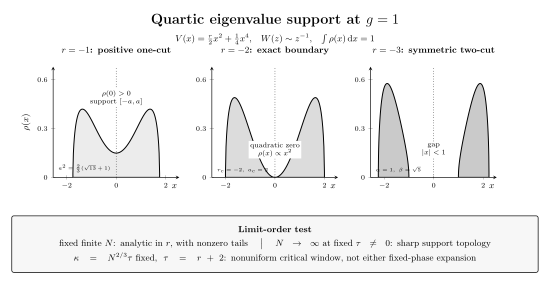
Normalized equilibrium densities for at . The curves use the exact formulas on this page and are quantitative, with unit-normalized area. The phase boundary is ; at every fixed finite the stable integral is analytic in , so the sharp support topology and any critical scaling window belong to specified large- limits rather than a finite- singularity.
The map encodes a positivity test as well as an algebraic solution. A formally normalized density that is negative anywhere is not an equilibrium measure.
Positivity and the two-cut phase
Section titled “Positivity and the two-cut phase”For , the polynomial is smallest at the origin. The one-cut density is nonnegative precisely when
At the boundary . Combining this with the normalization equation gives
For , the one-cut formula is negative near and must be rejected. The symmetric equilibrium measure instead has support
where
Its density is
on the two intervals and zero outside. Its normalization can be checked without a resolvent:
At , , , and joins the critical one-cut density. The even potential selects equal filling of the two wells in the symmetric equilibrium problem. A constrained unequal filling is different boundary data.
This solution is a direct instance of the planar eigenvalue and loop-equation method developed in Brézin et al. 1978, pp. 37–45.
Loop equation and branch rejection
Section titled “Loop equation and branch rejection”At finite , integration by parts produces a loop equation for
Its planar part has the algebraic form
where is fixed by moments and asymptotics. The quadratic equation has two formal branches. Only the branch with
is admissible for the declared saddle. Additional cuts require filling-fraction conditions; the polynomial equation alone does not choose them. The resolvent’s analytic and asymptotic characterization is summarized in Mariño 2015, §8.2, pp. 252–258.
The parameter and N limits
Section titled “The parameter and N limits”For and finite , and its finite moments are analytic for real . There is no exact finite- compact support: eigenvalue tails are small but nonzero. The sharp statements
refer to the equilibrium density obtained after at fixed nonzero .
Approaching while grows probes a separate critical window. Fixed one-cut or two-cut coefficients become nonuniform there, and a double-scaled description is required. Thus the operations “take at fixed phase” and “approach the phase boundary within an -dependent window” are not interchangeable. Rigorous quartic-matrix asymptotics distinguish regular one-cut expansions from the singular double-scaling regime Bleher and Its 2005, §§1–2.
Shared comparison. The large-N scaling comparison fixes the matrix action, operator normalization, and critical-limit warning used here.
Common pitfalls
Section titled “Common pitfalls”Keeping a normalized but negative one-cut density. Normalization is necessary, not sufficient. At , positivity forces a change of support.
Choosing the other algebraic resolvent branch. The saddle equation alone leaves a quadratic ambiguity. The physical branch has and a nonnegative normalized discontinuity.
Calling the finite-N crossover a phase transition. The sharp support topology belongs to the limiting density. State how scales with before using critical asymptotics.
Exercises
Section titled “Exercises”- Derive the discrete saddle equation from the eigenvalue integral.
Solution
The negative logarithm of the integrand is
Setting gives
which yields the stated equation after division by .
- Expand through order and recover the equations for and .
Solution
Using
cancellation of the term gives . The coefficient of is . Setting it to one gives .
- Show that the one-cut positivity boundary is .
Solution
At the boundary, , so . Insert this into
to obtain . Thus and .
- Normalize the two-cut density by substituting .
Solution
Evenness gives
The last integral equals . Since , the result is one.
References
Section titled “References”- Bleher, P. M., and Its, A. R. (2005). “Asymptotics of the Partition Function of a Random Matrix Model.” Annales de l’Institut Fourier 55, 1943–2000. doi:10.5802/aif.2147. Open PDF.
- Brézin, E., Itzykson, C., Parisi, G., and Zuber, J.-B. (1978). “Planar Diagrams.” Communications in Mathematical Physics 59, 35–51. doi:10.1007/BF01614153.
- Mariño, M. (2015). Instantons and Large N: An Introduction to Non-Perturbative Methods in Quantum Field Theory. Cambridge University Press. doi:10.1017/CBO9781107705968.