

Instanton Measures, Zero Modes, and Determinants
A classical instanton is not yet a contribution to an observable. One must identify inequivalent collective coordinates, remove gauge redundancy, replace zero eigenvalues by collective-coordinate Jacobians, evaluate the remaining determinants, and combine the ultraviolet scale dependence with the running coupling. For a charge-one instanton, this procedure explains both the factor and the scale-invariant geometric factor .
Required background. Gauge instantons, topological charge, and moduli fixes the BPST normalization and the bosonic moduli. Zero modes, collective coordinates, and moduli measures supplies the general change of variables.
Helpful background. The Faddeev–Popov construction supplies the gauge quotient and ghost determinant. Running couplings and dimensional transmutation supplies the renormalization-group interface.
From a saddle to a one-instanton measure
Section titled “From a saddle to a one-instanton measure”Let be a family of charge-one solutions labeled by moduli . A tangent must be projected into background gauge:
The moduli-space metric is the zero-mode norm
Changing from normalized Gaussian amplitudes to produces
For a charge-one instanton, . Because every entry of carries , its square root contributes
where the omitted numerical factor is absorbed into the normalization constant. This is the origin of the coupling power; it is not an additional loop effect.
Gauge transformations that approach the identity at infinity are not moduli. Background gauge removes them, and the Faddeev–Popov operator is given boundary conditions that exclude constant transformations. Constants at infinity instead rotate the embedding: their orbit is divided by for and by the stabilizer defined on the gauge-instanton page for . Thus “gauge orientation” and “gauge redundancy” are processed at different stages.
The full sequence is summarized below. Follow the lower checks as carefully as the central chain: a correct classical solution can still produce an uncontrolled size integral.
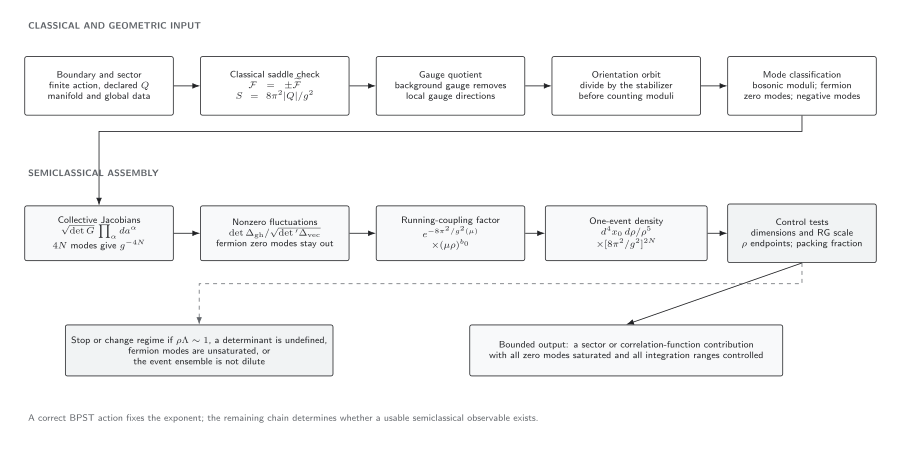
Construction of a one-instanton contribution (schematic). Gauge directions are removed before the physical modes are classified. Bosonic zero modes supply the collective-coordinate Jacobian and orientation measure, fermion zero modes must be saturated, negative modes require a contour, and the remaining determinants are normalized to the vacuum. A correct saddle exponent is not enough if the size integral or event ensemble is uncontrolled.
Determinants and the scale factor
Section titled “Determinants and the scale factor”After gauge fixing, a dimensionless one-loop factor must be normalized to the vacuum background. With the framed boundary condition just stated, its schematic form is
The prime omits genuine physical zero modes, not gauge transformations already excluded by the ghost boundary condition. Bosonic zero modes have become collective-coordinate integrals; fermionic zero modes become Grassmann integrals and must be saturated by insertions or masses. Negative modes, when present, require a contour prescription rather than omission. A self-dual BPST instanton has no physical negative mode, in contrast with a false-vacuum bounce; see the instanton–bounce boundary and mode comparison. Other gauge-group conventions are equivalent only after their residual group volumes, ghost zero modes, and orientation volumes are transformed together.
In pure Yang–Mills theory, the one-loop one-instanton density may be written
The constant depends on the renormalization scheme and on the normalization of the orientation volume. The powers have separate origins:
- is scale invariant: under , the five differentials supply , canceled by . Orientation coordinates are dimensionless.
- is the zero-mode Jacobian just derived.
- is the classical BPST weight.
- is the net scale dependence of the regulated nonzero-mode and ghost determinants.
The last two factors form a one-loop renormalization-group invariant combination. Since
one finds
Thus, to one-loop accuracy,
This standard measure was obtained by evaluating the determinants in the instanton background; see ‘t Hooft 1976, §§ III–V, pp. 3436–3448 and the corrected normalization analysis in Bernard 1979, pp. 3013–3019. Mariño 2015, § 4.5, pp. 129–146 derives the same coupling and size powers and makes the infrared limitation explicit.
Matter zero modes and observable dependence
Section titled “Matter zero modes and observable dependence”With active Dirac fermions in the fundamental representation,
For , each Dirac flavor supplies the chiral zero modes required by the index. In a vacuum amplitude the Grassmann integral vanishes in the massless limit. For a small nonzero mass satisfying , one mass insertion saturates each flavor pair and supplies the dimensionless factor
External fermion fields can saturate the same modes instead, producing a correlation-function selection rule. The detailed chirality and flavor structure is derived on Fermion Zero Modes, Index Data, and Selection Rules.
More generally, let denote the number of active fundamental flavors saturated by small masses, and let an observable insertion contribute a further power after positions and tensor structures are accounted for. The size integral therefore contains the local power
at one loop, before logarithmic corrections. A flavor with is not described by the small-mass factor and requires threshold matching instead. The ultraviolet endpoint converges only if , while the formal infrared endpoint converges only if . These mathematical tests do not extend weak coupling: the semiclassical expression must already be abandoned when . The Instanton Size Modulus and Infrared Limitations performs this check for explicit matter content.
Normalization checks
Section titled “Normalization checks”A usable measure should pass four independent tests:
- Dimensions: , , and are dimensionless.
- Renormalization scale: explicit -dependence cancels the running of the classical weight to the stated loop order.
- Zero-mode accounting: every omitted eigenvalue reappears as a bosonic collective coordinate or a Grassmann integral.
- Domain of integration: orientation stabilizers are quotiented once, and the range stays inside if the result is called semiclassical.
Failure of any one test invalidates the claimed prefactor even if the exponent is correct.
Common pitfalls
Section titled “Common pitfalls”Writing without saying what was removed. Translation, scale, orientation, fermion, gauge, and negative modes have different treatments. A prime is meaningful only together with that classification.
Treating as universal. The complete density is scheme dependent; physical observables become scheme independent only after all ingredients are combined consistently.
Integrating through strong coupling. A formally divergent large- integral signals loss of control. Cutting it off by hand is a model assumption, not a first-principles instanton prediction.
Exercises
Section titled “Exercises”- Show directly that the combination of the classical weight and is -independent at one loop.
Solution
The beta function gives . Therefore
which cancels .
- For pure , determine the one-loop small- and large- behavior of the vacuum size integral.
Solution
Here , so the explicit power is
Because , the integral converges at . It grows toward large , where becomes strong. The one-loop semiclassical formula therefore loses validity before its formal upper endpoint can be interpreted.
References
Section titled “References”- Bernard, Claude. “Gauge Zero Modes, Instanton Determinants, and Quantum-Chromodynamic Calculations.” Physical Review D 19 (1979): 3013–3019. DOI.
- ‘t Hooft, Gerard. “Computation of the Quantum Effects Due to a Four-Dimensional Pseudoparticle.” Physical Review D 14 (1976): 3432–3450; erratum 18 (1978): 2199. DOI.
- Mariño, Marcos. Instantons and Large N: An Introduction to Non-Perturbative Methods in Quantum Field Theory. Cambridge: Cambridge University Press, 2015. DOI.