

Global and Torsion Anomalies
A global anomaly is a nontrivial phase or sign acquired by the quantum functional around an admissible loop of background data. A purely global anomaly can remain even when every infinitesimal Ward identity and local anomaly polynomial is trivial. The decisive four-dimensional example is one physical left-handed Weyl fermion in the fundamental of : its perturbative polynomial vanishes, but the generator of produces a five-dimensional mod-two index equal to one and reverses the fermion Pfaffian. This page develops that diagnostic on closed spin manifolds and explains why torsion information is invisible to differential-form tests. General determinant-line, -invariant, and bordism theorems are left to the rigorous continuation.
Required background. What Is an Anomaly? supplies the counterterm test and the independent background-versus-dynamical and local-versus-global distinctions. Large Gauge Transformations and Topological Sectors supplies the admissible transformation group and its component group; in particular, “large” is a topological label, not already an anomaly verdict.
Helpful background. Homotopy, Degree, Winding, and Covering Spaces supplies the homotopy class of the finite transformation. Fredholm and Dirac Index Theorems and Zero-Mode Counting supplies the ordinary index and zero-mode framework; the mod-two refinement is introduced below.
A flat anomaly line can still have holonomy
Section titled “A flat anomaly line can still have holonomy”Let denote all fixed background data needed by the fermion problem: bundle, connection, metric, spin structure, and domain. Let be the transformations preserving those data in the declared sense, and write schematically
The chiral fermion functional is not always a single-valued complex function on . More accurately, it is a section of a determinant or Pfaffian line . The local anomaly measures the curvature of the natural connection on this line. Its family-index density is the local polynomial developed on Anomaly Polynomials and Inflow.
Vanishing curvature is weaker than a global trivialization:
The loop can be noncontractible, and a flat line can carry a finite phase
A globally admissible local counterterm changes the chosen representative or trivialization. A genuine global anomaly is the residual holonomy class after quotienting by all such counterterms allowed by the same bundle, boundary, and tangential data. Thus licenses the global test; it does not make that test unnecessary. A concise review of this local-form-versus-global-phase distinction is Monnier 2019, § 1, arXiv v2, pp. 1–2, especially p. 2, Open PDF. Its determinant-line and exponentiated- realization is developed in Witten and Yonekura 2021, §§ 3.2–3.3, arXiv v3, pp. 34–38, Open PDF.
A large transformation closes a mapping torus
Section titled “A large transformation closes a mapping torus”Take a closed oriented spin four-manifold , a principal -bundle , an admissible background , and a finite transformation . Choose a smooth family , , with
The endpoint identification by closes this path into a loop in . It also produces a closed five-dimensional mapping torus . Write for the bundle automorphism determined by . For a pure gauge transformation the base manifold can remain ; the nontrivial gluing is in the principal-bundle fibers,
In a trivialization this reduces to the familiar fiber action by a map . The connection and spin data are glued at the same time. A diffeomorphism would instead twist the base as well, a case deferred to the next page.
This construction has hypotheses that the notation can hide. The transformation must preserve the declared domain; the endpoint bundle and spin lift must glue, including the choice of whether an extra twist is inserted; the interpolating Dirac family must stay in one Fredholm problem; and any local anomaly must either vanish or be included in the full refined phase. A mapping torus made from an inadmissible transformation is not a detector for the original theory.
When the local anomaly has been canceled, parallel transport around the loop produces a finite phase invariant under admissible homotopies of that loop; flatness does not identify nonhomotopic loops. For complex chiral fermions this phase is encoded by a globally normalized determinant-line or exponentiated- construction. For the pseudoreal example below, the phase reduces to a sign and can be read by a mod-two index. Mapping-torus and bordism qualifications are spelled out in Davighi, Gripaios, and Lohitsiri 2020, §§ 2.1–2.2, arXiv v3, pp. 6–12, Open PDF.
Spectral flow reads the fermion phase
Section titled “Spectral flow reads the fermion phase”Let be the self-adjoint Hermitian Dirac family associated with . In a real or pseudoreal Pfaffian problem, symmetry-related eigenvalue crossings are counted once by the mod-two spectral flow . It equals the mod-two index of the appropriate five-dimensional Dirac operator on ,
In this real symmetry class, ; the real or pseudoreal structure protects this parity.
When the endpoint Pfaffians are nonzero, their ratio is
At a zero mode the numerical ratio is undefined. The invariant statement is then the transport and orientation of the Pfaffian line, or the corresponding relation among zero-mode-saturated correlation functions. Also, is not generally the reduction of an ordinary integer index: the five-dimensional operator is odd-dimensional and has no ordinary chiral index. The original sign argument is Witten 1982, pp. 324–328; the mapping-torus, spectral-flow, and mod-two-index formulation is reviewed in Wang, Wen, and Witten 2019, Introduction and §§ 2.2–2.3, arXiv v4, pp. 2–3 and 6–9, eqs. (2.3)–(2.9), Open PDF.
The comparison diagram makes the logical asymmetry visible. Inspect the dashed cross-arrow: clearing the infinitesimal branch sends the reader to the global branch rather than to an “anomaly-free” conclusion.
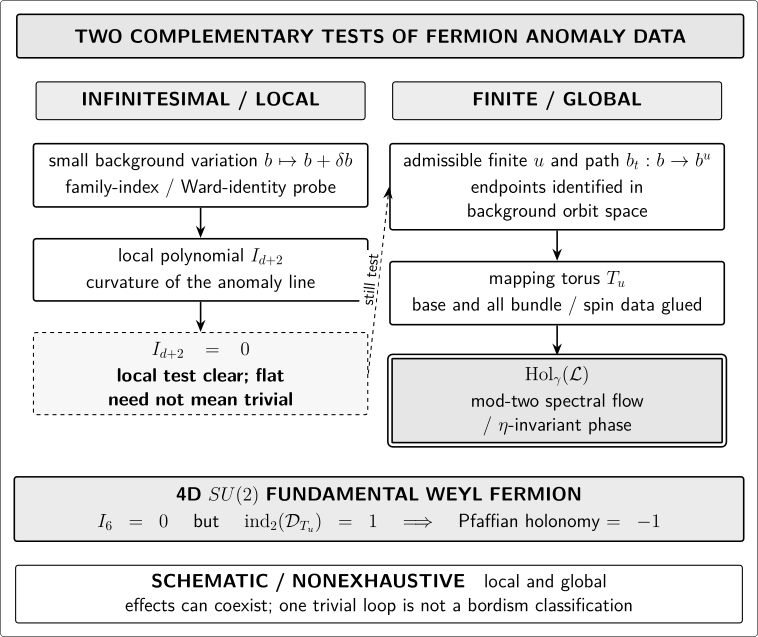
Local and global anomaly detectors are complementary. The left branch tests infinitesimal curvature through ; the right tests finite holonomy by a large transformation, mapping torus, and spectral or data. The sign at the bottom is the controlled mod-two example. The diagram is schematic and non-exhaustive: it suppresses the normalization and full bordism classification of general phases.
| Detector | Input | Output | What zero licenses | What zero does not test |
|---|---|---|---|---|
| Local polynomial | Infinitesimal background variation | Curvature / local anomaly class | Proceed to finite holonomy | Large loops, flat torsion phases |
| Finite-transformation holonomy | Admissible loop or large transformation | Phase in U(1) | Only that loop is clear | Other loops or non-mapping-torus classes |
| Mod-two spectral flow | Real or pseudoreal Fredholm family | Pfaffian sign | That sign obstruction is absent | General complex phases |
| Eta / bordism refinement | Closed odd-dimensional global data | Refined phase or anomaly character | Only the tested class is trivial | Unspecified structures or a full classification |
The figure and table encode five distinct steps. An infinitesimal variation tests . If that test vanishes, choose an admissible finite transformation and a path of backgrounds. Glue the endpoints to form . Evaluate the licensed spectral, mod-two, or invariant. A nontrivial holonomy is a witness of a global anomaly; a trivial result for one loop is not a classification theorem.
One SU(2) Weyl doublet fails the mod-two test
Section titled “One SU(2) Weyl doublet fails the mod-two test”Now fix the controlled application precisely. Let
- with its standard orientation, a fixed metric, and spin structure;
- the global gauge group be exactly , with the trivial bundle over ;
- be a Hermitian source connection with and ; and
- the fermion be one physical Lorentzian left-handed Weyl doublet, which is negative Euclidean chirality under the inherited continuation.
The index-normalized local polynomial is
Both terms vanish. The generators of a simple algebra are traceless, and has no symmetric cubic invariant, so
The characteristic-form normalization and chirality sign follow Álvarez-Gaumé and Vázquez-Mozo 2024, § 3, arXiv v2, pp. 5–8 and 10, eqs. (11), (17)–(19), and (22), Open PDF; only the vanishing result is used here.
This proves only that the local curvature test is silent. Choose a based transformation
representing the nonidentity element of , and form the gauge-twisted mapping torus . Witten’s mod-two computation gives
There is no globally consistent sign choice for the single-doublet Pfaffian. For identical doublets,
so this original obstruction cancels precisely when is even. A right-handed doublet contributes the same order-two class because is its own inverse.
The physical verdict still depends on the role of the connection. If is dynamical, the sign under an admitted gauge redundancy makes the putative theory inconsistent unless another sector cancels it. If is a fixed background for an exact global symmetry, the same sign is a ‘t Hooft anomaly and obstructs gauging. The metric and spin structure are explicit inputs, but this particular obstruction is an internal-gauge anomaly, not the gravitational or orientation-reversing cases treated next.
The even-doublet rule is deliberately narrow. For general representations, the familiar anomaly receives contributions from isospin representations. The exact parity coefficient is given in Wang, Wen, and Witten 2019, § 2.3, arXiv v4, p. 9, eq. (2.9), Open PDF. Generalized spin– structures on non-spin manifolds support an additional anomaly, a different domain described in Wang, Wen, and Witten 2019, Introduction and § 2.4, arXiv v4, pp. 2–3 and 9, Open PDF. Brennan and Intriligator’s 2024 analysis sharpens the counter-scope: matter that is healthy on ordinary spin manifolds can acquire a obstruction after the generalized structure is admitted Brennan and Intriligator 2024, Introduction, arXiv v3, pp. 1–5, especially pp. 2–4, eqs. (1.1)–(1.2), Open PDF. It is therefore not licensed to turn “even number of fundamental doublets” into a complete global-anomaly criterion for arbitrary matter, global form, or tangential structure.
Torsion survives a vanishing polynomial
Section titled “Torsion survives a vanishing polynomial”Characteristic forms live in real cohomology. They detect realified local characteristic data, while real differential forms forget finite torsion. Once the local polynomial vanishes, a globally defined anomaly phase may—under the hypotheses of an invertible, bordism-invariant response—descend to a character
where records the chosen tangential structure and the notation stands only for the orientation developed rigorously later. If a class has finite order , then
Such a root of unity can be nontrivial even though every de Rham anomaly form vanishes. The controlled diagnostic produces an order-two phase:
These equations alone establish the order of the phase, not the order of : a character can map an infinite-order class to . Showing that the underlying bordism class is torsion requires the separate bordism computation. “Global” and “torsion” are therefore not synonyms. Global refers to the finite or topological nature of the detector; torsion refers to finite order of the relevant class. A nontrivial global phase need not be torsion, and a mapping-torus test need not generate every relevant bordism class. Bordism computations for global forms of gauge groups illustrate both the power and the limits of the mapping-torus shortcut Davighi, Gripaios, and Lohitsiri 2020, § 1, §§ 2.1–2.2, and § 4.6, arXiv v3, pp. 2–12 and 29–30, Open PDF.
What the diagnostic can and cannot decide
Section titled “What the diagnostic can and cannot decide”A nontrivial phase for one admissible loop is decisive: it witnesses a global obstruction. The converse is much weaker. A trivial phase for one chosen transformation says nothing about untested loops, bundles, tangential structures, or non-mapping-torus bordism classes. Likewise, is neither a universal necessary nor a sufficient condition for an anomaly; the fermion representation and the full background structure enter the phase. This distinction between homotopy probes and bordism classification is emphasized by Davighi and Lohitsiri 2021, Introduction and §§ 3.2–3.4, arXiv v2, pp. 1–5 and 14–20, Open PDF.
Several further limits matter:
- A nonzero local polynomial and a global phase can coexist. Then the full refined invariant, not an isolated mapping-torus sign, carries the answer.
- On a manifold with boundary, the transformation and the Dirac domain must preserve the boundary problem. Boundary flux, edge modes, and inflow can change the combined system, as explained on Anomaly Polynomials and Inflow.
- Zero modes require line-valued transport or saturated correlators rather than the displayed ratio .
- A specialized current calculation can corroborate the same local-versus- global distinction without becoming a classification theorem. For example, Choi’s arXiv:2508.14895v1 sigma-model analysis finds a Pfaffian-line phase after its local anomaly-polynomial test vanishes Choi 2025, §§ 2.2–2.6 and 3.1, arXiv v1, pp. 7–15, Open PDF.
For determinant/Pfaffian-line holonomy, exponentiated invariants, and bordism classification with theorem-level hypotheses, continue to Global Anomalies, Determinant Lines, and Eta Invariants. For gravitational, discrete, and orientation-reversing cases, continue to Gravitational, Mixed, Discrete, and Orientation-Reversing Anomalies. For the renormalization-group constraints carried by a fixed-background anomaly, continue to ‘t Hooft Anomaly Matching.
Common pitfalls
Section titled “Common pitfalls”“The anomaly polynomial vanishes, so the theory is anomaly-free.” Vanishing removes the infinitesimal curvature obstruction. A flat determinant or Pfaffian line can still have nontrivial holonomy around a large loop.
“Every large transformation is anomalous.” Large only means disconnected from the identity inside the declared admissible group. The anomaly phase may be trivial, and the transformation’s physical role must still be identified.
“Spectral flow means count every degenerate eigenvalue crossing.” In the pseudoreal example the relevant quantity is mod-two Pfaffian spectral flow, which counts each symmetry-related crossing pair once. Ordinary degeneracy-counted spectral flow can hide the sign by an erroneous factor of two.
“A mapping torus computes the whole global-anomaly classification.” It tests the class realized by that loop. Other bundles or bordism classes may not be representable by the sampled mapping tori.
“The even-doublet rule is the complete answer.” It cancels the original anomaly for fundamental doublets on ordinary spin manifolds. Other representations and generalized spin– backgrounds require additional tests.
Check your understanding
Section titled “Check your understanding”1. Flat does not mean trivial
Section titled “1. Flat does not mean trivial”Explain why does not imply .
Solution
removes the curvature of the anomaly line connection. A flat line can still carry a nontrivial representation of the fundamental group, so a noncontractible loop may have finite holonomy.
2. What is twisted in the gauge mapping torus?
Section titled “2. What is twisted in the gauge mapping torus?”For a pure gauge transformation on a fixed four-manifold , state what is glued at and .
Solution
The underlying base can be . The principal-bundle fibers are identified by the bundle automorphism ; this reduces to an action by only in a trivialization. The endpoint connections and spin data must match under the same gluing. Saying only “” misses the essential bundle twist.
3. Count fundamental doublets
Section titled “3. Count fundamental doublets”Compute the phase of the generator of for identical left-handed fundamental doublets.
Solution
. The phases are , respectively. Thus this original mod-two obstruction cancels for an even number of doublets.
4. Diagnose the physical verdict
Section titled “4. Diagnose the physical verdict”The same sign is found first with a fixed source connection and then after that connection is made dynamical. What changes?
Solution
With a fixed source, the sign is a global ‘t Hooft anomaly of an exact global symmetry and obstructs gauging. Once the transformation is an admitted dynamical gauge redundancy, the nontrivial sign is an inconsistency unless another sector cancels it.
5. What does one trivial mapping-torus result prove?
Section titled “5. What does one trivial mapping-torus result prove?”Suppose the phase for one chosen large transformation is . May one declare the theory globally anomaly-free?
Solution
No. Only that loop has passed. Other transformation components, bundles, tangential structures, and bordism classes remain untested, and a nonzero local anomaly must be checked separately.
References
Section titled “References”- Álvarez-Gaumé, Luis, and Miguel Á. Vázquez-Mozo. “Anomalies and the Green–Schwarz Mechanism.” In Handbook of Quantum Gravity, edited by Cosimo Bambi, Leonardo Modesto, and Ilya L. Shapiro, 2241–2284. Singapore: Springer, 2024. DOI. Open PDF, arXiv v2.
- Brennan, T. Daniel, and Kenneth Intriligator. “Anomalies of 4d Spin Theories.” Journal of High Energy Physics 2024, no. 7 (2024): 157. DOI. Open PDF, arXiv v3.
- Choi, Changha. “Global Anomalies in Sigma Models with Majorana–Weyl Fermions.” arXiv:2508.14895v1 [hep-th], 2025. Stable record. Open PDF, arXiv v1.
- Davighi, Joe, Ben Gripaios, and Nakarin Lohitsiri. “Global Anomalies in the Standard Model(s) and Beyond.” Journal of High Energy Physics 2020, no. 7 (2020): 232. DOI. Open PDF, arXiv v3.
- Davighi, Joe, and Nakarin Lohitsiri. “Omega vs. Pi, and 6d Anomaly Cancellation.” Journal of High Energy Physics 2021, no. 5 (2021): 267. DOI. Open PDF, arXiv v2.
- Monnier, Samuel. “A Modern Point of View on Anomalies.” Fortschritte der Physik 67, nos. 8–9 (2019): 1910012. DOI. Open PDF, arXiv v2.
- Wang, Juven, Xiao-Gang Wen, and Edward Witten. “A New Anomaly.” Journal of Mathematical Physics 60, no. 5 (2019): 052301. DOI. Open PDF, arXiv v4.
- Witten, Edward. “An Anomaly.” Physics Letters B 117, no. 5 (1982): 324–328. DOI.
- Witten, Edward, and Kazuya Yonekura. “Anomaly Inflow and the -Invariant.” In Memorial Volume for Shoucheng Zhang, edited by Biao Lian, Chao-Xing Liu, Eugene Demler, Steven Kivelson, and Xiao-Liang Qi, 283–352. Singapore: World Scientific, 2021. DOI. Open PDF, arXiv v3.