

Goldstone's Theorem: Hypotheses and Pole Argument
Goldstone’s theorem is conditional: a broken continuous global symmetry forces massless spin-zero spectral weight only when a local conserved current, a suitable infinite-volume vacuum, locality, Lorentz symmetry, and the usual spectral assumptions all coexist. The safest proof never assumes that the global charge creates a normalizable state. It diagnoses breaking with a regulated local-current commutator, turns its nonzero value into a Ward-identity singularity, and then uses the spectral representation to place that singularity on .
This page proves that existence statement for ordinary continuous internal symmetries in relativistic QFT with spacetime dimension . It does not yet count independent modes, cover spacetime-symmetry breaking, or describe the Higgs mechanism.
Required background. Finite Volume, Thermodynamic Limits, and Pure Phases supplies the selected infinite-volume state and the order of limits. Quantum Currents, Improvements, and Conservation supplies the renormalized current, insertion identity, improvement, and boundary-flux conditions.
Helpful background. The Källén–Lehmann Representation develops the completeness, spectrum, and pole language used below.
The conditional relativistic theorem
Section titled “The conditional relativistic theorem”Let be a selected infinite-volume vacuum and let be the renormalized current for a continuous internal generator . Choose a smooth spatial cutoff that equals one on a ball of radius , vanishes outside a slightly larger ball, and define the partial charge
For a physical local Lorentz scalar , use the site convention
whenever the unsmeared charge exists. The regulated order-parameter variation is
The direction is detected as broken when this limit exists, is finite, and satisfies for at least one local operator.
Relativistic Goldstone theorem, existence form. Suppose all of the following hold:
- the QFT is unitary, local, and relativistic in spacetime dimensions;
- the symmetry is an exact ordinary continuous internal global symmetry, and the Ward identity used in the proof has no explicit or anomalous current-divergence term;
- is a normalized physical local current with as an insertion away from its contact terms;
- is a selected pure infinite-volume vacuum invariant under translations and Lorentz transformations;
- the physical Hilbert space has positive norm, a complete set of energy-momentum states, and the positive-energy spectrum condition;
- microcausality and sufficient decay or vanishing boundary flux make the partial-charge limit well defined; and
- a local scalar has .
Then the mixed current–operator spectral distribution has nonzero support at . In the standard spectral representation it contains a massless spin-zero contribution, and the corresponding time-ordered correlator has a pole with nonzero residue. This is an existence theorem for massless spectral content, not a claim that the excitation must be an elementary field or that every broken generator always gives a distinct mode. The current proof and its particle interpretation are given in Weinberg 1995, § 19.2, pp. 167–173; the regulated-charge qualification is made explicit in Álvarez-Gaumé, Orlando, and Reffert 2021, § 2.1, pp. 10–12, Open PDF.
Here “no anomalous current-divergence term” refers only to the flat-space conservation identity used below; it is not a general classification of anomalies. The broader anomaly taxonomy belongs to Anomalies, Inflow, and Matching.
A broken generator without a global charge vector
Section titled “A broken generator without a global charge vector”The partial charges are not a cosmetic regulator. In a broken infinite-volume representation, the vectors can have no normalizable limit even though commutators with bounded-support local operators converge. Thus the expression need not define a state in the Hilbert space of the selected phase.
The local commutator nevertheless has controlled time dependence. Current conservation gives
The derivative of lives only in the distant transition shell. For fixed , microcausality makes its commutator with vanish once that shell is spacelike separated; the stated decay and no-flux conditions control the limiting and boundary terms. Therefore is time independent. This is exactly where locality and boundary behavior enter. A long-range nonlocal interaction, physical boundary flux, or ill-defined current can invalidate the step. The spatial cutoff on the partial charge and the possible nonnormalizability of are discussed explicitly in Álvarez-Gaumé, Orlando, and Reffert 2021, § 2.1, pp. 10–11, Open PDF.
The Ward identity forces an infrared singularity
Section titled “The Ward identity forces an infrared singularity”Define the time-ordered mixed correlator without an extra prefactor of ,
Differentiating the time ordering produces the equal-time contact term,
Spatial integration of the right-hand side gives . With the Fourier kernel , integration by parts sends to . Writing derivative-contact polynomials as , with their constant part already included in , gives
For a scalar and a Lorentz-invariant vacuum, the nonlocal vector structure can only be longitudinal:
Derivative contacts are polynomials in momentum and vanish or remain analytic at ; they cannot supply or cancel a nonlocal inverse power. Since , the longitudinal form factor must contain
The sign is fixed by the declared charge and Fourier conventions: substituting the pole back gives , the regulated equal-time commutator. The prescription records that this is the time-ordered correlator. A local counterterm may change contact polynomials, but it cannot remove the nonlocal pole while remains nonzero.
Why the singularity lies on the massless shell
Section titled “Why the singularity lies on the massless shell”The Ward identity proves an infrared singularity. The spectral representation identifies its physical support. Fourier transform the positive-energy Wightman function and insert a complete set of physical states:
The spectrum condition restricts this distribution to . Lorentz covariance and the scalar nature of give its nontrivial vector part the form
Current conservation now imposes
as a distribution. Thus a massive shell at cannot carry the required longitudinal weight. Microcausality relates the two Wightman orderings entering the commutator, while the nonzero equal-time sum rule prevents the spectral coefficient from vanishing. Under the standard measure-valued spectral assumptions,
This is the massless-shell statement behind the Feynman pole. The mixed density need not itself be nonnegative; positivity is used for the physical Hilbert-space interpretation and completeness of the intermediate states. Weinberg’s derivation separates precisely these steps—Lorentz covariance, locality, conservation, the equal-time commutator, and the term—at Weinberg 1995, § 19.2, pp. 170–172.
Pole residue and the spectral state
Section titled “Pole residue and the spectral state”When the massless contribution admits the ordinary one-particle description, normalize states by
and define
The pole residue factorizes:
Individual and depend on state phases and operator normalization. The summed product is invariant under rephasing of the intermediate states and rescales with exactly as does. Because the diagnostic operator is a Lorentz scalar, the contributing massless sector has spin zero. Multiple massless states can share the residue, and a composite interpolating operator is entirely allowed. The pole does not prove that a particular elementary field in a Lagrangian is the Goldstone field. The factorized relation and its multi-current form appear in Weinberg 1995, § 19.2, pp. 172–173.
The figure condenses the proof into two independently checkable routes. Read the left branch as the time-ordered Ward-identity argument and the right branch as the positive-energy spectral argument. They meet only after the nonzero regulated variation supplies the missing premise: conservation by itself permits a zero spectral density. Solid arrows encode logical implications under the hypotheses stated on this page; the dashed final box marks conclusions that require different theorems.
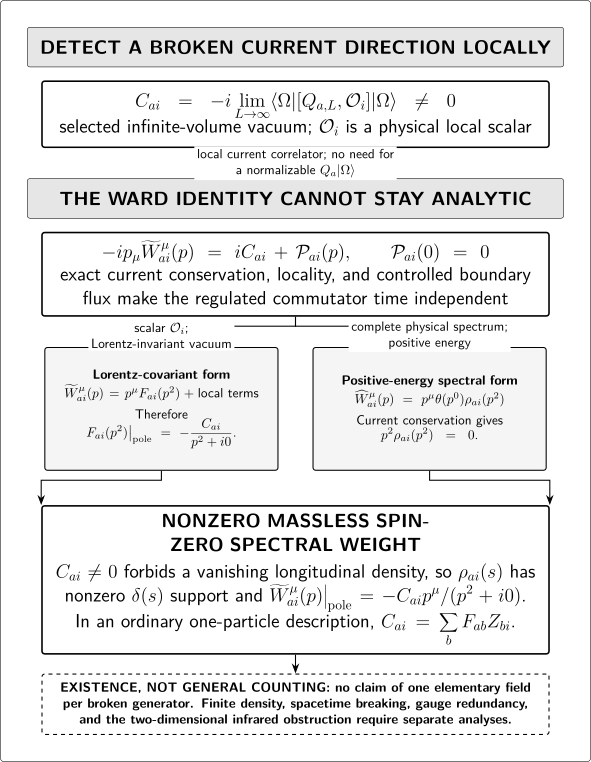
The two routes identify the same massless contribution. Lorentz covariance gives up to local terms, so the nonzero contact sum rule requires . Independently, positive-energy spectral support and current conservation give ; because , the longitudinal density cannot vanish and must contain nonzero support. With ordinary one-particle states the residue factorizes as . This schematic proves existence of massless spin-zero spectral weight in the page’s relativistic internal- symmetry scope, not a universal mode count or an elementary-field identification.
Every relationship in the diagram is also recorded in this semantic cross-check.
| Input or step | Consequence | What it does not establish |
|---|---|---|
| from the partial-charge commutator | The equal-time contact sum rule is nonzero | Existence of a normalizable vector |
| Exact current conservation, locality, and controlled flux | The regulated commutator is time independent and the Ward identity has no bulk breaking term | The conclusion when the current is anomalous, explicitly broken, or leaks through a boundary |
| Scalar and Lorentz-invariant vacuum | The nonlocal vector structure is longitudinal | Finite-density, nonrelativistic, or spacetime-symmetry kinematics |
| Complete positive-energy physical spectrum | and the nonzero sum rule puts weight at | Positivity of the mixed density or a single elementary interpolating field |
| Ordinary one-particle realization of the massless sector | One independent mode for every broken generator outside the stated relativistic setting |
Complex scalar: sign and residue check
Section titled “Complex scalar: sign and residue check”Return to the exact global model
A temporary source first selects a phase and is removed only after the infinite-volume limit. In the selected phase with real expectation value, the weakly coupled tree-level expansion is
The site conventions and give
The current is
The potential gives and . Using the free massless propagator in the leading current term yields
so . This checks the current sign, the Fourier sign, and the residue in one calculation. The angular mode and classical vacuum circle are developed in Tong 2019, § 2.2, pp. 58–61, official PDF.
In the exact interacting theory, replace the elementary calculation by the renormalized current and physical spectral states. If , the exact Ward identity fixes the residue pairing ; it does not require separately.
Now keep instead a permanent deformation
At fixed , the continuous current has a breaking insertion, , where in the declared renormalized-operator convention . Exact is reduced to . The Ward identity therefore contains an additional bulk term, while the residual discrete group has no infinitesimal current. Goldstone’s theorem does not force a zero-mass pole. The controlled lifting of that pole belongs to Explicit Breaking and Pseudo-Goldstone Modes.
Where the theorem stops
Section titled “Where the theorem stops”Each exception removes a specific proof step.
Finite volume. If the finite-volume ground state is unique and symmetry invariant, then . The selected broken phase appears only after the ordered infinite-volume limit.
Explicit or anomalous divergence. If , the Ward identity has a bulk insertion and need not be a nonzero constant. A shifted or absent pole is then possible.
Two spacetime dimensions. In the standard short-range relativistic setting, infrared fluctuations obstruct the assumed broken phase. The hypothesis fails rather than the theorem producing an ordinary Goldstone particle.
Finite density or nonrelativistic kinematics. Lorentz covariance is absent: a finite-density state selects a rest frame, while a nonrelativistic microscopic theory has no Lorentz symmetry. Additional structures enter the spectral decomposition, and dispersion and counting can differ.
Broken spacetime symmetries. The current and order parameter carry spacetime structure, and redundant Goldstone coordinates can be related by inverse-Higgs constraints. The scalar internal-symmetry decomposition used here is insufficient.
Nonlocal long-range interactions or boundaries. Microcausality, decay, or the no-flux limit can fail, so the partial-charge commutator need not become time independent.
Gauge redundancy. A gauge transformation is not an ordinary physical global symmetry. In covariant gauges the state space can lose positive-definite norm, while gauges with a physical Hilbert space can obscure manifest Lorentz covariance; in either description the theorem’s physical-current assumptions are not those of a broken global symmetry. See Elitzur’s Theorem and the Gauge-Invariant Higgs Mechanism.
The dimension, finite-density, spacetime, and counting qualifications are developed on Goldstone Counting, Low-Dimensional Obstructions, and Spacetime Exceptions.
Common pitfalls
Section titled “Common pitfalls”“Goldstone’s theorem assumes is a state.” The regulated proof assumes only convergent local commutators and current correlators. The unsmeared charge vector can be nonnormalizable in the broken phase.
“Current conservation alone proves a massless particle.” Conservation gives , but the nonzero regulated symmetry variation is what prevents the longitudinal spectral density from vanishing.
“A expression always proves a physical particle.” Gauge artifacts and nonphysical state spaces can also contain massless poles. The physical Goldstone interpretation uses locality, the spectrum condition, completeness, and positive-norm physical states.
“One broken generator means one new elementary field.” This page proves nonzero massless spectral support for a broken direction. Mode counting and elementary-field identification are separate questions.
“The temporary selector explicitly breaks the final theory.” It does while nonzero. It serves only to select the phase; exact current conservation is restored when the selector is removed after the infinite-volume limit.
Check the pole argument
Section titled “Check the pole argument”These questions are for self-study and are not graded.
- Suppose the mixed spectral density has support only at . Why is this incompatible with both and ?
- In the complex-scalar example, use and the massless Feynman propagator to recover the pole and check its divergence.
Check
-
Multiplication by is invertible on the support , so forces . The equal-time commutator would then vanish, contradicting . Nonzero longitudinal weight must therefore reach .
-
With , differentiating the first field contributes . Hence
Contracting gives , which equals because and .
What follows
Section titled “What follows”The theorem has now isolated the exact logical chain: a nonzero regulated local variation, a conserved current, a Lorentz-covariant spectral representation, massless support, and a factorized pole residue. The next pages separate the conclusions that require additional input.
- Goldstone Counting, Low-Dimensional Obstructions, and Spacetime Exceptions asks when broken directions and independent low-energy modes can be counted.
- Cosets and Nonlinear Realizations turns broken-direction coordinates into fields and invariant interactions.
- Explicit Breaking and Pseudo-Goldstone Modes deforms the Ward identity and follows the pole away from zero mass.
- Elitzur’s Theorem and the Gauge-Invariant Higgs Mechanism replaces broken-redundancy language with gauge-invariant physics.
References
Section titled “References”- Álvarez-Gaumé, Luis, Domenico Orlando, and Susanne Reffert. “Selected Topics in the Large Quantum Number Expansion.” Physics Reports 933 (2021): 1–66. DOI. Open PDF.
- Tong, David. The Standard Model: 2 Broken Symmetries. Part III lecture notes. Cambridge: University of Cambridge, Department of Applied Mathematics and Theoretical Physics, 2019. Official course page. Official PDF.
- Weinberg, Steven. The Quantum Theory of Fields, Volume II: Modern Applications. Cambridge: Cambridge University Press, 1995. DOI.