

Higher-Group Symmetry and Coupled Backgrounds
An ordinary symmetry and a one-form symmetry form a 2-group when their background gauge transformations cannot be made independent by an allowed redefinition. In the finite internal case, the structural data are a zero-form group , an Abelian one-form group , an action , and a Postnikov class . Direct product requires both trivial and trivializable ; vanishing with nontrivial gives a split or semidirect 2-group instead.
Where the corresponding descriptions exist, the operational tests encode the same coupling: a zero-form background change forces the two-form background to change, an invariant higher curvature obeys a modified Bianchi identity, the Ward identities mix, and the associator of zero-form walls carries a one-form symmetry surface. Finite cochains and continuous local currents are complementary diagnostics, not data available in every theory. Mere coexistence, a mixed anomaly, or one suggestive term in a Lagrangian is not enough. This page treats ordinary invertible internal zero-form and one-form symmetries, using finite cochains for global structure and a four-dimensional Abelian differential-form model for the local Ward identity. Full classification, noninvertible extensions, spacetime symmetry, and higher -groups lie outside that scope.
Required background. Higher-Form Currents, Charges, Backgrounds, and Ward Identities supplies the background degrees, gauge transformations, and Ward/contact conventions. What Is a Symmetry of a QFT? supplies exact and faithful actions, kernels, and the distinction between a physical symmetry and a presentation of it.
Helpful background. Characteristic Classes and Chern–Weil Theory supplies the distinction between a characteristic class and a chosen representative. Wess–Zumino Consistency and Descent supplies counterterm and consistency tests used to distinguish coupled transformations from anomalies.
Scope of the cited results, checked 9 August 2026. The operational background, defect-network, and compact-Abelian statements below were checked against the published sources and current review cited at the point of use. They support the bounded internal 2-group tests stated here; they do not turn one local form representative into a classification of torsion backgrounds, prove that every mixed anomaly is a 2-group, or establish a phase of the example.
Coupled backgrounds are the operational test
Section titled “Coupled backgrounds are the operational test”Let be an oriented -dimensional spacetime. A zero-form symmetry has codimension-one topological walls and acts on local operators. A one-form symmetry has codimension-two topological surfaces and acts on genuine lines by linking. In the continuous Abelian convention, their currents and duals have degrees
Finite symmetries retain the wall, surface, line, and background degrees but generally have no infinitesimal Noether currents. On a triangulation or Čech cover, write a finite zero-form background as a flat -connection . The action makes into the local coefficient system . A candidate one-form background is a two-cochain
For an Abelian finite direct-product comparator with trivial action, the two backgrounds are independent:
A 2-group replaces the independent flatness condition by
Here is the coboundary twisted by the background and is the pullback of a chosen Postnikov cocycle. This equation does more than correlate two response coefficients: it says that is a trivialization of the three-cocycle . A global lift exists only when
If that obstruction is nonzero, the chosen background does not extend to an ordinary absolute 2-group background on closed . One must instead change the background, supply relative or boundary data, or declare singular background defects that account for the obstruction.
The one-form gauge move remains
A zero-form gauge change of must transport the local system by and shift so that the boxed constraint remains true. In the simpler case of Abelian and trivial , let . One can write
The descendant depends on cochain conventions; the invariant statement is preservation of . There is likewise no preferred cocycle representative. If
then the constraint is unchanged. Thus only , not a displayed cocycle formula, is structural. A direct-product presentation exists only when is trivial and an allowed redefinition sets to zero.
These finite data, their gauge transformations, and their dependence on the cocycle representative are developed in Benini, Córdova, and Hsin 2019, §§ 2.2–2.3, pp. 12–17, especially eqs. (2.8) and (2.10)–(2.23), Open PDF. A current review that compares continuous and discrete descriptions and emphasizes the split-versus-direct-product distinction is Bhardwaj et al. 2024, § 5, arXiv v2, pp. 114–121, especially eqs. (5.4)–(5.8), (5.19)–(5.24), (5.29), and (5.33)–(5.35), Open PDF.
Invariant curvatures encode the mixing
Section titled “Invariant curvatures encode the mixing”Continuous differential forms provide a useful local orientation, but they do not replace the finite or differential-cohomological global data. Specialize in this section to four dimensions. Take a continuous background with curvature and a background . In one consistent normalization, an integer coefficient enters the coupled transformations as
The combination
is invariant under these local transformations when . Its Bianchi identity is therefore modified:
The plus sign in the shift of , the minus sign in , and the minus sign in its Bianchi identity form one convention package. Reversing a source or charge convention changes them coherently. Large transformations and torsion require compact higher connections or differential cocycles; the local formula alone neither proves the quantization of nor classifies the global 2-group.
The same coupling appears in the Ward identities. Retain the site’s plus-source convention and define the background response at fixed sources by
On a closed , or for compactly supported parameters, background covariance gives
Because the parameters are arbitrary, the local identities without charged insertions, explicit breaking, boundary flux, or anomaly are
Every term in the second equation is a four-form. Charged insertions add distributional contacts, a physical boundary adds flux terms, explicit breaking adds operator sources, and a genuine anomaly adds a background variation. Those terms must not be hidden inside the structural right-hand side above.
The coupled transformation, invariant curvature, and Bianchi identity are given in Córdova, Dumitrescu, and Intriligator 2019, § 1.2, pp. 6–8, especially eqs. (1.15)–(1.16), version-of-record PDF. Their Ward-identity derivation, including the no-anomaly qualification, is in Córdova, Dumitrescu, and Intriligator 2019, § 1.4, pp. 12–13, eqs. (1.30)–(1.37), version-of-record PDF.
Postnikov data appear in finite defect networks
Section titled “Postnikov data appear in finite defect networks”The cochain constraint has a defect-dual reading. Let be a zero-form symmetry wall, a one-form symmetry surface, and a genuine charged line. For closed, oriented, disjoint and in a region where integer linking and removal of the unlinked surface are defined, let denote all other insertions outside the sweep. In a character sector ,
Reversing either support orientation negates the linking number and inverts the phase. An open or surface-attached line instead requires its endpoint or relative data. The one-form symmetry surface is topological in the declared complement; the charged line need not be.
Crossing a wall transports the surface label by . Binary wall fusion is resolved along a codimension-two junction. The static comparison between the two ways to fuse three walls is decorated by the codimension-two surface label
In the bordism that implements this associator move, four zero-form walls meet on a codimension-three locus and the -surface ends or emerges there. For the next coherence comparison, the pentagon identity gives the twisted cocycle condition , so the accumulated surface label cancels. Changing by a coboundary corresponds to redefining the binary wall junctions, so a nonzero class is precisely the obstruction to removing every associator decoration.
The two geometries should remain distinct. The static F-move is decorated by a codimension-two symmetry defect; in the bordism that implements the move, a codimension-three locus is the source or boundary of that defect. The label arithmetic does not construct, normalize, or prove coherence of the required junction spaces; those are additional operator data.
The wall, surface, charged-line, and associator descriptions are explicit in Benini, Córdova, and Hsin 2019, pp. 3–5, figs. 2–4 and eqs. (1.1)–(1.4); § 2.1, pp. 10–12, especially eqs. (2.5)–(2.7), Open PDF. Their cochain and junction calculation appears in Benini, Córdova, and Hsin 2019, §§ 2.2–2.3, pp. 12–17, eqs. (2.8)–(2.23), Open PDF.
The figure compares independent and coupled backgrounds, then translates the coupling into wall, surface, line, and junction data. Inspect the forced arrow in panel B and the associator insertion in panel C: they are the same Postnikov datum in background and operator language.
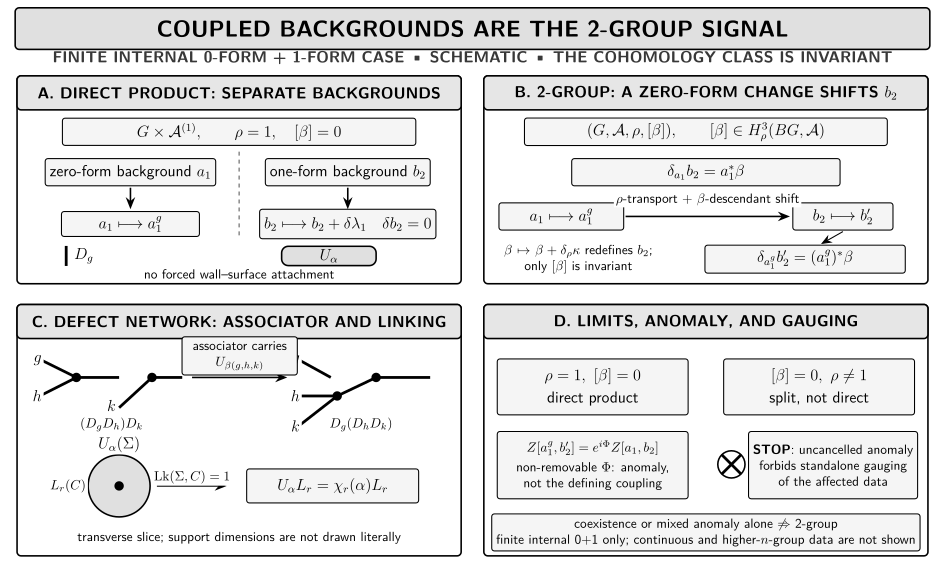
A finite internal 2-group is specified here by , an Abelian one-form symmetry , an action , and a Postnikov class . The constraint forces a transformed whenever changes; defect-dually, the associator of three walls carries the -surface , whose action is measured by a linked -charged line. Direct product requires and . The diagram is schematic and not to scale; its transverse-slice icons do not show literal support dimensions, and anomaly and gauging are separate tests.
The following table is the complete nonvisual reading of the figure.
| Test | Direct product | Coupled 2-group | Defect or qualification |
|---|---|---|---|
| Structural data | G and 𝒜 with trivial mutual action | G, 𝒜, ρ, and [β] | [β] lies in twisted degree-three cohomology |
| Backgrounds | The one- and two-cochains are independent | The 𝒜 coefficients are transported by the G background | Finite internal case; global lifts must exist |
| Flatness | The two-cochain is closed | Its twisted coboundary equals the pulled-back Postnikov cocycle | The sign follows the declared cochain convention |
| Zero-form gauge change | Does not force a two-cochain change | Forces coefficient transport and a Postnikov-descendant shift | The transformed field is fixed by preserving the constraint |
| One-form gauge change | Add an ordinary exact two-cochain | Add a twisted exact two-cochain | Gauge-for-gauge data are omitted from the schematic |
| Representative change | No Postnikov representative | A coboundary change of β is absorbed by redefining the two-cochain | Only [β] is invariant |
| Direct-product test | ρ is trivial and [β] vanishes | Nontrivial action or class obstructs a direct-product presentation | Vanishing [β] with nontrivial ρ is split or semidirect |
| Wall associator | No forced one-form surface insertion | The triple-wall comparison carries the label β(g, h, k) | Static move: codimension-two surface; bordism source: codimension-three locus |
| Charged line | A symmetry surface acts through its linking character | The associator surface is measured by that same linked action | Requires a genuine line and a declared linking domain |
| Anomaly test | May be anomaly-free or anomalous | May be anomaly-free or anomalous | An unremovable phase is an anomaly, not the mixing datum |
| Gauging | Test the chosen factor and its anomaly | Preserve the coupled transformation and full background family | An uncancelled anomaly stops standalone gauging |
| Global and boundary data | Independent sectors still need global definitions | The pulled-back Postnikov obstruction must be trivialized | Boundaries or singular defects require relative completion |
| Scope | Finite internal comparator | Finite internal 2-group | Continuous refinements and higher structures need additional data |
First application: a compact Abelian theory with a finite surface network
Section titled “First application: a compact Abelian theory with a finite surface network”Consider a four-dimensional compact gauge theory on a closed oriented spin bulk, with the spin structure fixed and . Let be a faithfully normalized compact connection, with , and let locally with on every closed oriented two-cycle. Take two complex scalars of gauge charge , so . Choose interactions that preserve their flavor doublet symmetry and include no dynamical odd-electric-charge endpoint. Magnetic backgrounds and monopole sectors are held outside this calculation. The Wilson lines are
Charge-two matter supplies the gauge-invariant endpoint composite
so both closed Wilson loops are genuine in the declared global form, but is screenable while remains unscreened. The unscreened electric class is , and the exact electric one-form symmetry is . Let its closed oriented surface be , . For disjoint supports in a linking ball,
Thus detects the nontrivial surface and makes the action faithful; is neutral in the screening quotient. Surface fusion is
For two incoming sheets and one outgoing sheet meeting along an oriented line , a declared junction
obeys the unsourced incidence rule . This congruence is a necessary charge check, not a construction or normalization of the junction.
The scalars also form a doublet of a flavor presentation. Its central element acts like a compact gauge transformation, so the faithful flavor symmetry on gauge-invariant local operators is . The zero-form factor is therefore continuous, whereas the electric one-form factor and its surface network are finite.
If line equivalences retain the flavor-center charge of an allowed endpoint, the refined charge group is
The first entry is the Wilson charge and the second is the flavor-center charge; the relation records that a charge-two endpoint is a flavor doublet. The associated extension is
Let be an flavor background and let be its obstruction to an lift. Choose cocycle representatives and for the following local formulas. The Bockstein for the displayed extension gives
The electric two-form background is therefore not independent of ; in the convention used here it satisfies
This coupling can be seen directly at the cochain level. Choose a -valued lift of and form
Since modulo four, the condition is equivalent to the boxed equation. A change of lift forces modulo two if is held fixed. That forced compensation is the concrete failure of independent flavor and electric-background transformations.
Poincaré-dually, the chosen representative is a two-dimensional, codimension-two surface network whose boundary is the one-dimensional, codimension-three locus dual to the chosen representative. Across a small transverse three-disk meeting that locus once, the signed surface incidence is
When the right-hand side is zero, this is the ordinary unsourced fusion rule. When it is one, an odd number of nontrivial electric surfaces may meet or end at the prescribed background-sourced line. In particular, three sheets are incidence-allowed at such a Postnikov junction even though three unsourced sheets would violate ordinary incidence. The locus is a background defect, not an unconstrained dynamical junction.
The drawn network depends on those representatives; its boundary class and the lift obstruction do not. As a direct cohomological consequence, on closed nonsingular a globally defined exists only if ; it is the chosen trivialization. A nontrivial cohomology class requires a relative setup, a boundary completion, or specified singular background defects. This global check is the application-level version of above.
The compact gauge theory, faithful flavor symmetry, electric , charge refinement, and Bockstein constraint are worked out in Bhardwaj et al. 2024, Examples 5.2 and 5.4, arXiv v2, pp. 123–129, eqs. (5.50)–(5.58) and (5.70)–(5.94), Open PDF. The general defect-network interpretation and its junction ceiling are supported by Benini, Córdova, and Hsin 2019, pp. 3–5 and §§ 2.1–2.3, pp. 10–17, Open PDF.
Nothing in this calculation selects a Coulomb, Higgs, confining, or topologically ordered phase. The finite surface action is exact kinematic symmetry data; spontaneous realization is a separate state-dependent test.
What the diagnostic proves—and what it does not
Section titled “What the diagnostic proves—and what it does not”The following distinctions keep the operational test within its domain.
Product, split, and non-split are different. Trivial and give independent product backgrounds. Nontrivial with gives a split or semidirect 2-group. A nonzero Postnikov class is a non-split extension datum. Only a subgroup acting trivially on every admitted operator of the QFT should be quotiented from the physical symmetry. The kernel of merely fixes the one-form labels and can still act faithfully on local operators.
The Postnikov class is not a ’t Hooft anomaly of the full 2-group in the QFT usage here. It tells the backgrounds how to transform and the defects how to associate. A ’t Hooft anomaly is instead an unremovable phase-valued failure of the generating functional under those full coupled transformations. Some symmetry-fractionalization literature calls the obstruction an “anomaly”; the convention here reserves that word for the response-functional obstruction. Either a direct product or a 2-group can be anomaly-free or anomalous. This terminology distinction is stated in Benini, Córdova, and Hsin 2019, pp. 6–8 and pp. 13–17, especially the discussion preceding § 3, Open PDF.
There is an important realization ceiling in a narrower setting. For -dimensional Abelian bosonic TQFTs, a 2026 result proves that the obstruction vanishes for time-reversal symmetry and reports that no nontrivial example was then known for finite unitary , while emphasizing that no general unitary-case proof was available. That theorem is antiunitary and model-specific: it neither trivializes the general 2-group datum above nor applies to the four-dimensional compact model. It does warn against treating every formal cohomology class as a realized QFT example Orii 2026, introduction, pp. 1–2, eqs. (1.1)–(1.4), version-of-record PDF.
Local curvature is not the global background. The differential-form makes the local mixing and Ward identity transparent. Torsion, nontrivial bundles, large gauge transformations, and finite backgrounds require cochains, Čech data, or differential cocycles. Conversely, a finite cochain representative does not by itself provide a local Noether current.
Gauging is a separate operation. Once the coupled background family is known, an anomaly test and all measure, sector, boundary, and topological choices must still be made. The coupled transformation can prevent gauging one factor in isolation even when a larger coupled gauging is meaningful. This orientation is discussed in Córdova, Dumitrescu, and Intriligator 2019, § 7.2, pp. 82–84, especially fig. 2 and eq. (7.7), version-of-record PDF.
The structure does not decide dynamics. A 2-group constrains operator selection rules, allowed backgrounds, anomalies, and possible infrared realizations. It does not alone determine a mass gap, phase, spectrum, confinement law, or renormalization-group endpoint.
Boundaries and singularities change the equations. On a manifold with boundary, cochain Stokes produces boundary data. A surface may end on a declared boundary operator, and an obstructed background may be meaningful only relative to a bulk or singular locus. Absolute closed-bulk equations must not be reused without that completion.
Common pitfalls
Section titled “Common pitfalls”Inferring a 2-group from coexistence. Two symmetry factors can coexist with independent backgrounds. Exhibit the non-removable coupled transformation, twisted constraint, invariant curvature, or equivalent associator decoration before claiming a higher group.
Calling every mixed anomaly a Postnikov class. A mixed anomaly is a phase obstruction of the response functional. Postnikov data are part of the symmetry transformation law, and a direct-product symmetry can also have a mixed anomaly.
Using as the direct-product test. The action must also be trivial. Otherwise the 2-group is split but the zero-form symmetry still permutes one-form charges.
Treating the cocycle representative as invariant. The formulas for , , and their descendants change together under redefinition. Physical conclusions must depend on and the complete coupled background, not on one convenient cochain formula.
Confusing a sourced junction with ordinary fusion. In the compact example, three nontrivial surfaces can meet only because the Postnikov background supplies one unit of incidence. Without that source, the ordinary conservation rule still applies.
Ignoring screening and global lifts. The linking detector must be a genuine line in the declared spectrum, and the background must exist globally. A screenable line or an obstructed lift invalidates the claimed absolute test.
Check your understanding
Section titled “Check your understanding”These checks test the operational distinctions used on this page.
1. Product or split?
Suppose but exchanges two one-form charges. Is the symmetry a direct product?
No. A redefinition removes the Postnikov cocycle, but the zero-form factor still acts nontrivially on . The result is a split or semidirect 2-group. Direct product also requires .
2. Derive the mixed Ward identity.
Insert the coupled transformation into the plus-source variation and integrate the variation by parts. What identity follows from arbitrary ?
On closed and without contacts or anomaly,
Hence . The degrees are four on both sides. Varying separately gives .
3. Change the cocycle representative.
Why does not define a new 2-group?
Redefine . Then and shift by the same pulled-back coboundary, so the constraint is unchanged. The invariant datum is the cohomology class .
4. Check the compact-model linking character.
For and a positive unit link, compare and .
The phase is . Thus multiplies by and acts trivially on . This matches the endpoint test: charge-two matter screens , while remains the faithful detector of .
5. Diagnose a three-surface junction.
Can three outward-oriented sheets meet at an ordinary junction? What changes at a unit source?
Without a source, modulo two, so the junction is forbidden. Across a transverse disk with , the sourced incidence equation has the same left- and right-hand sides, so the junction is permitted. The source is part of the background data and does not construct the junction amplitude.
6. Separate structure from anomaly.
A generating functional acquires a phase under the full coupled background transformation. Does that phase establish the 2-group?
No. The 2-group must already be established by the coupled transformation or equivalent defect data. If no allowed counterterm removes the phase, it is an anomaly of that coupled symmetry. The anomaly then constrains gauging and infrared realization but is not the Postnikov class itself.
Continue to operators, gauging, anomalies, and mathematical structure
Section titled “Continue to operators, gauging, anomalies, and mathematical structure”Higher-Group Operators, Gauging, and Anomalies continues from the background test to operator actions, compatible gauging, anomaly representatives, and renormalization-group persistence. Gauging a Higher-Form Symmetry supplies the independent higher-form sector sum and operator-attachment tests that must be rechecked for coupled backgrounds.
For a theorem-first treatment of invertible higher-form defect actions, see Invertible -Form Symmetries and Topological Defects. That route is a formal continuation rather than a prerequisite and does not replace a dedicated classification of all higher groups. Model-specific global-form and duality applications continue in Generalized Symmetries, Global Forms, and Anomalies.
References
Section titled “References”-
Benini, Francesco, Clay Córdova, and Po-Shen Hsin. “On 2-Group Global Symmetries and Their Anomalies.” Journal of High Energy Physics 2019, no. 3 (2019): 118. DOI. Open PDF.
-
Bhardwaj, Lakshya, Lea E. Bottini, Ludovic Fraser-Taliente, Liam Gladden, Dewi S. W. Gould, Arthur Platschorre, and Hannah Tillim. “Lectures on Generalized Symmetries.” Physics Reports 1051 (2024): 1–87. DOI. Open PDF, arXiv v2.
-
Córdova, Clay, Thomas T. Dumitrescu, and Kenneth Intriligator. “Exploring 2-Group Global Symmetries.” Journal of High Energy Physics 2019, no. 2 (2019): 184. DOI. Version-of-record PDF.
-
Orii, Ippo. “Vanishing of the Obstruction for Time-Reversal Symmetry in D Abelian Bosonic TQFTs.” Journal of High Energy Physics 2026, no. 3 (2026): 018. DOI. Open version-of-record PDF.