

Symmetry Realization and Breaking
A theory’s symmetry need not leave its selected state invariant. This chapter explains spontaneous breaking through ordered limits and physical vacuum states, then distinguishes Goldstone conclusions from explicit breaking and gauge-invariant Higgs phenomena.
Enter this chapter
Section titled “Enter this chapter”Begin with Symmetry Realization and Order Parameters, then examine the finite-volume limit before drawing a vacuum orbit.
Helpful background. Vacua, States, and Representations and Clustering, Vacuum Assumptions, and Long-Range Correlations supply the distinctions between a vacuum, a representation, and clustering.
Topics
Section titled “Topics”- Symmetry Realization and Order Parameters — Defines how an exact symmetry acts on a selected state.
- Finite Volume, Thermodynamic Limits, and Pure Phases — Explains why source removal and infinite volume need an ordered limit.
- Vacuum Orbits and Unbroken Subgroups — Identifies the stabilizer of a vacuum and the associated orbit.
- Goldstone’s Theorem: Hypotheses and Pole Argument — Derives massless spectral consequences under a stated theorem package.
- Goldstone Counting, Low-Dimensional Obstructions, and Spacetime Exceptions — Tests counting rules when Lorentz invariance, dimension, or other assumptions change.
- Cosets and Nonlinear Realizations — Uses coset coordinates to describe nonlinear symmetry actions.
- Explicit Breaking and Pseudo-Goldstone Modes — Relates small explicit breaking to approximate Goldstone behavior.
- Elitzur’s Theorem and the Gauge-Invariant Higgs Mechanism — Separates gauge redundancy from physical Higgs signatures.
How the ideas fit together
Section titled “How the ideas fit together”An infinitesimal source can select a pure broken phase when the thermodynamic limit is taken before the source is removed. Reversing the limits can preserve a symmetric state. Goldstone counting then depends on additional dynamical assumptions; outside Lorentz-invariant vacua, broken generators can pair into fewer modes. See Watanabe 2020, §§ 2–3.
Compare the two branches in the figure: a global symmetry connects physically distinct states, whereas a proper gauge transformation changes the representative. Gauge-fixed expectations alone therefore do not establish a physical order parameter.
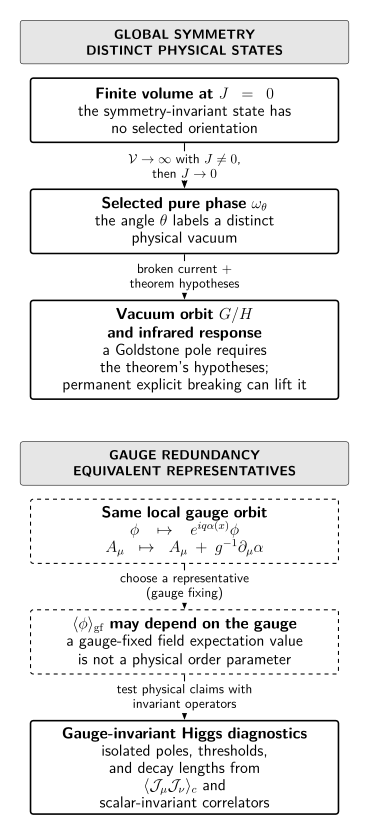
Global symmetry breaking and gauge-Higgs diagnostics follow different logical chains. In the upper chain, at nonzero selector followed by can select a physical vacuum on ; a Goldstone pole is conditional on the current theorem’s hypotheses, and permanent explicit breaking can lift it. In the lower comparison, and lie on one gauge orbit. Gauge fixing can choose a representative, but physical Higgs-like behavior is tested with connected gauge-invariant current and scalar correlators: isolated poles when they exist, and thresholds, decay lengths, or thermodynamic data more generally. The diagram is schematic and not to scale.
Review the chapter
Section titled “Review the chapter”Does a symmetric finite-volume ground state rule out spontaneous breaking in the thermodynamic limit?
Solution
No. The infinite-volume and zero-source limits can fail to commute. A small source held fixed during the volume limit can select a state with a nonzero order parameter that persists when the source is subsequently removed.
Where to go next
Section titled “Where to go next”Continue to Anomalies, Inflow, and Matching for constraints on which symmetry realizations can occur at low energies.