

Majorana Fields and Reality Conditions
A Majorana condition exists when the complex spinor representation admits a Lorentz-equivariant antilinear involution with . Its fixed points form a real spinor representation. In four-dimensional Lorentzian spacetime such a structure exists on the Dirac module, but it exchanges the two Weyl modules. Reality and chirality are therefore different restrictions: no nonzero four-dimensional spinor is simultaneously Majorana and Weyl, even though one complex Weyl field supplies exactly the independent data needed to construct a Majorana field.
This page makes that statement concrete for a free four-dimensional field. It distinguishes the charge-conjugation matrix, the antilinear reality map, the bilinear used in the action, and a possible symmetry of a full theory; derives the factor one-half in the action and the one-family mode expansion; and then states the dimension- and signature-dependent test. Neutrino phenomenology and supersymmetric multiplets remain outside the scope.
Required background. Weyl Fields and Chirality supplies the chiral projectors, the two-component free action, the qualified chirality–helicity comparison, and the particle/antiparticle content of a complex Weyl field.
Helpful background. Spinors, Conjugations, Bilinears, Chirality, and Fierz Identities supplies the reusable distinction among charge-conjugation, hermitizing, and bilinear intertwiners, together with the full dimension/signature workflow.
Charge conjugation defines an antilinear real structure
Section titled “Charge conjugation defines an antilinear real structure”Work first with the proper orthochronous Lorentz group in four-dimensional Minkowski spacetime. We inherit the metric, orientation, Clifford algebra, Dirac adjoint, and from the site conventions. In the preferred basis the hermitizing matrix is and .
Choose a linear charge-conjugation intertwiner with the four-dimensional normalization
The associated charge-conjugate spinor is
These formulas relate three objects that should not be conflated:
- is a linear map from the transpose or dual representation;
- is the matrix part of an antilinear map on spinors;
- , where is componentwise conjugation in the chosen basis, is the basis-independent antilinear operation.
The Clifford relation implies
and hence, for the proper spin representation,
Thus maps a spinor to another spinor with the same Lorentz transformation law. Its square is
In four-dimensional signature the overall normalization of can be chosen so that
Then is an involution, and the Majorana condition is the fixed-point condition
The existence of a matrix satisfying a transposed Clifford identity is not, by itself, enough: the square decides whether a nonzero ordinary fixed subspace exists. Nor does this kinematic spinor map prove that charge conjugation is a symmetry of an interacting Lagrangian.
The free equation is compatible with the condition. For real , let . Then
Therefore implies , so restricting the free solution space to -fixed spinors is dynamically consistent. The four-dimensional construction, action, and charge-conjugation identities are developed in Srednicki 2007, § 36, pp. 226–232. Srednicki uses together with ; since , the complex Clifford algebra agrees. His , so his positive-frequency is the site’s ; his displayed first-order equation differs from the site equation only by an overall minus sign.
The definition is also covariant under a change of gamma basis. If
then the relevant matrices transform as
Consequently and the fixed-point condition survives. Saying that a spinor has “real components” can be true in a specially chosen Majorana basis; it is a realization of this invariant condition, not its definition.
Four-dimensional reality exchanges chirality
Section titled “Four-dimensional reality exchanges chirality”An explicit chiral basis checks every sign. Use the local matrices already introduced on the Weyl page,
with and . One consistent phase choice is
and therefore
Direct multiplication gives
Multiplying and by a common phase changes component formulas but not . The extra normalization reduces that phase freedom to a sign. No physical conclusion below depends on which sign is chosen.
Charge conjugation reverses chirality. The adjoint projector reversal from the Weyl page gives
A left-handed two-component spinor therefore builds the Majorana spinor
in the displayed phase convention. It satisfies but has both left- and right-handed components. Reversing the phase of reverses the lower sign and leaves the invariant statement unchanged.
This also proves the four-dimensional incompatibility. If a spinor were both left-handed and Majorana, then
Thus there is no nonzero Majorana–Weyl spinor in four-dimensional Lorentzian signature. The equality of independent component counts between a complex Weyl field and a Majorana field does not turn the antilinear condition into a chiral projection.
The free action needs a factor one-half
Section titled “The free action needs a factor one-half”The invariant bilinear used in the action is another map. Define
It transforms as , unlike . In the chosen normalization and happen to have the same numerical entries. For a Majorana spinor,
Let be Grassmann odd. The free action is
Equivalently, it is
In four dimensions,
For odd columns , . Varying the action, integrating the second kinetic variation by parts, and using these transpose symmetries makes its two bulk contributions equal. With compactly supported variations, or boundary conditions that kill the flux term,
The outer factor cancels the duplicate variation, leaving the ordinary Dirac equation
The constrained four-component variation and its two-component origin are given in Srednicki 2007, § 37, pp. 237–238, eqs. (37.16)–(37.23).
The factor prevents double counting a constrained field. It does not halve the equation of motion, the excitation energy, or the usual propagator.
Two-component masses expose the pairing
Section titled “Two-component masses expose the pairing”Fix an antisymmetric two-spinor tensor by
For Grassmann-odd fields the antisymmetric spinor contraction is symmetric in field labels:
It is therefore not zero when . A single left-handed field has the Majorana form
Two independent left-handed fields and instead give the Dirac pairing
The Dirac mass is invariant under and . The self-pairing transforms with twice the phase and, for , preserves only the sign from that ordinary phase action. For several fields the Majorana mass matrix is symmetric because only the symmetric part multiplying survives.
The same algebra carries internal representation data. A self-pairing mass requires an invariant tensor with the required symmetry; a field in a generic complex representation cannot acquire it by notation alone. This does not mean every Majorana field is a gauge singlet: real nonabelian representations can admit the necessary pairing. Gauge assignments and neutrino mass models belong downstream. Two-component mass terms and their four-component completions are treated in Schwartz 2014, § 10.6.1 and §§ 11.3–11.4, pp. 178–179 and 192–195.
One operator family supplies both frequency sectors
Section titled “One operator family supplies both frequency sectors”The physical free field makes the reality identification visible. Use the Minkowski Fock representation of the canonical page. Hatted fields and momentum-labelled operators are operator-valued distributions, so the formulas below are interpreted after wave-packet smearing. Let be the vacuum with in that distributional sense, and use the dense finite-particle wave-packet domain for quadratic operators.
Choose compatible phases for the spinors so that
and define
Then
Charge conjugation interchanges the two displayed terms, so the expansion obeys . In a different spin basis, the relation between and can contain a unitary matrix and phases; the one-family statement is invariant even when the simple label-by-label formula changes.
The nonzero mode anticommutator is
After vacuum-relative reordering, the free energy on the stated domain is
The negative-frequency term has not been deleted. Reality identifies its creation operator with the adjoint of the positive-frequency annihilation operator. Equivalently, in a compatible Dirac spin basis the independent particle and antiparticle families are identified. A Majorana field therefore has two spin modes of one self-conjugate particle species, rather than two particle plus two antiparticle modes.
This identification removes the ordinary additive vector charge. It does not remove fermion parity. At , the phase of the equivalent Weyl field appears as a chiral rotation of the four-component Majorana field, not as an independent particle-minus-antiparticle charge. The Majorana mode identification, CAR, Hamiltonian, and absence of the ordinary charge are derived in Srednicki 2007, § 39, pp. 250–251. The full constrained canonical construction and positivity proof remain on Canonical Quantization of the Free Dirac Field.
Grassmann symmetry controls the bilinears
Section titled “Grassmann symmetry controls the bilinears”Self-conjugacy does not make every bilinear vanish. At the level of Grassmann-valued classical fields, the relevant four-dimensional transpose symmetries are
where . Grassmann exchange therefore allows
to be nonzero, while it forces
for one identical field. In particular, the scalar mass does not vanish: the antisymmetry of combines with the anticommutation of the field components.
These statements are exchange identities for Grassmann or operator fields. They must not be applied unchanged to commuting numerical plane-wave spinors. At the quantum level, coincident composite operators also require a regulator and an operator definition. The Majorana construction and four-dimensional bilinear exchange rules are checked independently in Weinberg 2000, Ch. 26 appendix, pp. 107–108, eqs. (26.A.1)–(26.A.8). Weinberg uses with ; the complex map matches the site Clifford sign, while every displayed bilinear symmetry above was verified directly in the site normalization.
Dirac, Weyl, and Majorana reduce data differently
Section titled “Dirac, Weyl, and Majorana reduce data differently”The comparison must say what is being counted. “Off shell” below counts independent real component functions before the equation of motion. “Modes” counts independent one-particle creation modes at fixed nonzero momentum in the free Fock representation.
In the comparison below, inspect the different operations: Weyl projection discards one chirality, whereas Majorana identification reconstructs it antilinearly; the shared real-component count does not make the theories identical.
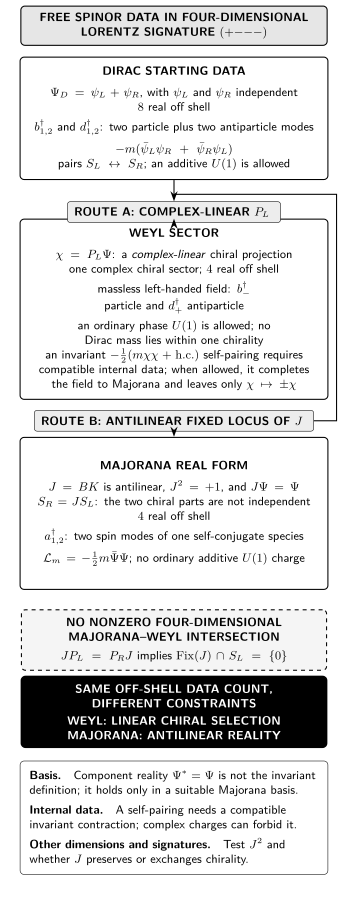
Schematic comparison for free fields in four-dimensional Lorentzian signature. A Dirac field has independent and data. A Weyl description makes a complex-linear chiral selection, whereas a Majorana condition imposes the antilinear identification . The drawing is not a dimension-independent equivalence chart, and an internal invariant pairing is still required for a self-mass.
| Description | Defining data | Real components off shell | Creation modes at fixed momentum | Mass and ordinary phase |
|---|---|---|---|---|
| Dirac | Independent left and right sectors | 8 | Two particle spins plus two antiparticle spins | A Dirac mass pairs the sectors and can preserve an additive U(1) |
| Complex Weyl | One complex chiral sector | 4 | One particle helicity plus the opposite antiparticle helicity when massless | The massless phase is allowed; a two-component self-pairing needs compatible internal data, breaks that ordinary phase to the sign, and gives a Majorana completion |
| Majorana | Right sector fixed as the charge conjugate of the left | 4 | Two spin or helicity modes of one self-conjugate species | A factor-one-half self-mass is allowed when an invariant pairing exists; no ordinary additive U(1) |
The equal number four in the last two rows has different meaning. A Weyl condition is complex linear and discards one chiral module. A Majorana condition is antilinear and relates the two modules. In the massless theory the same independent data can be packaged either as one complex Weyl field or as a self-conjugate four-component field, but the four-component field is not itself chiral.
Dimension and signature decide which reality condition exists
Section titled “Dimension and signature decide which reality condition exists”The four-dimensional result is not universal. For a complex spin module in a chosen real form, first find a Spin-equivariant antilinear map . Two tests then control the ordinary names:
- If , has a real fixed subspace and an ordinary Majorana condition is possible.
- If , no nonzero spinor satisfies . A symplectic Majorana condition can become possible only after adding an internal doublet with another quaternionic structure.
- In even dimension, means reality preserves each chiral module, so Majorana–Weyl can be possible.
- If , reality exchanges the two chiralities, as it does in four-dimensional Lorentzian signature.
Selected examples illustrate the test without replacing the full periodic classification:
| Quadratic space | Reality test | Consequence |
|---|---|---|
| Lorentzian | and exchanges the Weyl modules | Majorana exists; nonzero Majorana–Weyl does not |
| Euclidean | Each Weyl module is quaternionic | No ordinary single-spinor Majorana condition; symplectic reality requires doubling |
| Lorentzian | A real structure can preserve chirality | Majorana–Weyl spinors can exist |
Here counts positive and negative directions, so the site uses . The arbitrary-signature classification used here is inherited from Spinors, Conjugations, Bilinears, Chirality, and Fierz Identities, whose exact structural authorities are Deligne 1999, Table 1.4.1, printed p. 103, PDF and Van Proeyen 1999/2016, §§ 3.2–3.3 and Tables 1–2. Van Proeyen writes and organizes the table by ; for the site convention , , and therefore . His left/right words must also be translated by chirality eigenvalue rather than copied.
An independent Lorentzian check is supplied by Weinberg 2000, Ch. 32 appendix, pp. 403–406. That source treats one-time Lorentzian signature, so it supports the Lorentzian examples but not the Euclidean row by itself.
Finally, a real structure for the Spin representation is not automatically a module structure for the full real Clifford algebra. In four-dimensional signature the Majorana fixed subspace is preserved by the proper spin group even though individual gamma matrices need not preserve that real subspace. This distinction prevents an apparent contradiction between Spin-module and real-Clifford tables.
Common pitfalls
Section titled “Common pitfalls”Defining Majorana spinors by real components. Componentwise conjugation is basis dependent. The invariant definition is a Lorentz-equivariant antilinear involution and its fixed subspace; a Majorana basis merely turns that involution into ordinary component conjugation.
Treating , , , and as one matrix. They are related but have different source and target spaces, linearity, and basis-transformation laws. They can share numerical entries only after additional convention choices.
Calling a four-dimensional Majorana field Weyl. One complex Weyl spinor constructs a Majorana field, but charge conjugation supplies the opposite chirality. The resulting four-component field is self-conjugate, not chiral.
Deleting the negative-frequency term. Self-conjugacy identifies the two operator families; it does not remove the creation term. A local Majorana field still has both frequency sectors and two physical spin or helicity modes.
Saying that a Majorana field has no continuous symmetry in every limit. It has no ordinary additive vector phase. At zero mass, the equivalent Weyl phase is represented as a chiral rotation, while a nonzero self-mass breaks that rotation.
Equating self-conjugacy with complete gauge neutrality. A nonzero ordinary abelian charge is incompatible with one self-conjugate field, but a real nonabelian representation can support Majorana fields. The invariant internal pairing must be checked.
Claiming that the scalar mass vanishes. The scalar bilinear uses an antisymmetric spinor matrix and Grassmann-odd components. The two minus signs make the bilinear nonzero rather than zero.
Wick rotating the Lorentzian condition unchanged. Changing signature changes the real form and can change . Recompute the intertwiner instead of carrying “real components” through an analytic continuation.
Check your understanding
Section titled “Check your understanding”Check 1: square the charge-conjugation map
Section titled “Check 1: square the charge-conjugation map”Starting from , compute and state the condition for an ordinary Majorana fixed subspace.
Solution
Antilinearity conjugates the first matrix:
Thus the map is an involution precisely when . If instead , the equation would imply , so the only ordinary fixed spinor is zero.
Check 2: exclude a four-dimensional Majorana–Weyl spinor
Section titled “Check 2: exclude a four-dimensional Majorana–Weyl spinor”Assume , , and . Use chirality exchange to determine .
Solution
Because ,
The contradiction is specific to a reality map that exchanges chirality. When a different dimension and signature give , the same argument does not apply.
Check 3: show why the Majorana mass is nonzero
Section titled “Check 3: show why the Majorana mass is nonzero”Let for Grassmann-odd two-component fields. Show that this contraction is symmetric in .
Solution
Exchange the fields, use their anticommutation, and then interchange the two spinor indices:
The antisymmetric epsilon tensor and the Grassmann exchange supply two minus signs. Hence need not vanish, and only a symmetric flavor mass matrix contributes.
Where the distinction is used next
Section titled “Where the distinction is used next”- Canonical Quantization of the Free Dirac Field supplies the full CAR, Fock-vacuum, domain, and positivity construction used by the mode specialization here.
- Dirac, Majorana, and Seesaw Neutrino Masses develops gauge-invariant neutrino masses, lepton-number questions, and seesaw phenomenology.
- Supersymmetry Across Dimensions, Signatures, and Reality Conditions develops the full classification of supercharge reality conditions.
- Massive and Massless Unitary Supermultiplets develops the resulting supersymmetric particle multiplets.
- Fermion Signs and Closed Loops develops interacting Majorana-flow conventions and closed-loop sign rules.
References
Section titled “References”- Deligne, Pierre. “Notes on Spinors.” In Quantum Fields and Strings: A Course for Mathematicians, pp. 99–135. American Mathematical Society, 1999. Official IAS publication record; Open PDF.
- Schwartz, Matthew D. Quantum Field Theory and the Standard Model. Cambridge University Press, 2014. DOI.
- Srednicki, Mark. Quantum Field Theory. Cambridge University Press, 2007. DOI.
- Van Proeyen, Antoine. Tools for Supersymmetry. arXiv:hep-th/9910030v7. Originally submitted 1999; version 7 revised 2016. arXiv.
- Weinberg, Steven. The Quantum Theory of Fields. Volume III: Supersymmetry. Cambridge University Press, 2000. DOI.