

Haag’s Theorem: Physical Meaning and Scope
Haag’s theorem does not say that interacting quantum field theories are impossible. In a bounded four-dimensional scalar version, it says that a genuinely interacting continuum field cannot be related to a free field by one global unitary identification of the complete sharp-time canonical algebra while both theories also retain the theorem’s irreducibility, vacuum, Poincaré-covariance, positive-spectrum, locality, and domain assumptions. If all of those premises hold, the candidate “interacting” field is forced to be free. Practical constructions remain consistent by changing a named premise rather than by refuting the implication.
Required background. Fock Space, Vacuum, and Particle Number supplies the free vacuum representation and the representation dependence of particle number. Regulators, Cutoffs, and Continuum Limits distinguishes a finite-regulator construction from its continuum limit. Hilbert Positivity and Unitary Evolution separates a physical positive Hilbert space from auxiliary indefinite descriptions and states what unitary evolution preserves.
Helpful background. Canonical–Functional Crosswalk for Regulated Systems shows that even a free canonical–functional equivalence requires matched regulators, states, boundaries, orderings, and domains.
The fixed-time comparison that triggers the theorem
Section titled “The fixed-time comparison that triggers the theorem”Consider two neutral Hermitian scalar field systems in -dimensional Minkowski spacetime. The comparison field is free with mass on a Hilbert space ; is a candidate interacting field on . Use spatial test functions so that the sharp-time fields and conjugate momenta below mean spatially smeared operators on stated invariant dense domains. When a common index is useful, set and let .
A deliberately bounded canonical Hall–Wightman version, supplemented by the local Wightman hypotheses used below, assumes:
- and are local covariant operator-valued tempered distributions in positive physical Hilbert spaces. Each theory has its own common invariant dense domain for the field products used below, together with well-defined sharp-time fields and conjugate momenta.
- Each theory carries a strongly continuous unitary representation of the connected Poincaré group, has joint translation spectrum in the closed forward cone, and has a cyclic Poincaré-invariant vacuum or . The sharp-time and transform covariantly under the spatial translations and rotations implemented by that representation. In the stated sufficient version, the vacuum is also the unique normalizable vector invariant under this spatial Euclidean subgroup.
- At , each jointly represented field–momentum pair obeys the equal-time canonical commutation relations and is irreducible: the bounded commutant of the joint algebra generated by all and is .
- At that time, one global unitary satisfies and intertwines both canonical fields.
For real Schwartz test functions, the equal-time relations are, on the declared domains,
The unitary identification is
Under this deliberately strong, source-matched Hall–Wightman package, intertwines the spatial Euclidean symmetries and maps the vacua up to phase. Hall and Wightman then obtain equality of the first four vacuum functions; in particular, the two-point functions coincide. Appending the Jost–Schroer free-field criterion forces to be a free scalar field of the same mass. Thus a nontrivial interacting field cannot satisfy every premise at once Hall and Wightman 1957, § 3, printed pp. 35–39 (PDF), Klaczynski 2016, arXiv v1, § 11.4, Theorem 11.6, printed pp. 48–49 (PDF).
The canonical time-zero assumptions are stronger than the Wightman axioms, which do not themselves impose canonical commutation relations or guarantee sharp-time momenta. They are stated here because they make the role of irreducibility mathematically sound: the commuting equal-time scalar fields alone cannot form an irreducible family on a nontrivial Hilbert space. A field-only corollary instead has to assume the vacuum mapping explicitly, or invoke a different theorem-specific hypothesis package; it must not silently replace joint field–momentum irreducibility by irreducibility of the commuting field family.
The theorem concerns this operator representation, not the bare fact that and are abstractly isomorphic Hilbert spaces. An arbitrary unitary isomorphism need not intertwine the fields, symmetry representations, vacua, domains, or local algebras.
The hypothesis map and its altered-premise branches
Section titled “The hypothesis map and its altered-premise branches”The figure should be read as an implication with side exits. Follow the central arrows to see how a global sharp-time intertwiner becomes a free-field conclusion; then inspect which exact premise is replaced in finite-regulator, finite-volume, asymptotic, and formal perturbative settings.
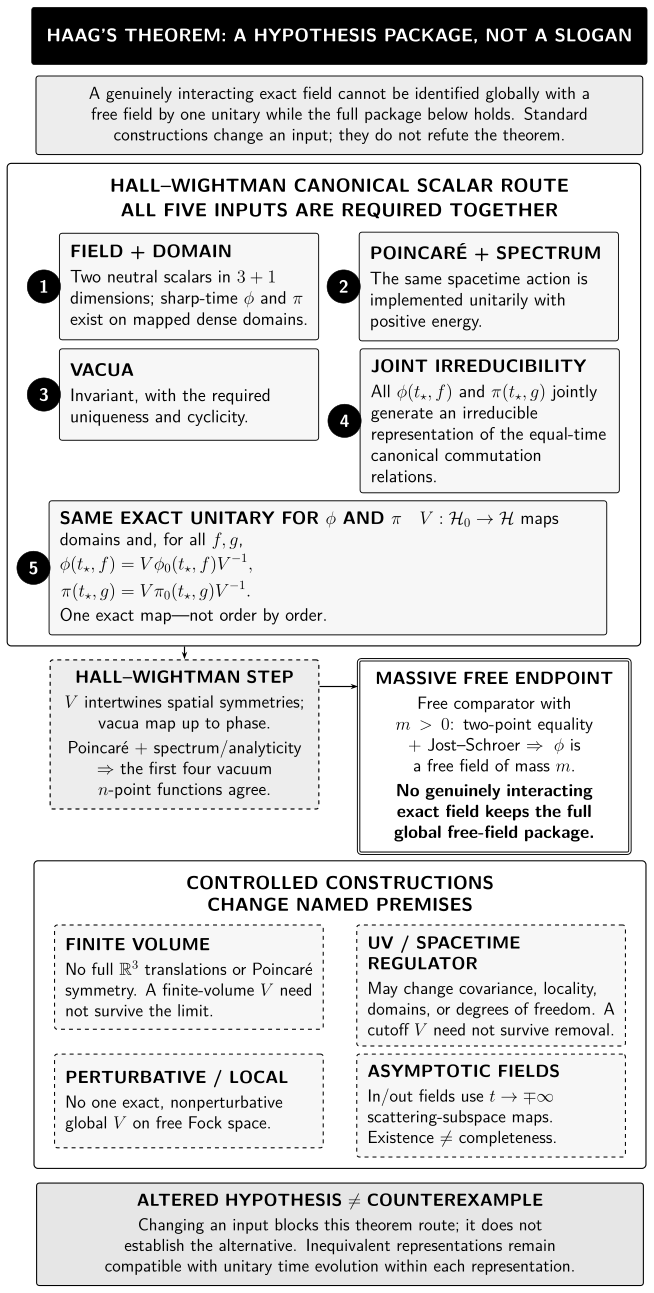
Haag’s obstruction is conditional. For the displayed positive-metric massive scalar theorem, a global unitary equivalence of the complete sharp-time field–momentum representation combines with its joint irreducibility, the unique vacuum, covariance, and the spectrum condition to give the free-field two-point function and hence a free field. Regulated models, finite volume, asymptotic limits, and formal perturbative series leave this implication intact while changing its premises. The map is schematic and not a proof or a dimension-independent theorem.
The following table is the complete nonvisual version of that map.
| Input or branch | Role in the bounded theorem | What follows or changes | What must not be inferred |
|---|---|---|---|
| Sharp-time canonical fields and domains | Make both all-test-function operator identities meaningful at one time | The same complete field–momentum set is compared | Equality of a few matrix elements or formal symbols |
| One global unitary | Intertwines the represented field and momentum on the mapped domains | Equal-time vacuum correlations can be compared | Any abstract Hilbert-space isomorphism has this property |
| Irreducibility | The joint field–momentum commutant makes the discrepancy between the two spatial symmetry actions a scalar | The same unitary intertwines the spatial Euclidean subgroup | A reducible representation has the same conclusion without further work |
| Unique invariant vacuum | Identifies the vacuum carried across by the intertwiner, up to phase | Equal-time vacuum expectation values agree | Degenerate phases are automatically fixed by the theorem |
| Poincaré covariance and positive spectrum | Extend spacelike equality through Lorentz covariance and analytic uniqueness | The candidate and free two-point distributions agree | Spatial covariance alone supplies the relativistic conclusion |
| Local Wightman field package | Supplies distributional control, cyclicity, and the hypotheses of free-field rigidity | The candidate field is free with the same mass | The same statement covers gauges, massless fields, or other dimensions unchanged |
| Finite ultraviolet and infrared regulator | Replaces the continuum representation and generally breaks exact boosts or locality assumptions | An exact regulated interaction picture may exist | Its unitary has a global continuum limit |
| Finite volume alone | Changes global spacetime symmetries but can leave infinitely many modes | The stated Poincaré theorem no longer applies directly | Finite volume automatically means finitely many degrees of freedom |
| Asymptotic in and out fields | Replace finite-time field equality by large-time limiting relations | Free asymptotic particle descriptions and scattering may survive | The interacting field is globally the free field at finite time |
| Formal perturbation theory | Works order by order in a formal-series or regulated category | Renormalized coefficients and controlled approximations can be meaningful | The formal Dyson operator is a convergent global unitary on the continuum Hilbert space |
From equal-time equivalence to free-field rigidity
Section titled “From equal-time equivalence to free-field rigidity”The proof architecture is short to state but theorem-level in its analytic and domain details.
1. Intertwine the spatial symmetries. Spatial translations and rotations act covariantly on both sharp-time canonical pairs. Conjugating one action through and comparing it with the other gives an operator commuting with the jointly irreducible field–momentum algebra. It is therefore a scalar phase; group continuity and normalization remove that phase in the standard formulation.
2. Identify the vacuum. The vector is invariant under the second spatial Euclidean action. Uniqueness of the normalizable invariant vacuum then gives
Consequently the two theories have the same equal-time vacuum correlations. This is where irreducibility and vacuum uniqueness do real work; neither is decorative.
3. Use relativistic covariance. For two points with spacelike difference, a proper orthochronous Lorentz transformation places them on one equal-time hyperplane. Scalar covariance therefore extends equality of the two-point functions from equal time to all spacelike separations.
4. Use the spectrum condition. Positive energy makes the two-point distributions boundary values of analytic functions in a tube domain. Analytic uniqueness extends their equality from the spacelike region to the full distributional boundary.
5. Invoke free-field rigidity. The Jost–Schroer theorem says, in this massive scalar Wightman setting, that a field with the free two-point function is itself a free field of that mass. A complete proof must control the domains, analytic continuation, and reconstruction step; this page records the logic rather than reproducing it.
Hall and Wightman’s first step uses the canonical time-zero package to derive the spatial-symmetry and vacuum mapping. Their relativistic step adds full covariance and absence of negative energy and proves equality of the first four vacuum expectation values. The later Jost–Schroer criterion supplies the sharper “the candidate field is free” endpoint used here. The conclusion therefore combines two named results; unitary equivalence alone does not supply it.
What the obstruction means for the interaction picture
Section titled “What the obstruction means for the interaction picture”The exact interaction-picture slogan posits a unitary family relating a free field to the interacting Heisenberg field,
with the equalities understood for the complete canonical representation and its domains. At any chosen , the unitary supplies the theorem’s sharp-time comparison. If both sides also satisfy the remaining continuum hypotheses and is free, the conclusion says that cannot be genuinely interacting.
The accurate lesson is therefore narrower than “the interaction picture is nonsense.” A single exact global unitary cannot simultaneously do this job in the nontrivial continuum theory under the displayed hypotheses. A cutoff Dyson operator, a formal time-ordered exponential, a local algebraic comparison, or a large-time wave operator is a different mathematical object. Perturbative calculations can remain predictive without converging to the forbidden global unitary. Modern discussions emphasize precisely this distinction between the theorem and the calculational frameworks used in renormalized QFT Earman and Fraser 2006, §§ 3–6, manuscript pp. 8–22 (open preprint), Klaczynski 2016, arXiv v1, § 17, printed pp. 68–71 (PDF).
First application: diagnose the changed premise
Section titled “First application: diagnose the changed premise”A combined ultraviolet and infrared regulator. A finite lattice with finitely many sites, or a finite box plus a finite mode cutoff, has finitely many canonical degrees of freedom. Regular irreducible representations of the finite-dimensional Weyl CCR are then unitarily equivalent; when the regulated free and interacting Hamiltonians generate well-defined unitary dynamics, an exact regulated interaction picture can be defined. But exact continuum Poincaré covariance, the continuum local field algebra, or both have been replaced. The decisive question is whether the regulated observables converge—not whether the cutoff unitary exists. Its limit may fail even when every finite-cutoff is unitary Klaczynski 2016, arXiv v1, § 5.2, printed pp. 20–21 (PDF).
Finite volume without a UV cutoff. Compactifying space removes exact boosts and changes the global symmetry group, so the displayed Poincaré theorem does not apply verbatim. It does not necessarily reduce the field to finitely many modes: a continuum field in a box still has an infinite tower. “Finite volume” and “finite-dimensional canonical system” are not synonyms Earman and Fraser 2006, § 4, manuscript pp. 12–15 (open preprint).
Asymptotic fields. Scattering theory compares the interacting theory with free in and out fields through limits as or . Those fields encode asymptotic particles; they are not asserted to equal the interacting local field at one finite time by a global unitary on the full interacting representation. Existence of the wave operators, their ranges, and asymptotic completeness are separate questions. Haag’s theorem therefore does not remove the conceptual basis of LSZ-style scattering Buchholz and Dybalski 2024, §§ 1–3, manuscript pp. 1–6 (PDF).
Formal or perturbative constructions. A Dyson series can be an order-by-order algebraic object, often with switching functions and regulator-dependent counterterms. Equality in a formal power-series algebra is not equality of bounded operators, and “unitary order by order” is not a proof that a unitary exists after summation and regulator removal. The theorem blocks an unqualified operator interpretation; it does not erase the calculated coefficients or their controlled physical predictions Fredenhagen and Rejzner 2013, §§ 1–2 and 6–7, manuscript pp. 3–8 and 25–34 (PDF).
Direct interacting representations. Constructive and local-algebraic approaches can define the interacting theory without placing it globally in the free vacuum representation. Local algebras may admit useful local comparisons even when the global representations are inequivalent Earman and Fraser 2006, § 5, manuscript pp. 18–19 (open preprint). This is consistent with the theorem: the forbidden premise is the single global sharp-time intertwiner with the rest of the package intact.
What Haag’s theorem does not say
Section titled “What Haag’s theorem does not say”It is not a nonexistence theorem for interacting QFT. It excludes a conjunction of representation and symmetry assumptions. Removing one premise makes this implication unavailable; it does not prove that no interacting construction exists.
It is not a proof that perturbation theory is inconsistent. It warns against reading a regulated or formal interaction picture as an already-constructed continuum unitary equivalence. Order-qualified renormalized predictions require their own error and existence statements.
It is not merely the statement that infinite systems have many representations. Inequivalent representations are the practical resolution, but the theorem’s force comes from the complete hypothesis chain. Conversely, inequivalent representations need not always represent physically distinct theories.
It does not forbid every use of free-field language. Asymptotic fields, quasiparticle expansions, effective fields, Gaussian reference states, and finite-cutoff bases can all be useful when their status is declared.
It does not cover every field class without revision. The theorem stated here is massive, scalar, positive-metric, flat-spacetime, and Wightman-style. Massless infrared sectors, gauge-fixed fields, indefinite auxiliary spaces, curved backgrounds, boundaries, lower dimensions, and nonlocal fields require separate variants.
Historically, Haag isolated the global representation problem while examining whether the Dyson matrix could exist in a relativistic field theory Haag 1955, Chapter III § 4, printed pp. 30–32 (PDF). Hall and Wightman completed and generalized the argument using their invariant-analytic-function theorem. The historical sequence is another reason to state the exact version instead of citing “Haag’s theorem” as a slogan.
Check your understanding
Section titled “Check your understanding”1. Why is an abstract unitary isomorphism insufficient?
Answer
The theorem requires one unitary to intertwine every sharp-time smeared field and conjugate momentum on the mapped domains and, through the other hypotheses, the relevant symmetry and vacuum structures. An arbitrary Hilbert-space isomorphism need not preserve any of those data.
2. Why can a finite-cutoff interaction picture exist without contradicting Haag’s theorem?
Answer
The regulator changes the represented algebra and usually exact continuum covariance or locality. With both UV and IR cutoffs there may be only finitely many canonical degrees of freedom. The theorem’s full continuum premise package is absent, and the existence of each regulated unitary says nothing by itself about a global continuum limit.
3. Which steps fail if the spectrum condition is removed?
Answer
Equal-time and spacelike comparisons may still be written, but the positive-energy tube analyticity used to extend equality to the full two-point distribution is no longer licensed. The Jost–Schroer endpoint cannot be reached by this proof route.
4. Why do asymptotic free fields survive the obstruction?
Answer
They arise from large-time limits and act on a declared scattering space. The theorem instead assumes a global finite-time unitary intertwining the complete sharp-time field–momentum representation. Wave-operator existence and asymptotic completeness are additional scattering claims.
Where the proof and variants continue
Section titled “Where the proof and variants continue”- Haag-Theorem Variants, Domains, and Proposed Evasions develops theorem variants and diagnoses exactly which domains and hypotheses are changed.
- Haag’s Theorem and Inequivalent Representations gives the theorem-first representation analysis.
- Interacting Fields, Asymptotic Observables, and Effective Descriptions is the next synthesis: it organizes the free-field structures that remain useful after the global unitary premise is withdrawn.
References
Section titled “References”- Buchholz, Detlev, and Wojciech Dybalski. “Scattering in Relativistic Quantum Field Theory: Basic Concepts, Tools, and Results.” arXiv:math-ph/0509047v3, revised 2024 (originally submitted 2005). Stable record. Open PDF, v3.
- Earman, John, and Doreen Fraser. “Haag’s Theorem and Its Implications for the Foundations of Quantum Field Theory.” Erkenntnis 64 (2006): 305–344. DOI. Open preprint.
- Fredenhagen, Klaus, and Katarzyna Rejzner. “Perturbative Algebraic Quantum Field Theory.” In Mathematical Aspects of Quantum Field Theories, edited by Damien Calaque and Thomas Strobl, 17–55. Springer, 2015; arXiv v2 revised 2013. DOI. Open PDF, v2.
- Haag, Rudolf. “On Quantum Field Theories.” Det Kongelige Danske Videnskabernes Selskab, Matematisk-fysiske Meddelelser 29, no. 12 (1955): 1–37. Open PDF.
- Hall, D., and A. S. Wightman. “A Theorem on Invariant Analytic Functions with Applications to Relativistic Quantum Field Theory.” Det Kongelige Danske Videnskabernes Selskab, Matematisk-fysiske Meddelelser 31, no. 5 (1957): 1–41. Open PDF.
- Klaczynski, Lutz. “Haag’s Theorem in Renormalised Quantum Field Theories.” arXiv:1602.00662v1 [hep-th] (2016). Stable record. Open PDF, v1.