

Massive and Massless Spin-One Polarizations
For a nonzero future-directed momentum, a massive Proca polarization is an ordinary vector in the three-dimensional space orthogonal to a timelike momentum. A photon polarization also begins in a three-dimensional orthogonal space, but a null momentum lies inside its own orthogonal space and supplies a pure-gauge direction. Quotienting that direction leaves two helicities. The massive longitudinal vector grows like at fixed nonzero spatial momentum, so neither it nor the massive completeness tensor has a finite componentwise limit, even though transverse modes and conserved-current contractions can approach the photon result smoothly.
Required background. The Proca Field supplies the massive mass shell, equation-derived transversality, three-mode count, and longitudinal scaling. The Free Maxwell Field and Gauge Redundancy supplies the null mass shell, gauge equivalence of polarization representatives, and the two-mode quotient.
Helpful background. Bilinear and Hermitian Forms, Adjoints, and Isometries supplies Lorentz-signature orthogonality and orthonormal bases. Normal Forms, Spectra, and Projectors supplies basis-independent projector language.
A timelike momentum has three orthogonal polarizations
Section titled “A timelike momentum has three orthogonal polarizations”Work in four-dimensional Minkowski space and consider nonzero on-shell momenta, away from boundary, topology, and zero-mode complications. For a positive-frequency plane wave,
the polarization vector is the coefficient . Complex coefficients are convenient for helicity; a real classical field includes the corresponding complex-conjugate mode. Proca theory has no gauge equivalence among these coefficients.
Choose a massive momentum along the positive -axis,
The three vectors
obey
For the nontrivial third vector,
Thus is a three-dimensional negative-definite space, and every one of its directions is physical. At , where a direction is undefined, the rest-frame basis for gives the same count. Schwartz 2014, § 8.2.2, p. 117 constructs this fixed-frame basis and checks its transversality and normalization.
The basis-independent map onto is the mixed-index projector
Because , it satisfies
Orthonormal completeness instead gives the two-lowered-index tensor
These objects differ by a sign after raising one index:
So the polarization sum itself is not an idempotent mixed-index projector. In the rest frame, , an immediate sign and rank check. Weinberg 1995, § 5.3, pp. 210–212 derives the massive spin-one sum using a mostly-plus metric; reversing the metric changes his to the displayed , while its rank remains three.
A null momentum contains its own gauge direction
Section titled “A null momentum contains its own gauge direction”Now take
The source-free Maxwell equation requires . A general solution therefore has the form
Unlike the massive case, implies . The plane-wave gauge equivalence
can set to zero without changing or . The physical polarization space is consequently
with convenient representatives
The quotient is more than a count. If , then
because every additional term contains either or . The Lorentz form therefore descends to a negative-definite form on . The field-strength amplitude
is likewise unchanged by the shift. These are the invariant reasons that the direction is removed rather than counted as a third photon. Schwartz 2014, §§ 8.2.3–8.2.4, pp. 118–120 develops the pure-gauge direction, the two transverse representatives, and the three-versus-two comparison.
After complexifying the two-dimensional space, define
For the active-rotation convention , these have helicities . A real Maxwell field pairs each positive-frequency helicity amplitude with its complex-conjugate negative-frequency mode. This does not mean that the massless little group has one real two-dimensional irreducible representation: the two complex finite-helicity sectors are separate.
Massless completeness needs a reference vector
Section titled “Massless completeness needs a reference vector”A covariant tensor that selects two representatives cannot be built from the null momentum alone. Indeed, a mixed tensor made only from and has the form . Requiring it to annihilate forces , after which its trace is zero rather than two.
Introduce an auxiliary vector with , and choose representatives satisfying
The mixed-index projector onto this two-plane is
Direct contraction gives
Because and the two-plane is negative definite, orthonormal completeness gives . The associated polarization sum is
Again . For the fixed frame above and , the lowered-index tensor is , exactly the sum of and . Its spatial part is the familiar transverse sum derived in Srednicki 2007, § 55, p. 337.
Changing changes the representatives and adds terms containing or ; it does not create another physical direction. In particular, for a conserved current ,
so the reference-dependent terms vanish. The formula is a completeness relation for chosen potential representatives, not a gauge-invariant tensor identity independent of auxiliary data.
The little groups encode the same distinction
Section titled “The little groups encode the same distinction”The little group is the subgroup of Lorentz transformations that preserves a standard momentum. For timelike momentum it is , or on the quantum-state cover. The negative-definite space carries the three-dimensional spin-one representation, matching the three vectors .
For nonzero null momentum the little group is . In a finite-helicity representation its translation-like subgroup acts trivially on physical states; on potential representatives, the corresponding action can appear as a shift proportional to , precisely the gauge direction quotiented above. Schwartz 2014, § 8.4.2, pp. 126–128 exhibits this little-group shift of the potential and its gauge interpretation. The remaining rotation labels the one-dimensional complex helicity classes and . Weinberg 1995, § 2.5, pp. 68–74 derives the massive and massless little groups and the finite-helicity condition. Representations with nontrivial translation action are outside this free Proca–Maxwell comparison.
The schematic makes the change in physical polarization space visible: inspect the dashed null direction and the different projector traces, then compare the fixed-momentum limit at the bottom.
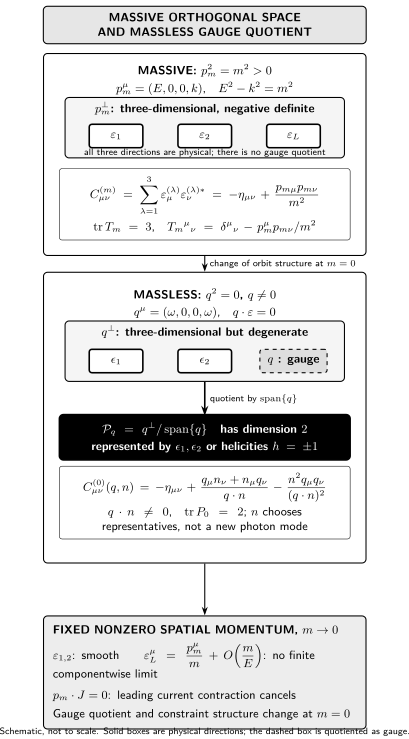
Schematic, not to scale. For , all three directions in are physical and . For , the direction lies inside but is pure gauge, so has dimension two and . The displayed completeness tensors have both indices lowered and become the negatives of the corresponding mixed-index projectors after raising one index. The limit statement assumes a fixed nonzero spatial momentum and, for current decoupling, .
The massless limit is conditional
Section titled “The massless limit is conditional”Follow an on-shell family with fixed , , and
The normalized longitudinal vector obeys the exact identity
The first term diverges componentwise like , while the second is . The norm nevertheless remains because its finite value comes from cancellations among divergent components. The transverse vectors can be held fixed and have smooth limits, but inherits the singular term.
Now let be a nonsingular family of currents satisfying . Current conservation removes the leading term:
The full massive sum gives the sharper check
If the current and held-fixed couplings approach finite limits, this contraction can match the massless conserved-current contraction. Weinberg 1995, § 5.3, p. 212 shows the same longitudinal decoupling in a mostly-plus convention. Zinn-Justin 2021, § 21.2, p. 510 provides an independent Euclidean conserved-current check; only the algebraic current-conservation cancellation is used here, so no Euclidean polarization norm is imported.
This conditional smoothness does not identify the two state spaces. At , a gauge quotient appears, the constraint class changes, and the longitudinal Proca state is absent from the photon spectrum. A nonconserved current, a current that itself grows as , or an interaction whose couplings scale singularly can retain the or behavior. Nor can one hold the massive rest frame fixed and reach a nonzero null momentum.
What the comparison establishes
Section titled “What the comparison establishes”The three-versus-two result has three mutually consistent forms:
- geometrically, is a three-dimensional physical space, whereas must be quotiented by its null direction;
- algebraically, the projectors have traces three and two; and
- representation-theoretically, massive spin one is an triplet while the finite-helicity photon carries the two helicity classes of the massless little group.
The spacelike Lorentz normalization is not a negative Hilbert-space norm. It records the sign of a spacelike four-vector; positivity of physical quantum states is a separate statement.
The next pages use these results in different ways. Maxwell Constraints as a Worked Application derives the two-mode count from canonical reduction. Physical-Mode Quantization of the Free Electromagnetic Field turns the two transverse representatives into photon oscillators, while Covariant Free-Photon Quantization and Propagator explains why a covariant potential description contains auxiliary components. Spinor representatives for null momenta belong to Spinor-Helicity Variables, and interacting high-energy longitudinal scattering belongs to Longitudinal Vector Bosons and the Equivalence Theorem.
Common pitfalls
Section titled “Common pitfalls”Calling the lowered-index polarization sum a projector. The actual idempotent maps are and . Raising one index on either polarization sum gives the negative of the corresponding projector.
Setting in the massive completeness relation. The term has no such componentwise limit. Contract first with the declared observable and use current conservation only when it is genuinely available.
Counting the null momentum as a third photon. It solves because , but it produces zero field strength and is removed by the gauge quotient.
Treating the reference vector as physical. The vector selects potential representatives. Conserved-current contractions eliminate its contribution; a generic gauge-dependent tensor component need not.
Check your understanding
Section titled “Check your understanding”- Verify that and .
Solution
Write . Squaring produces . Its trace is .
- For , show explicitly that the gauge quotient leaves two normalized representatives.
Solution
Transversality gives . Choosing sets to zero. An orthonormal basis for the remaining classes is and , each with norm and mutual inner product zero.
- Derive the exact decomposition of and test it against a conserved current.
Solution
Subtract from . Since , the difference is . Contracting with removes and leaves a term of order for a nonsingular current family.
References
Section titled “References”- Schwartz, Matthew D. Quantum Field Theory and the Standard Model. Cambridge University Press, 2014. DOI.
- Srednicki, Mark. Quantum Field Theory. Cambridge University Press, 2007. DOI.
- Weinberg, Steven. The Quantum Theory of Fields. Volume I: Foundations. Cambridge University Press, 1995. DOI.
- Zinn-Justin, Jean. Quantum Field Theory and Critical Phenomena. 5th ed. Oxford University Press, 2021. DOI.