

Free-Field OPE Preview and Further Developments
A free-field operator-product preview has two logically separate steps. Wick’s theorem first isolates the exact singular c-number contraction of a separated product; a local Taylor expansion of the remaining free Wick bilocal then organizes its short-distance matrix elements into Wick composites and derivatives. This supplies the vocabulary of coefficient distributions, local bases, scaling order, truncation, and remainder. It does not define interacting renormalized operators, prove convergence, or supply the conformal or theorem-level versions of the OPE.
Required background. Coincident Products and Contact Terms supplies the distinction between a separated product and an extension through a diagonal. Wick’s Theorem and Free Gaussian Factorization supplies the contraction and normal-product decomposition.
Helpful background. Products, Scaling Degree, and Extensions of Singular Distributions supplies the extension test for singular coefficients. Singular Support and Wavefront Sets supplies the microlocal language for restrictions and products.
A free bilocal product separates its singular contraction
Section titled “A free bilocal product separates its singular contraction”Fix a centered real massless free scalar in four-dimensional Minkowski space, its vacuum , and vacuum normal ordering . We use the Wightman ordering throughout this calculation. Let be the base point, smeared with a compactly supported test function , and let be the relative separation. Vacuum translation invariance makes the contraction depend only on ; it does not erase the -dependence of matrix elements between arbitrary states.
The positive-frequency two-point distribution is
At separated points, and more precisely as a bilocal operator-valued distribution on the free finite-particle domain,
This equality is exact. The contraction contains the short-distance and light-cone singularities; the vacuum-normal bilocal has smooth matrix elements at on the test-function-generated finite-particle domain. Schwartz gives the time-ordered two-field split and the all-pairings theorem in Schwartz 2014, §§ 7.A.1–7.A.2, pp. 101–103; the displayed Wightman split follows from the same creation–annihilation normal-order algebra with the ordered vacuum contraction . The chapter overview used the time-ordered counterpart, obtained by replacing the product by and by . Those are different orderings, and the rest of this page keeps the Wightman choice fixed.
Wick composites give the first local terms
Section titled “Wick composites give the first local terms”Only the smooth normal-product factor is Taylor expanded. Through second order,
Leibniz’s rule for the free Wick square gives
Combining the exact Wick decomposition with the local Taylor jet therefore gives the first free short-distance terms
For this base-point choice and descendant basis, the factor is fixed by Leibniz’s rule: the Taylor term contains one differentiated field, whereas differentiates either of two identical factors. Expanding about the midpoint removes the odd term, and a different descendant basis can reshuffle its coefficient.
More generally, for any fixed finite ,
This raw Taylor basis is intentionally not reduced by equations of motion or total derivatives. Such reductions depend on whether one is comparing local insertions, integrated functionals, or on-shell matrix elements, as explained in Local versus Integrated Operator Redundancies.
Wick’s theorem and the OPE do different jobs
Section titled “Wick’s theorem and the OPE do different jobs”A second free check makes the distinction visible. At , Wick’s theorem gives the exact combinatorial identity
There are two complete cross-pairings and four single cross-contractions. That counting is Wick factorization. The OPE step comes afterward: expand each remaining normal bilocal or multilocal factor in local Wick composites, and order the result by its behavior as .
This calculation is also a bounded historical checkpoint, not a modern convergence theorem. Wilson formulated the short-distance expansion weakly in matrix elements and displayed this free-scalar Wick/Taylor example in Wilson 1969, §§ II–III, pp. 1500–1502. Weinberg’s later account identifies Wilson’s 1969 work as the beginning of the systematic study of operator-product expansions in Weinberg 1996, ch. 20 opening, p. 252.
The distinction matters at the diagonal. In this Wightman example, the one-sided wavefront-set structure makes a canonical distribution even though it has scaling degree four. That does not make every collision harmless: pulling the resulting multipoint distribution back to a further diagonal can still fail. For the time-ordered counterpart, is defined off the diagonal and its extensions through can differ by a multiple of . Such contact data are not determined by a punctured, separated-point expansion.
The asymptotic symbol needs a declared test
Section titled “The asymptotic symbol needs a declared test”On this page, is neither equality at nor convergence of an infinite operator series. It abbreviates the following finite-order statement. For vectors and in the test-function-generated finite-particle domain and a compactly supported that smears the base point, the normal bilocal has smooth matrix elements and
uniformly for in a chosen compact set of relative-coordinate directions. Each finite Taylor subtraction improves the short-distance remainder in this declared family of matrix elements. The statement does not assert operator-norm convergence as , and it does not authorize pointwise substitution on the light cone. The free Klein–Gordon example, its finite-order asymptotic reading in regular states, and the dependence of the split on the Wick prescription are reviewed in Hollands and Wald 2023, § 2, pp. 2–4 (Open preprint PDF).
A generic OPE notation packages the same questions as
Before this notation has a definite meaning, one must state the theory and ordering, the local operator basis, the approach to the collision, the state or topology in which the remainder is tested, the truncation rule, and whether diagonal-supported contact data are included. The free calculation above supplies one answer to those questions, not the universal answer.
Scaling orders the free coefficients
Section titled “Scaling orders the free coefficients”For the four-dimensional massless free scalar, and
The first terms then obey the free scale-invariant mnemonic
| Local term | Free dimension | Coefficient in the displayed product | Coefficient scaling |
|---|---|---|---|
This is canonical free-field power counting. In an interacting theory, the operators must first be renormalized, operators with the same quantum numbers can mix, logarithms and anomalous dimensions enter, and the coefficients acquire scale and scheme dependence. None of that follows by decorating the free table with running couplings.
Reference choices reshuffle coefficients and composites
Section titled “Reference choices reshuffle coefficients and composites”The split between coefficient and local Wick operator already depends on the free reference. Let two centered quasifree Hadamard references have two-point functions related by
where is smooth. Their bilocal and local normal products satisfy
Thus : the full product is unchanged while the coefficient/operator split is reshuffled. Free Wick Products and Point Splitting develops this reference dependence. Interacting scheme dependence and operator mixing are richer structures and belong to the later renormalization treatment.
Where the developed OPE treatments continue
Section titled “Where the developed OPE treatments continue”The boundary map below should be read by following the labels on the four regions, not as a derivation from one region to another. The free preview supplies a concrete contraction, a local Wick basis, and a finite-order asymptotic test. Each other region adds hypotheses and structures that the preview does not establish.
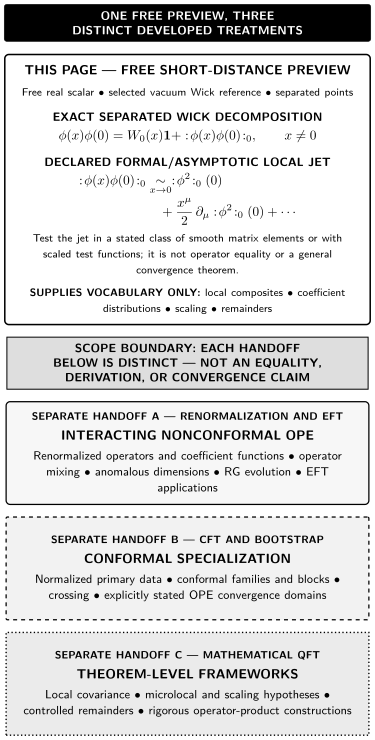
The free-field region isolates singular contractions and expands the smooth normal-product remainder only in a declared finite-order short-distance sense; its compact notation has the smeared base point understood. The three separated continuations add, respectively, interacting renormalization and coefficient evolution, conformal primary data and convergence domains, or theorem-level local-covariant and microlocal hypotheses. The separated regions, direct labels, and border styles mark scope boundaries and canonical continuations, not equivalences or automatic derivations. The diagram is schematic and not to scale.
| Claim being made | Additional structure required | Canonical continuation |
|---|---|---|
| free Wick/asymptotic preview | fixed free reference, ordering, domain, local Wick basis, and finite-order remainder test | this page |
| interacting Wilson expansion | renormalized composite basis, mixing, scale and scheme, anomalous dimensions, coefficient evolution, and a stated asymptotic regime | Renormalization and Effective Field Theory and Dual Evolution of Operators and Wilson Coefficients |
| conformal OPE | normalized primaries and descendants, radial or Euclidean domain, blocks, crossing, and an explicit convergence statement | From the Local OPE to Conformal Data |
| theorem-level operator products | specified algebraic or microlocal framework, local covariance where applicable, admissible states, topology, and remainder theorem | Local Covariant Wick Powers and Operator Products |
In a unitary Euclidean CFT, radial quantization gives a genuine convergence statement when a sphere separates the fused insertions from the spectator insertions; this is a theorem with a geometric domain, not a consequence of the free Taylor jet. Pappadopulo, Rychkov, Espin, and Rattazzi 2012, § 2, p. 7, and § 4.1, pp. 12–14 (Open PDF) gives the radial-state argument and convergence bound.
Theorem-level OPE statements are not confined to CFT. For renormalizable scalar interactions on globally hyperbolic Lorentzian spacetimes, Hollands constructs the OPE order by order as a formal perturbation series; its short-distance remainder is controlled in arbitrary Hadamard-state expectation values in the specified algebraic topology in Hollands 2007, § 3, pp. 14–20. In a different setting, massive Euclidean theory, Hollands and Kopper prove convergence of the OPE sum at each fixed finite loop order after insertion into correlators whose spectator fields are smeared with smooth test functions having compact momentum support in Hollands and Kopper 2012, pp. 1–4 in the open manuscript (Open PDF). These bounded results prevent the false shortcut “only conformal OPEs can converge”; neither is proved by the free example on this page.
The interacting short-distance expansion and its mixing qualifications are developed structurally in Zinn-Justin 2021, §§ 11.3–11.6, pp. 248–257. That treatment supplies context for the first continuation; it is not evidence that the free Taylor jet has already performed the interacting construction.
Common mistakes about the free preview
Section titled “Common mistakes about the free preview”“The OPE is just Wick’s theorem.” Wick’s theorem enumerates free contractions exactly. The OPE organizes the uncontracted factors into local operators in a declared short-distance sense.
“The whole product is Taylor expanded.” The singular contraction is a distribution and is kept as a coefficient. Only the smooth free normal-product matrix elements receive the Taylor expansion used here.
“The formula defines the product at coincidence.” It is first a separated-point statement. Extending singular coefficients through the diagonal can introduce local contact terms.
“The dots mean a convergent series.” Here they mean that every stated finite truncation has a controlled remainder in a declared matrix-element test. Conformal convergence and theorem-level remainder statements require additional hypotheses.
“The free dimensions become interacting dimensions automatically.” Interacting operators require renormalization and can mix. Anomalous dimensions and RG equations are new results, not notational replacements.
Check your understanding
Section titled “Check your understanding”Check 1: locate the factor one half
Taylor expansion gives . Since , the coefficient of is .
Check 2: recover the Wick coefficients
For , choose one field at each point for a single contraction: choices. A complete cross-pairing has choices. This gives .
Check 3: diagnose the diagonal
In four dimensions has scaling degree four but is a canonical Wightman distribution because its wavefront covectors have one frequency orientation. A further diagonal pullback is a new operation and may fail. By contrast, extending the time-ordered coefficient through the origin permits the local ambiguity . Ordering and collision operation must be named before diagnosing a contact term.
Check 4: place a stronger claim
A statement about running Wilson coefficients and operator mixing belongs to Renormalization and EFT. A statement about convergent radial OPEs and conformal blocks belongs to CFT. A theorem with microlocal domains and a specified remainder topology belongs to Mathematical QFT. None is established by the free Wick/Taylor calculation alone.
Continue to interacting, conformal, and rigorous treatments
Section titled “Continue to interacting, conformal, and rigorous treatments”- Renormalization and Effective Field Theory develops interacting nonconformal OPEs, renormalized composite operators, mixing, anomalous dimensions, and EFT use.
- Dual Evolution of Operators and Wilson Coefficients develops the coupled scale evolution of the operator basis and its coefficient functions.
- From the Local OPE to Conformal Data specializes the expansion to normalized conformal data, blocks, crossing, and explicit convergence domains.
- Local Covariant Wick Powers and Operator Products supplies theorem-level local-covariant and microlocal frameworks.
- Local Operators and Short-Distance Structure returns to the chapter map and its other local-operator routes.
References
Section titled “References”-
Hollands, Stefan. “The Operator Product Expansion for Perturbative Quantum Field Theory in Curved Spacetime.” Communications in Mathematical Physics 273 (2007): 1–36. DOI. Open PDF, arXiv:gr-qc/0605072.
-
Hollands, Stefan, and Christoph Kopper. “The Operator Product Expansion Converges in Perturbative Field Theory.” Communications in Mathematical Physics 313 (2012): 257–290. DOI. Open PDF, arXiv:1105.3375.
-
Hollands, Stefan, and Robert M. Wald. “The Operator Product Expansion in Quantum Field Theory.” arXiv:2312.01096 [hep-th], 2023. Open preprint PDF.
-
Pappadopulo, Duccio, Slava Rychkov, Johnny Espin, and Riccardo Rattazzi. “OPE Convergence in Conformal Field Theory.” Physical Review D 86 (2012): 105043. DOI. Open PDF, arXiv:1208.6449.
-
Schwartz, Matthew D. Quantum Field Theory and the Standard Model. First ed. Cambridge: Cambridge University Press, 2014. DOI.
-
Weinberg, Steven. The Quantum Theory of Fields, Volume II: Modern Applications. Cambridge: Cambridge University Press, 1996. DOI.
-
Wilson, Kenneth G. “Non-Lagrangian Models of Current Algebra.” Physical Review 179, no. 5 (1969): 1499–1512. DOI.
-
Zinn-Justin, Jean. Quantum Field Theory and Critical Phenomena. Fifth ed. Oxford: Oxford University Press, 2021. DOI.