

Electroweak Gauge and Matter Structure
The electroweak sector is a chiral gauge theory: left-handed quarks and leptons occupy weak doublets, their right-handed partners are weak singlets, and one scalar doublet permits gauge-invariant Yukawa interactions. With the convention , the hypercharges below reproduce the observed charge pattern and pass the one-generation anomaly checks.
Required background. The Yang–Mills action and self-interaction supplies the non-Abelian covariant derivative and field strength. Compact Lie groups, roots, and weights supplies weights and representation labels.
Helpful background. Perturbative chiral gauge anomalies develops the quantum consistency derivation previewed here.
The structural chain is summarized below. Representations and the Higgs orbit determine the unbroken charge, mass eigenstates, currents, Yukawa rotations, low-energy matching, and finally a renormalized observable; every arrow has an algebraic check.
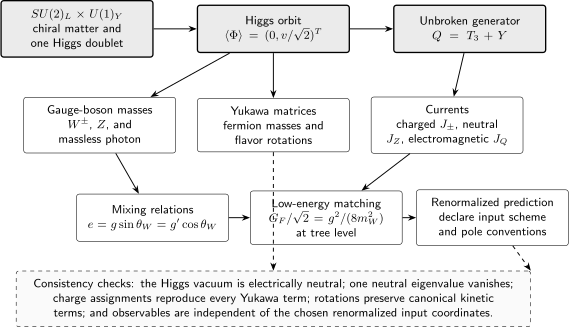
The electroweak construction closes when the vacuum is electrically neutral, the photon remains massless, Yukawa terms reproduce the charges, rotations preserve kinetic terms, and observables are independent of input coordinates. The diagram is schematic.
One-generation field content
Section titled “One-generation field content”Use Hermitian generators , where are Pauli matrices, and
Terms for groups under which a field is a singlet are omitted. The minimal one-generation assignments are
| Field | Chirality | Component charges from | |
|---|---|---|---|
| left | |||
| right | |||
| right | |||
| left | |||
| right | |||
| scalar |
This chiral gauge-and-scalar organization is the renormalizable lepton model introduced in Weinberg 1967, pp. 1264–1266, extended here by the quark and color representations.
The minimal renormalizable model has no right-handed neutrino. Adding one with is a consistent extension of the local gauge representation but changes the neutrino-mass sector and is treated separately.
For example,
whereas
Substituting these derivatives into fixes every gauge vertex and its chirality. The hypercharge table and its conversion to electromagnetic charge are derived in Schwartz 2014, §29.3, pp. 592–94.
The table specifies representations of the local gauge algebra. It does not by itself choose the exact global quotient of or its line-operator spectrum; that is a separate global-form question.
Gauge-invariant interactions constrain hypercharge
Section titled “Gauge-invariant interactions constrain hypercharge”The kinetic terms are
A bare Dirac mass such as is not invariant. The scalar permits
The hypercharge sums, including the sign from a barred field, are
These are fast convention checks. Using the alternative convention without doubling every tabulated would fail them and change the coupling.
The gauge interactions and scalar potential preserve baryon and individual lepton numbers at the classical renormalizable level, while the Yukawa matrices break much of the flavor symmetry. Quantum anomalies and nonperturbative electroweak effects refine those statements; they should not be inferred from the kinetic terms alone.
Quantum consistency preview
Section titled “Quantum consistency preview”For anomaly calculations, rewrite every fermion as a left-handed Weyl field. Thus become with conjugate non-Abelian representations and opposite hypercharges. One generation then satisfies
and
The mixed gravitational–hypercharge sum also vanishes. There are four left-handed weak doublets after color multiplicity—three quark doublets and one lepton doublet—so the number is even, as required by the global anomaly of an theory with an odd number of Weyl doublets Witten 1982, pp. 324–328. The complete perturbative anomaly calculation and its relation to charge quantization are given in Schwartz 2014, §30.4, pp. 631–634.
Anomaly cancellation is necessary quantum consistency; it does not select the global gauge group uniquely and it is not the same check as invariance of an individual Yukawa term.
Checks and failure modes
Section titled “Checks and failure modes”Charge check. Apply to both entries of every doublet and to every singlet. The neutral Higgs component must have , otherwise the proposed vacuum direction would break electromagnetism.
Vertex check. Right-handed singlets have no coupling. A right-handed charged current signals an incorrect representation or an extension beyond this model.
Yukawa check. Verify both the contraction and the hypercharge sum. Up-type masses require , not .
Anomaly check. Convert right-handed fields to left-handed conjugates before summing. Keeping the original hypercharge while conjugating the representation produces a false nonzero result.
Generation check. Repeating the table gives three generations, but replication alone does not define flavor mixing. Mixing begins when independent Yukawa matrices are diagonalized.
Common pitfalls
Section titled “Common pitfalls”Mixing the two hypercharge conventions. State or once and translate the table and coupling together. Electric charge is the invariant checkpoint.
Calling the table an anomaly proof. Classical covariant derivatives can be written for an anomalous spectrum. The triangle and global anomaly conditions are additional quantum tests.
Ignoring color multiplicity. Color does not enter , but it enters anomaly sums and the count of weak doublets.
Further study
Section titled “Further study”The Higgs and current derivations require the typed input
The next operation is to identify the Higgs vacuum orbit and physical scalar content. Detailed flavor misalignment belongs to Quark Flavor and CP.
References
Section titled “References”- Schwartz, Matthew D. Quantum Field Theory and the Standard Model. Cambridge University Press, 2014, §§29.3 and 30.4, pp. 592–602 and 631–634. DOI.
- Weinberg, Steven. “A Model of Leptons.” Physical Review Letters 19, no. 21 (1967): 1264–1266. DOI.
- Witten, Edward. “An Anomaly.” Physics Letters B 117, nos. 5–6 (1982): 324–328. DOI.