

Chiral EFT for Pions and Nucleons
Chiral EFT extends the pion theory by adding a nucleon isodoublet that transforms through the nonlinear compensator of . Derivatives, pion masses, loops, and recoil corrections are ordered in ; low-energy constants encode unresolved QCD. This expansion is perturbative in the one-nucleon sector, but few-nucleon intermediate states introduce a separate infrared enhancement and must not be iterated until the nuclear-force power counting and regulator are declared.
Required background. Chiral Lagrangians and Low-Energy QCD supplies , spurions, external sources, and mesonic power counting.
Helpful background. Heavy-Particle EFT and HQET Architecture supplies the residual-momentum field split and recoil expansion.
The regime map below places the explicit-pion theory developed on this page beside its pionless limit and the few-body enhancements that modify naive counting. Read downward from the scale comparison: the field content fixes the counting, shallow poles can promote iteration, and every prediction must carry consistent currents, calibration, uncertainty, and validation.
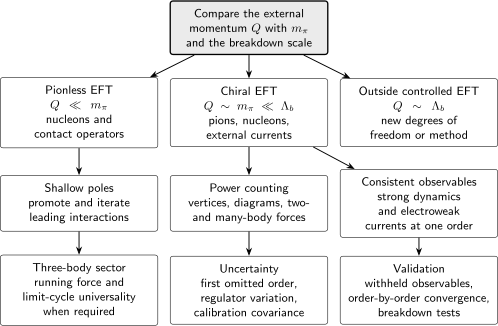
Nuclear-EFT regime map. Pionless EFT applies below the pion scale, chiral EFT resolves pions below its breakdown scale, and shallow poles can require leading interactions to be iterated. Three-body counterterms, electroweak currents, uncertainty, and validation enter at orders fixed by the chosen expansion. The diagram is schematic.
Pions, nucleons, and nonlinear symmetry
Section titled “Pions, nucleons, and nonlinear symmetry”For two light flavors, write
For every and pion configuration there is a compensating such that
Thus nucleons transform linearly under the unbroken isospin group but nonlinearly under the full chiral group. With external sources suppressed, useful covariant building blocks are
transforms as a connection and . Scalar, pseudoscalar, vector, and axial sources covariantize these expressions exactly as on the mesonic page; differentiating the source-dependent action later generates nuclear currents.
The leading relativistic pion–nucleon Lagrangian is
Expanding gives the derivative one-pion interaction
while expanding gives the two-pion Weinberg–Tomozawa interaction. Their derivative structure realizes the chiral soft-pion Ward identities; the complete amplitude must include the pole and contact graphs required at the same order. The construction and its relation to the relativistic pion–nucleon theory are reviewed in Bernard, Kaiser, and Meißner 1995, §§2–3 and Burgess 2020, §8.2.3, pp. 203–205.
Heavy-baryon and covariant organizations
Section titled “Heavy-baryon and covariant organizations”The nucleon mass does not vanish in the chiral limit, so a naive relativistic loop expansion contains analytic powers of that obscure the counting. Choose a timelike velocity and split
Using and , write
Integrating out produces
followed by fixed recoil operators in powers of . This heavy-baryon formulation makes counting manifest but expands relativistic analytic structure. A covariant formulation instead retains relativistic propagators and subtracts the analytic pieces that violate the assigned counting, for example in an extended-on-mass-shell scheme. After low-energy constants are matched in the same convention, on-shell amplitudes agree through the retained order. Heavy-baryon and covariant expressions are schemes, not different physical theories; the original heavy-fermion construction is given by Jenkins and Manohar 1991, pp. 558–562.
Counting and matching a pion–nucleon amplitude
Section titled “Counting and matching a pion–nucleon amplitude”The local expansion counts
Each loop supplies additional powers of , while counterterms at the same order absorb its ultraviolet dependence. A calculation must identify whether explicit resonances have been retained: integrating them out moves their effects into low-energy constants and changes the practical breakdown scale, but not the symmetry construction.
Expanding the connection to quadratic order gives
The resulting Weinberg–Tomozawa seagull and the nucleon Born graphs from two axial vertices organize low-energy scattering. The seagull scales as
where is the pion energy. The derivative numerator enforces the soft-pion limit; recoil, pion-mass insertions, loops, and subleading constants supply higher orders. The exact coefficient and sign depend on the isospin tensor and all-incoming convention, whereas the scaling and Ward identities do not.
The same axial vertex joined by a pion propagator produces one-pion exchange between two nucleons,
For , its numerator and propagator cancel in chiral degree, so . This is a kernel scaling. Whether it is inserted once or iterated is decided by the infrared enhancement of few-nucleon propagation, not by the one-nucleon loop counting.
| Ingredient | Count or matching role | Failure if omitted |
|---|---|---|
| Renormalized low-energy inputs in a named convention | Normalization or scheme shifts masquerade as higher-order effects | |
| Subleading constants | Short-distance QCD and integrated-out resonances | Pion–nucleon and two-pion-exchange sectors become inconsistent |
| Recoil terms | Fixed by Lorentz symmetry order by order | Heavy-baryon result fails a covariant expansion check |
| Loop counterterms | Same chiral order and subtraction scheme as loops | Scale dependence remains in an observable |
| Breakdown scale | Sets and the first omitted order | A nominal order label has no error meaning |
Single-baryon versus few-nucleon infrared behavior
Section titled “Single-baryon versus few-nucleon infrared behavior”In an irreducible single-baryon graph, residual energies and pion energies scale as . In a reducible two-nucleon intermediate state near threshold,
so the propagator is enhanced from to . Repeating a nominally leading two-body kernel can therefore be order one. Mixing this enhancement into the pion–nucleon counting is the central category error: first build and renormalize irreducible kernels, then solve the few-body equation under an explicit nuclear counting. Nuclear Forces and the Chiral Expansion performs that second step.
Checks and limitations
Section titled “Checks and limitations”- Symmetry: transforms homogeneously and every nucleon bilinear is invariant under the compensator .
- Dimensions: has mass dimension in the momentum-space normalization used by the Lippmann–Schwinger equation.
- Soft limit: the leading one-pion and two-pion vertices contain derivatives, so the chiral-limit amplitude obeys the appropriate soft-pion constraint.
- Scheme check: heavy-baryon and covariant amplitudes agree after expanding to the same order and translating low-energy constants.
- Stop rule: do not use the expansion when external momenta approach omitted resonances or , or when a reducible few-body enhancement has been treated perturbatively without justification.
This page does not select a high-order fitted interaction or a many-body solver. Those choices require a regulator, calibration set, covariance, and dated numerical evidence.
Common pitfalls
Section titled “Common pitfalls”Counting as a soft scale. The nucleon’s rest energy is removed from low-energy propagation; residual momentum is soft. Positive powers of in a covariant loop must be organized by a counting-preserving subtraction, not interpreted as chiral enhancement.
Iterating because an interaction is called leading order. “Leading” identifies the kernel’s chiral order. Iteration follows from the scaling of reducible propagators and may require promoted counterterms.
Comparing low-energy constants across schemes without translation. Field variables, subtraction, explicit resonances, and regulator choices can move analytic contributions among constants. Compare on-shell amplitudes or perform an explicit matching conversion.
References
Section titled “References”- Bernard, Véronique, Norbert Kaiser, and Ulf-G. Meißner. “Chiral Dynamics in Nucleons and Nuclei.” International Journal of Modern Physics E 4 (1995): 193–346. DOI.
- Burgess, C. P. Introduction to Effective Field Theory: Thinking Effectively about Hierarchies of Scale. Cambridge: Cambridge University Press, 2020, §8.2.3. DOI.
- Jenkins, Elizabeth, and Aneesh V. Manohar. “Baryon Chiral Perturbation Theory Using a Heavy Fermion Lagrangian.” Physics Letters B 255 (1991): 558–562. DOI.