

Consistency Checklist for Standard Model Extensions
A Standard Model extension becomes a usable quantum-field-theory framework only after its fields and symmetries define a single-valued action, all gauge and global consistency conditions are checked, its vacuum and spectrum exist in the claimed domain, amplitudes remain controlled, and observables are connected to identified experimental datasets without exceeding either theory or data validity. Passing these tests does not prove ultraviolet completion, naturalness, or empirical relevance; it establishes the narrower claim that the declared low-energy model is internally coherent and predictively specified.
Required background. Gauge-Anomaly Cancellation and Quantum Consistency supplies the left-handed-Weyl anomaly conventions used below.
Helpful background. EFT Positivity and UV Consistency explains when analyticity and unitarity impose additional Wilson-coefficient constraints.
The map below organizes the consistency checks before any parameter limit is interpreted. Scalar, vector, fermion, neutrino, axionlike, and extended-Higgs portals may be represented as resolved models, simplified mediators, or effective operators, but those descriptions are related only in their common matching and validity domain.
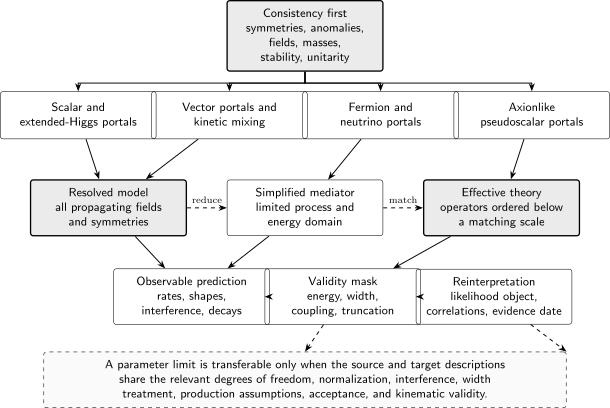
A portal prediction is transferable only when the source and target descriptions share the relevant degrees of freedom, symmetries, normalization, interference, width, acceptance, and kinematic regime. Dashed links denote reduction or matching; the diagram is schematic.
The finite consistency chain
Section titled “The finite consistency chain”Test the following conditions in order. Later phenomenology cannot repair an earlier structural failure.
| Condition | Information needed | Decisive check | Where to resolve a failure |
|---|---|---|---|
| Field theory | spins, representations, faithful gauge group, global charges, Hermitian operators | every term is Lorentz and gauge invariant and has a declared normalization | representation or global-form analysis |
| Quantum gauge consistency | all left-handed Weyl fermions with spectator multiplicities | local gauge, mixed gravitational, and relevant global anomalies vanish | anomaly-safe matter construction |
| Mass generation | bilinears, Yukawas, scalar representations, symmetry breaking | every claimed mass follows from an allowed operator and leaves the intended unbroken group | scalar or gauge-sector construction |
| Vacuum | complete scalar potential and parameter domain | boundedness, stationary conditions, positive physical masses, and the selected vacuum’s competition with other extrema | scalar-sector analysis |
| Perturbative control | couplings, renormalization scale, thresholds, partial waves | running remains in the declared domain and relevant -matrix eigenvalues obey unitarity | RG, matching, or a different description |
| Flavor and accidental stability | full flavor tensors and exact/remnant symmetries | unwanted tree flavor change, CP phases, and accidentally stable charged or colored states are identified | flavor or cosmology specialists |
| Decoupling and matching | heavy masses, their symmetry origin, matching scale, retained order | low-energy amplitudes reproduce the full theory within the stated power correction | matching and EFT methods |
| Observable | pole or fiducial definition, widths, interference, matrix elements | the predicted quantity is gauge invariant and calculable at the stated order | amplitudes or precision-observable methods |
| Statistical inference | likelihood, covariance, versions, overlap, validity mask | the statistical conclusion uses only released information inside a mask fixed before fitting | Research or the original experimental publication |
For a product of simple groups and Abelian factors, local anomaly tests can be organized as
Every sum is over left-handed Weyl fields. A right-handed field must first be replaced by its left-handed conjugate, reversing its Abelian charges and conjugating its non-Abelian representation. These perturbative sums are necessary but not sufficient: the faithful global form, allowed bundles, line operators, and global anomalies require separate tests Bilal 2008, §§3–4, 7.
Resolve failed consistency checks
Section titled “Resolve failed consistency checks”A useful review is a short reproducible workflow:
- Write a field table containing spin, representation under every gauge factor, all Abelian charges, multiplicity, and proposed mass source.
- State the actual gauge group, not only its Lie algebra, and verify that every representation descends to that quotient.
- Generate every renormalizable interaction allowed by the declared symmetries. If an omitted operator is merely set to zero, state the protecting symmetry or the tuning.
- Evaluate local anomaly sums exactly and test relevant global anomalies. Do not proceed with an anomalous gauge current.
- Expand about each candidate vacuum, remove gauge zero modes, and test the physical Hessian, boundedness, and competing extrema.
- Diagonalize kinetic and mass matrices in that order, rotate currents with the same transformations, and verify positive residues and masses.
- Calculate a representative high-energy partial wave, RG trajectory, and heavy-mass limit. Match coefficients and estimate the first omitted power independently.
- Define an observable with its pole/width or fiducial prescription and retain interference with the Standard Model.
- Freeze the theory-validity mask, dataset identity, likelihood, covariance, nuisance semantics, and data cutoff before inference.
As a minimal counterexample, one left-handed fermion of charge under a new gives
so a Proca mass or a small coupling cannot make the gauged model consistent. Adding a field of charge cancels both sums and permits the gauge-invariant bilinear ; it creates a vectorlike pair, not a proof that every possible global or ultraviolet condition is satisfied. An anomalous gauge theory can sometimes be treated below a cutoff with additional Wess–Zumino data, but that is a different EFT whose cutoff and compensating terms must be explicit Preskill 1991, §§2–4.
Four claims that must remain distinct
Section titled “Four claims that must remain distinct”Internal consistency means the stated model defines controlled amplitudes in a stated domain. It can still be incomplete above a cutoff.
Ultraviolet completion additionally supplies new degrees of freedom or dynamics that continue the theory while preserving unitarity, locality, and the assumed analyticity properties. Positivity can rule out some low-energy coefficient patterns, but passing known bounds is not an existence proof.
Naturalness is a declared sensitivity criterion. For example, technical naturalness asks whether a small parameter restores a symmetry when set to zero; it does not turn a parameter estimate into an experimental fact ’t Hooft 1980, pp. 135–157.
Empirical motivation is a property of dated observations and a specified statistical comparison. It cannot be inferred from elegance, consistency, or the availability of a portal operator.
Decoupling is similarly conditional. Heavy particles whose masses can be taken large at fixed dimensionless couplings usually generate local inverse-mass corrections, but masses tied to symmetry-breaking couplings can leave nondecoupling effects. The hypotheses of the decoupling theorem must therefore be checked rather than quoted as a slogan Appelquist and Carazzone 1975, pp. 2856–2861.
Specifying observables and experimental inputs
Section titled “Specifying observables and experimental inputs”Before a search result can test the model, preserve the following semantic fields:
| Layer | Minimum information |
|---|---|
| Observable | pole, pseudo-observable, or fiducial definition; units; cuts; theory order; width and interference convention |
| Theory response | parameter basis, matching/running versions, matrix elements, generator or analytic code, uncertainty, and software checksum |
| Validity | energy transfers, EFT truncation, perturbativity/unitarity, width, gauge completion, interpolation domain, and a mask fixed before fitting |
| Experimental inputs | experiment, dataset/data period, record DOI, exact resource version and checksum, likelihood/covariance identity, and nuisance semantics |
| Dependence | shared events, calibrations, priors, theory inputs, and cross-covariances with other results |
| Dates and corrections | data cutoff, license, corrections/errata, review date, and superseding record |
This is a reproducibility contract, not a current exclusion summary. A plot without its released likelihood or response information may support only the claims its producer documents; private detector emulation is never relabeled as official evidence. Reinterpretation recommendations and the information needed to make results reusable are developed by the LHC Reinterpretation Forum Abdallah et al. 2020, §§2–5.
Limiting checks and common failures
Section titled “Limiting checks and common failures”- Switch-off: every induced coupling and mixing angle must vanish continuously when the portal coupling does, unless an independently declared interaction remains.
- Heavy-mass limit: after refitting low-energy inputs, amplitudes must approach the matched EFT with the predicted power residual; a constant remainder requires a named nondecoupling mechanism.
- Gauge check: longitudinal or gauge-parameter dependence must cancel in a physical amplitude. Growth that violates partial-wave unitarity marks a missing state, symmetry relation, or cutoff.
- Vacuum check: positive masses at one stationary point do not prove global boundedness or vacuum selection.
- Evidence check: a valid model point is not evidence for the model, and a negative result constrains only the declared observable, model map, and validity domain.
Use Consistent New Matter and Gauge Sectors when the first failure is representation, anomaly, or mass construction; use the relevant scalar, vector, fermion, or pseudoscalar sibling for its mechanism. Description-layer failures go to Effective, Simplified, and Mediator Descriptions, and experimental applications go to Search Validity and Reinterpretation for Portal Models.
References
Section titled “References”- Abdallah, Waleed, et al. “Reinterpretation of LHC Results for New Physics: Status and Recommendations after Run 2.” SciPost Physics 9 (2020): 022. DOI.
- Appelquist, Thomas, and J. Carazzone. “Infrared Singularities and Massive Fields.” Physical Review D 11 (1975): 2856–2861. DOI.
- Bilal, Adel. “Lectures on Anomalies.” arXiv:0802.0634 [hep-th] (2008). arXiv.
- ’t Hooft, Gerard. “Naturalness, Chiral Symmetry, and Spontaneous Chiral Symmetry Breaking.” In Recent Developments in Gauge Theories, edited by Gerard ’t Hooft et al., 135–157. NATO Advanced Study Institutes Series B, vol. 59. New York: Plenum Press, 1980. DOI.
- Preskill, John. “Gauge Anomalies in an Effective Field Theory.” Annals of Physics 210 (1991): 323–379. DOI.