

Collinear Factorization and Operator-Defined PDFs
Collinear factorization is a leading-power statement that separates a process-dependent short-distance coefficient from renormalized hadron matrix elements. A PDF is therefore defined by an operator, scheme, scale, parton species, and parent hadron; its apparent probability interpretation is limited. A testable factorization claim must also state the observable, convolution, power remainder, and known factorization boundary.
Required background. Deep-inelastic scattering and the parton model supplies the measured structure functions and momentum fraction. Collinear factorization and splitting amplitudes supplies the leading-region and singular-limit analysis.
Helpful background. Factorization operator structure supplies the general hard–collinear operator organization.
The map below shows where the declarations in a factorization theorem enter. Solid arrows build the factorized observable; dashed arrows are closure tests that can invalidate an apparently finite result.
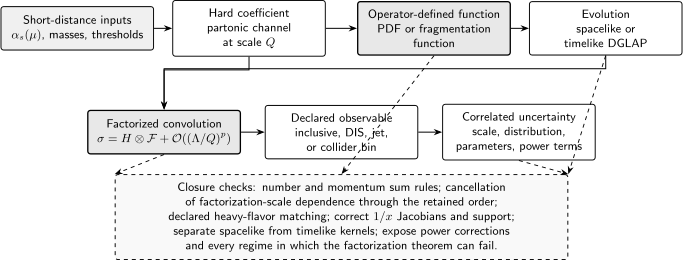
Factorization and evolution chain. Hard functions and renormalized long-distance distributions carry compensating scheme and scale dependence; only their matched convolution predicts the declared observable. Sum rules, threshold matching, retained-order scale cancellation, and power corrections are independent checks. The diagram is schematic.
The leading-power factorization statement
Section titled “The leading-power factorization statement”For a DIS structure function with and kinematics away from an untreated endpoint, write
where
labels the factorization scheme. The remainder contains target-mass and higher-twist terms and may be enhanced near endpoints. In a process with incoming hadrons on both beams there is one PDF convolution per beam; in identified-hadron production, a fragmentation convolution can also appear.
The statement has three different levels:
- Hard coefficients are perturbative if their characteristic virtualities are short-distance.
- PDFs are universal only among processes for which the relevant factorization theorem and Wilson-line structure agree.
- The complete convolution is physical; its split into coefficient and PDF depends on and .
Leading regions, subtraction, and the cancellation or deformation of soft attachments are the substance of a proof, not consequences of dimensional analysis. A systematic proof architecture for inclusive hard processes is given in Collins, Soper, and Sterman 1989, §§2–6, pp. 1–67.
An operator-defined quark PDF
Section titled “An operator-defined quark PDF”Choose a lightlike vector with . A schematic renormalized unpolarized quark PDF is
with
Normalization factors vary with light-cone conventions; the invariant content is the bilocal light-ray operator, its gauge link, its parent-hadron state, and its ultraviolet renormalization. Gluon PDFs use a corresponding gauge-invariant bilocal field-strength operator. Operator definitions, renormalization, and sum rules were established explicitly by Collins and Soper 1982, §§2–6, pp. 445–92.
The Wilson line resums longitudinally polarized collinear gluon attachments and makes the nonlocal product gauge covariant. Setting it to one is at most a gauge-specific intermediate simplification, not a gauge-invariant definition.
In the leading collinear description the support is , with a common convention identifying negative- quark support with antiquarks; when quarks and antiquarks are listed separately, both have . Probability intuition can be useful at leading order, but renormalized PDFs beyond leading order need not remain pointwise positive in every scheme.
Scheme and scale cancellation
Section titled “Scheme and scale cancellation”Renormalizing the light-ray operators mixes momentum fractions. Write their evolution as
The coefficient functions obey the compensating equation
so
through the calculated order. The minus sign is a direct check: moving collinear logarithms into the PDF removes them from the coefficient. Finite convolutions define scheme transformations,
and leave the observable unchanged at common accuracy. Converting a PDF without converting is not a scheme change; it is an inconsistent prediction.
An explicit DIS calculation showing how the collinear term is absorbed and the residual scale dependence cancels is given in Schwartz 2014, §32.4, pp. 685–94.
Sum rules and universality tests
Section titled “Sum rules and universality tests”Conserved currents and the energy–momentum tensor imply exact normalization constraints in compatible schemes:
Evolution kernels must preserve these relations. They constrain complete flavor combinations and the full parton sum; they do not determine the dependence.
Universality should be checked as a proposition with hypotheses:
| Question | What must match |
|---|---|
| same collinear PDF in DIS and color-singlet hadroproduction? | leading-power theorem, collinear operator, scheme, and active-flavor convention |
| same object after resolving transverse momentum? | no—the transverse separation, soft subtraction, rapidity scale, and Wilson-line direction must be retained |
| same object for an identified final-state hadron? | no—the relevant matrix element is a fragmentation function |
| same factorization for every colored final state? | no—Glauber exchange and color entanglement require a process-specific analysis |
Domain checks and failure modes
Section titled “Domain checks and failure modes”Scale cancellation. Differentiate the complete convolution and verify cancellation through the claimed order. Residual dependence is an omitted-order diagnostic only after the same scheme and flavor number are used throughout.
Sum rules. Test valence-number moments and the total momentum moment after evolution and threshold matching. A failed moment often exposes an index orientation, plus-distribution, or matching error.
Power counting. State rather than hiding it. At large , small , low , or near a heavy threshold, logarithmic or power enhancements can change the appropriate description.
Observable and Glauber check. Inclusiveness that proves cancellation for one process need not survive a veto or a more differential measurement. When spectator interactions cannot be deformed or cancelled, the advertised universal convolution may fail.
Common pitfalls
Section titled “Common pitfalls”Calling a PDF data. A fitted PDF is a theory-dependent inference represented by a particular release, parameterization, evolution setup, and covariance. The operator is universal within a theorem; a numerical fit is versioned input.
Suppressing the factorization scheme. The label belongs to the coefficient and PDF together. Only their common-scheme convolution is observable.
Assuming positivity is exact. Leading-order probability intuition is not a theorem about every renormalized higher-order scheme. Test physical cross sections and exact sum rules instead.
Further study
Section titled “Further study”A complete collinear input has the type
The next operation is DGLAP evolution and its sum-rule checks. Retaining transverse recoil instead leads to TMD factorization and rapidity evolution.
References
Section titled “References”- Collins, John C., and Davison E. Soper. “Parton Distribution and Decay Functions.” Nuclear Physics B 194, no. 3 (1982): 445–92. DOI.
- Collins, John C., Davison E. Soper, and George Sterman. “Factorization of Hard Processes in QCD.” In Perturbative Quantum Chromodynamics, edited by A. H. Mueller, 1–91. World Scientific, 1989. DOI. Open PDF.
- Schwartz, Matthew D. Quantum Field Theory and the Standard Model. Cambridge University Press, 2014, §32.4, pp. 685–94. DOI.