

Hadron Quantum Numbers and the QCD Spectrum
Hadrons are gauge-invariant QCD excitations organized first by exact conserved quantum numbers and only then by approximate flavor symmetries or constituent-model assignments. A color-singlet interpolating operator selects a spectral channel, while a pole or spectral contribution identifies the state content. This page constructs the standard meson, baryon, gluonic, and hybrid channels and states precisely when , flavor multiplets, and quark-model labels are meaningful.
Required background. Confinement with dynamical quarks supplies the color-singlet and string-breaking picture; spectral decomposition of two-point functions supplies poles, overlaps, and continuum support. Helpful background. Operators, observables, and matrix elements clarifies why an interpolating field is not itself a particle state.
The diagram below follows the distinct QCD operators used in this chapter to their extraction methods. It is a guard against reading an operator overlap as a state probability, a finite-volume level as a resonance mass, or a scheme-dependent parton distribution as a directly measured density.
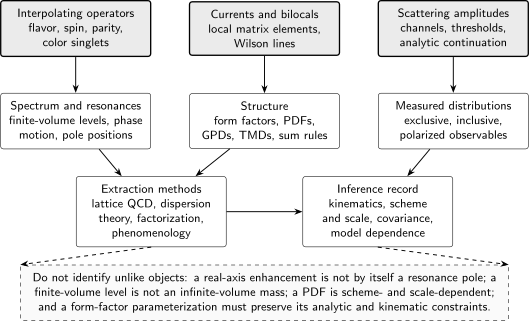
Hadron observable and method map. Spectra and resonance poles, current form factors, and PDFs/GPDs/TMDs are defined by different QCD correlators and extracted through different analytic, factorization, phenomenological, or finite-volume steps. The diagram is schematic and does not assign numerical precedence to any method.
Color-singlet operators and spectral channels
Section titled “Color-singlet operators and spectral channels”For a local gauge transformation ,
The invariant tensors and therefore produce the familiar local color singlets
Here act on spin, acts on flavor, and the color indices are displayed. The baryon contraction is invariant because . Gluonic operators such as and hybrid operators such as create further color-singlet channels. Separated quark fields require Wilson lines to make the operator gauge invariant. The group-theory content is the singlet part of
These decompositions classify color contractions, not physical flavor multiplets. In a confining theory, color-nonsinglet contractions do not define isolated asymptotic hadrons; the singlet operators above are the appropriate probes of the physical spectrum Schwartz 2014, § 26.2, pp. 512–514.
An operator fixes a channel but generally overlaps with every state carrying the same exact quantum numbers. With relativistic normalization and zero spatial momentum, its Euclidean correlator has the spectral form
in finite volume, where . The energies are properties of QCD in that volume; the overlaps depend on the chosen operators. In infinite volume, multiparticle sums become continuous spectral contributions. A stable hadron gives an isolated physical-sheet pole below all allowed strong-decay thresholds. An unstable hadron instead requires a scattering-amplitude pole on an analytically continued sheet, so it must not be identified with one term of this finite-volume sum Briceño, Dudek, and Young 2018, §§ II.A and IV.A, pp. 3–4 and 16–18.
Exact labels and approximate organization
Section titled “Exact labels and approximate organization”For QCD in vacuum with vanishing strong CP angle and without electromagnetic or weak interactions, spatial rotations, parity, baryon number, and the exact vector flavor symmetries implied by degenerate quark masses classify states. Charge conjugation supplies only for neutral states mapped to themselves. The useful hierarchy is:
| Label | Status in the stated QCD limit | Qualification |
|---|---|---|
| Total spin | exact in infinite-volume vacuum | On a spatial lattice, only cubic-group irreducible representations are exact before the continuum limit |
| Parity | exact when | A nonzero strong CP angle would remove this classification |
| Charge conjugation | exact for self-conjugate neutral channels | It is not a label for open-flavor or electrically charged states |
| Baryon number | exact for strong QCD | Electroweak effects are outside this page |
| Isospin | approximate for | Broken by and electromagnetism |
| Flavor | more strongly approximate for | Multiplet splittings measure symmetry breaking; they do not invalidate the exact labels |
| Heavy-quark spin/flavor | emergent as | Its controlled corrections belong to HQET |
The light pseudoscalar and baryon multiplets illustrate how approximate flavor symmetry organizes many channels without making their masses equal in real QCD Schwartz 2014, § 28.2.3, pp. 572–576. A quoted multiplet assignment should therefore state the symmetry limit and the breaking effects being neglected.
For a local flavor-neutral bilinear, parity and charge conjugation follow from
with . Applying these transformations to gives, for example:
| Interpolating bilinear | Rotational channel | for a neutral diagonal flavor combination |
|---|---|---|
| scalar | ||
| pseudoscalar | ||
| spatial vector | ||
| spatial axial vector |
The table states transformation properties of operators. It does not assert that each operator couples to only one level, nor that the dominant state has a simple constituent wavefunction.
Constituent labels are assignments, not definitions
Section titled “Constituent labels are assignments, not definitions”In a quark–antiquark model with relative orbital angular momentum and total quark spin , the state assignment implies
The parity factor contains the opposite intrinsic parities of a fermion and antifermion; charge conjugation also exchanges them, yielding the second sign. These formulas are valuable selection rules inside that model space. They are not fundamental definitions of and , which come from the symmetry transformations above.
A combination impossible for a simple assignment—such as —is called spin-exotic. Its observation establishes that a minimal constituent basis is insufficient, but it does not by itself decide among gluonic excitation, multihadron dynamics, or a more complicated compact configuration. That microscopic inference requires an operator basis and scattering information.
From a QCD question to a defensible spectrum statement
Section titled “From a QCD question to a defensible spectrum statement”| Question | Object to construct | Quantity that can be inferred | Necessary check |
|---|---|---|---|
| Which exact channel is probed? | Color-singlet operator projected onto momentum and the relevant rotational/flavor representation | , and only when defined | Transform every color, spin, and flavor index |
| Is there a stable particle? | Infinite-volume two-point function or equivalent spectral measure | Physical-sheet pole mass and residue | Verify the pole lies below all allowed strong-decay thresholds |
| Is a level predominantly one structure? | Matrix of correlators built from several operator types | Basis-dependent overlap pattern | Enlarge the basis and test stability; do not turn overlap size into a probability |
| Is an enhancement a resonance? | Coupled-channel scattering amplitude | Continued pole, sheet, and residues | Enforce unitarity and include nearby thresholds |
| Is a flavor or constituent assignment useful? | Symmetry-breaking or model analysis | Approximate multiplet or label | State the symmetry limit and compare alternative operator content |
This chain keeps the observable, the QCD operator, and the extraction method distinct. Numerical masses, widths, and assignments are deliberately not tabulated here because their status depends on channel definitions, analyses, and source dates.
Independent checks and limitations
Section titled “Independent checks and limitations”- Color: every open fundamental index must be paired with an invariant tensor or a Wilson line. A bare separated is not gauge invariant.
- Dimensions: in four dimensions , so a local bilinear has dimension and a local three-quark interpolator dimension . Smearing or nonlocal separation introduces additional length scales but does not change the state quantum numbers.
- Discrete symmetries: compute and from field transformations. Do not assign to a channel that charge conjugation maps to a distinct flavor state.
- Spectral meaning: energies are basis independent, whereas overlaps are not. In finite volume, avoided crossings and extra levels constrain an amplitude but are not resonance pole positions.
- Domain: at nonzero temperature, density, external fields, or finite spatial symmetry, the vacuum classification can reduce. Nuclear bound states and their many-body quantum numbers lie outside this chapter.
Common pitfalls
Section titled “Common pitfalls”Calling an operator a state. The same operator can overlap a ground state, radial excitations, and multiparticle states. Report the channel and the extracted spectral information separately.
Treating flavor symmetry as exact. Isospin and flavor- multiplets are controlled approximations, not exact degeneracies in QCD with physical quark masses and electromagnetism.
Calling a bump or a finite-volume level a resonance. An unstable hadron is defined through an analytically continued amplitude. Continue to Hadron Resonances and Coupled Channels for that construction.
Informal self-check
Section titled “Informal self-check”Classify the neutral local bilinear and explain why observing a level with large overlap onto it does not prove a pure constituent configuration.
Answer
Under parity, , so the spatial vector is odd. The identity makes a neutral diagonal bilinear charge-conjugation odd. After projection onto the vector rotational representation it therefore probes . The overlap depends on the interpolating basis and renormalization; all QCD states in the channel, including multihadron states, may contribute. Only the energy or amplitude singularity and a basis-stability analysis support a state interpretation.
Further study
Section titled “Further study”- For unstable channels, send the exact quantum numbers, open channels, and thresholds to the coupled-channel pole analysis.
- For a local-current probe of a selected stable channel, send the external-state normalization and current quantum numbers to the form-factor decomposition.
- For heavy-light spin multiplets, send the light-cloud quantum numbers and heavy flavor to HQET.
- For a heavy quark–antiquark channel, send its color, spin, orbital, and threshold information to the NRQCD route.
References
Section titled “References”- Briceño, Raúl A., Jozef J. Dudek, and Ross D. Young. “Scattering Processes and Resonances from Lattice QCD.” Reviews of Modern Physics 90 (2018): 025001. DOI · Open PDF
- Schwartz, Matthew D. Quantum Field Theory and the Standard Model. Cambridge: Cambridge University Press, 2014, §§ 26.2 and 28.2.3. DOI