

Heavy-Quark Symmetry and HQET
HQET describes a hadron containing one heavy quark by removing its mechanical momentum and expanding the remaining dynamics in . At leading order the heavy source carries a fixed velocity and interacts without reference to its spin or mass, producing heavy-quark spin and flavor symmetries. Perturbative matching, kinetic and chromomagnetic operators, and subleading currents quantify how real heavy-light hadrons depart from that limit.
Required background. Heavy-particle EFT and HQET architecture supplies matching and power counting; hadron quantum numbers and the QCD spectrum supplies heavy-light state labels. Helpful background. Integrating out heavy fields supplies the general matching logic.
A single heavy source and its residual momentum
Section titled “A single heavy source and its residual momentum”For a heavy quark inside a hadron moving with four-velocity , write
The expansion presumes . It does not require the hadron to be at rest, and it does not apply to the relative momentum of a heavy quark–antiquark pair. Introduce
Because , the matrices obey , , and . The phase removes the large rest-mass oscillation. The field annihilates the low-energy heavy quark; is the off-shell small component separated by energy approximately .
Substitution into gives
where . The algebraic equation of motion for the small field is
Eliminating and expanding its inverse operator yields the HQET Lagrangian
Both subleading operators have mass dimension five, so their coefficients have dimension . In the rest frame, and the leading equation is ; supplies the kinetic correction. Reparameterization invariance fixes the kinetic coefficient in the usual formulation, while carries short-distance matching and running. The derivation and symmetry consequences are developed in Neubert 1994, §§ 3.1–3.3 and Schwartz 2014, §§ 35.1 and 35.4, pp. 761–763 and 770–774.
Spin-flavor symmetry and heavy-light multiplets
Section titled “Spin-flavor symmetry and heavy-light multiplets”The leading Lagrangian contains neither a Dirac spin matrix nor the heavy-quark mass. For heavy flavors treated at the same velocity it is invariant under rotations of heavy spin and flavor. The light degrees of freedom therefore carry a conserved total angular momentum in the infinite-mass limit. Combining it with heavy spin gives a degenerate pair
when . The familiar lowest heavy-light light-cloud assignment produces and partners in this limit. Chromomagnetic interactions break the spin degeneracy at ; flavor symmetry is likewise broken by finite masses and matching coefficients. These are controlled symmetry statements, not claims of exact degeneracy in measured spectra.
The symmetry is especially restrictive for heavy-to-heavy currents. Matching a QCD current at the heavy scales gives
where . The leading pseudoscalar-to-pseudoscalar vector-current matrix element reduces to one universal function,
At zero recoil, , heavy-flavor charge normalization gives in the strict heavy-quark limit. Physical form factors also contain the perturbative coefficient , subleading-current matrix elements, and insertions of and . Selected zero-recoil amplitudes are protected against first-order power corrections, but that protection is not universal across currents or kinematics Neubert 1994, §§ 3.4–3.7.
Inclusive heavy-hadron observables
Section titled “Inclusive heavy-hadron observables”For a sufficiently inclusive decay, the optical theorem converts the summed rate into the forward matrix element of a time-ordered product of weak currents. When the released energy is hard, that product admits a local expansion,
The leading operator is . After use of the HQET equation of motion there is no independent gauge-invariant dimension-four operator contributing to a total inclusive width, so the first nonperturbative corrections normally enter through dimension-five kinetic and chromomagnetic matrix elements, at . This conclusion requires sufficient inclusiveness and a valid local expansion. Severe kinematic cuts or endpoint regions introduce additional scales and nonlocal shape functions; quark–hadron duality limitations are not estimated by formal power counting alone.
Selecting HQET rather than a heavy-pair EFT
Section titled “Selecting HQET rather than a heavy-pair EFT”| Diagnostic | HQET: one heavy source | NRQCD or potential EFT: heavy pair |
|---|---|---|
| Momentum organization | , | , |
| Heavy antiparticle | integrated out at the hard matching step | retained as an independent Pauli field |
| Leading degrees of freedom | plus light quarks and gluons | heavy quark and antiquark; singlet/octet pair fields after soft matching |
| Expansion parameters | and | , , and ratios among , , , |
| Leading organizing principle | heavy-quark spin/flavor symmetry | nonrelativistic kinetic energy and color-potential dynamics |
| Typical observable | heavy-light form factor or inclusive heavy-hadron rate | quarkonium energy, decay, threshold, or production matrix element |
The scale map makes the choice operational. Both theories begin by matching at , but HQET retains residual momentum of order , whereas NRQCD resolves the additional and scales of a slow heavy pair.
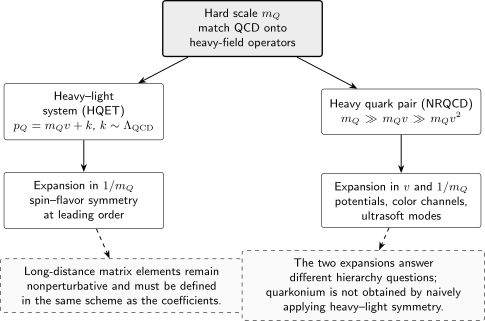
Heavy-quark hierarchy map. HQET expands a single heavy source in and exposes spin–flavor symmetry; NRQCD expands a heavy pair in and separates hard, soft, and ultrasoft scales. Long-distance matrix elements remain nonperturbative in both descriptions. The diagram is schematic.
Having two heavy flavors in a current, as in , does not make the external heavy-light hadrons quarkonium. Each hadron still contains one heavy source surrounded by light degrees of freedom.
Calculational methods and uncertainties
Section titled “Calculational methods and uncertainties”| Quantity | Representation | Inputs that must be fixed | Checks and principal limitations |
|---|---|---|---|
| Heavy-light mass splitting | matrix elements of and | heavy-mass scheme, Wilson coefficients, operator renormalization | spin-average relations, scale cancellation, higher powers in |
| Exclusive heavy-to-heavy form factor | matched HQET current and subleading insertions | recoil , current basis, schemes, matching scale | at leading order, protected versus unprotected channels, recoil range |
| Inclusive width or moment | forward-scattering operator expansion | cut definition, perturbative order, local matrix elements and covariance | absence of term for total rates, endpoint sensitivity, duality assumptions |
| Numerical QCD determination | renormalized correlation functions or sum rules | action/current matching or continuum scheme, fit and covariance | discretization or continuum-model dependence, finite volume, truncation |
The heavy-quark mass definition must be shared by Wilson coefficients and matrix elements. Using a pole mass in one piece and a short-distance mass in another leaves an uncancelled infrared ambiguity. Power-counting estimates such as describe truncation size; they are not statistical standard deviations unless embedded in an explicit uncertainty model.
Independent checks and limitations
Section titled “Independent checks and limitations”- Projectors: verify and . A sign error here propagates into every leading-current identity.
- Residual scaling: every covariant derivative acting on is residual, , after hard matching. A derivative of order signals that the phase separation or mode assignment is wrong.
- Dimensions: has dimension four; and have dimension five and require coefficients.
- Symmetry limit: dropping must remove heavy-spin dependence. Taking at fixed must reduce all leading heavy-to-heavy form factors to the same convention.
- Matching-scale cancellation: the dependence of cancels that of the HQET current to the computed order. A physical form factor cannot inherit the arbitrary matching scale.
- Domain: HQET is not controlled for charm-like masses merely because a heavy label is present; the relevant expansion parameter and required precision must be assessed. Near endpoints, local inclusive expansions can fail.
A reproducible toy check
Section titled “A reproducible toy check”A reproducible calculation uses the illustrative function
It obeys , , and . Thus it has the correct zero-recoil normalization and satisfies the illustrative slope inequality . It is not a fit to QCD. The calculation’s sample values and are power-counting parameters for the first omitted terms, not probabilistic errors.
Common pitfalls
Section titled “Common pitfalls”Using heavy-flavor symmetry at finite mass without matching. The symmetry belongs to the leading effective Lagrangian. Short-distance coefficients and power corrections must accompany a physical prediction.
Treating the residual momentum as an observable unique split. A small change in the reference velocity reshuffles and ; reparameterization invariance ensures consistent descriptions agree. Truncated calculations must respect the corresponding coefficient relations.
Applying HQET to quarkonium. A slow heavy antiquark is not integrated out of heavy-pair dynamics. Use the NRQCD route when the hierarchy is nonrelativistic relative motion.
Informal self-check
Section titled “Informal self-check”Show that is a projector and explain why the leading HQET interaction is spin independent.
Answer
The Clifford algebra gives . Hence and . The leading term contains no spin matrix; rotations of the two projected heavy-spin components leave it invariant. Spin dependence first appears through the chromomagnetic operator at order .
Further study
Section titled “Further study”- Send matched heavy-light current form factors, their recoil variable, scheme, and covariance to the current-structure route.
- Send Wilson coefficients, operator basis, and power counting to the broader effective-theory practice route.
- Send a system with an active slow heavy quark and antiquark, together with estimates of , , , and , to Quarkonium and NRQCD.