

Chiral Lagrangians and Low-Energy QCD
At momenta and pion masses small compared with the chiral scale, QCD is represented by the most general local action of its Goldstone field consistent with chiral symmetry, discrete symmetries, and a power counting. At leading order this construction fixes the pion kinetic and mass terms and the complete tree-level amplitude; loops and higher-order low-energy constants then improve the prediction while canceling each other’s renormalization-scale dependence.
Required background. Chiral Order Parameters, Current Algebra, and Pions fixes the breaking pattern and decay-constant convention; Chiral Effective Theory and Nonlinear Symmetry supplies effective-field-theory matching and truncation logic.
Helpful background. Cosets and Nonlinear Realizations supplies the general coset construction.
The chiral field and external sources
Section titled “The chiral field and external sources”For two light flavors, encode the three Goldstone fields in
The vacuum is after aligning the mass matrix. A different coordinate choice on the same coset changes off-shell vertices but not on-shell amplitudes.
To derive currents and impose local Ward identities, couple QCD to left, right, scalar, and pseudoscalar sources . Their covariant combinations are
with transformations
The physical limit is and . Functional derivatives with respect to these sources generate the corresponding QCD currents and densities, so every effective operator automatically obeys the symmetry’s Ward identities.
Power counting and the leading action
Section titled “Power counting and the leading action”Count a derivative or external momentum as and the quark mass, hence , as . The unique even-parity two-derivative action without external field strengths is
and are low-energy constants in the two-flavor chiral limit. Matching the scalar source gives at leading order in the convention of the preceding page.
For a connected mesonic graph with loops and vertices from operators of chiral dimension , dimensional counting gives
so each loop raises the order by two powers of . The expansion parameters are schematically and . The theory ceases to be predictive at a stated truncation when these are not small or when omitted resonances become dynamical.
The diagram summarizes how that expansion inherits QCD information. The upper chain is fixed by symmetry and vacuum realization; external sources and matched low-energy constants turn it into amplitudes, while the singlet-anomaly and theta branches require additional topological information.
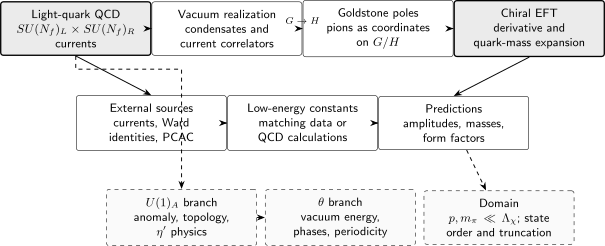
Low-energy QCD map. Symmetry realization fixes the pion field space and operator structure, but low-energy constants must be matched and predictions require with an explicit truncation order. The , topology, and theta sectors are related but not identical. The diagram is schematic.
Quadratic expansion and the pion mass
Section titled “Quadratic expansion and the pion mass”Set and at leading order. The exponential field expands as
Using gives
where, in this exponential parametrization,
The quadratic terms verify canonical normalization and the leading mass relation. Together with , the latter reproduces
at leading order. The distinction between in the chiral limit and the measured begins at higher chiral order.
The leading ππ amplitude
Section titled “The leading ππ amplitude”Let , with all external pions on shell and
Inserting the four-pion interactions and using the on-shell relation reduces the tree amplitude to
with
Replacing by changes only the indicated higher-order remainder. The result is Weinberg’s low-energy theorem Weinberg 1966, pp. 616–619.
Three checks expose most normalization or crossing errors:
- Crossing: exchanging an incoming and outgoing pion permutes and the corresponding Kronecker tensors; the displayed decomposition is closed under every such permutation.
- Adler zero: at the analytically continued point , every scalar function vanishes. This point is explicitly unphysical for on-shell equal-mass scattering because it violates ; it is a soft-current constraint on the analytic amplitude.
- Isospin projection: using the on-shell sum gives
which has the required parity in each channel.
A reproducible calculation implements the same quadratic expansion, four-pion terms, tensor decomposition, crossing permutations, and Adler-point test. A mismatch with these equations is a convention or algebra error, not a new prediction.
Loops, low-energy constants, and remainders
Section titled “Loops, low-energy constants, and remainders”At , one-loop graphs built from generate nonanalytic logarithms and ultraviolet poles. The most general contains local counterterms with renormalized coefficients . In a conventional subtraction scheme,
with coefficients fixed by the divergence basis. For any observable amplitude,
up to . A loop logarithm by itself is not a prediction; its scale dependence cancels only after the appropriate low-energy constants are included. The systematic one-loop construction is given by Gasser and Leutwyler 1984, §§3–7.
A complete result therefore states:
- the operator basis and subtraction convention;
- the scale at which renormalized constants are quoted;
- whether or physical parameterize lower-order terms;
- the chiral order retained and an remainder;
- the kinematic domain below inelastic thresholds and omitted resonances.
Common pitfalls
Section titled “Common pitfalls”Mixing decay-constant conventions. If the axial generator is rescaled, rescales inversely. Keep from the current definition through the scattering amplitude.
Calling the Adler point physical. For massive on-shell pions, conflicts with . It is an analytically continued soft point used to check the symmetry structure.
Keeping loops but dropping counterterms. The result then depends on the subtraction scale and is not an observable. Include every local operator required at the same chiral order.
Exercise
Section titled “Exercise”Expand the leading mass term for through fourth order in and verify its contribution to .
Solution
For ,
Thus
which gives the displayed mass and four-pion interaction after the irrelevant vacuum constant is dropped.
References
Section titled “References”- Burgess, C. P. Introduction to Effective Field Theory: Thinking Effectively about Hierarchies of Scale. Cambridge: Cambridge University Press, 2020, §§8.1–8.2. DOI.
- Gasser, Jürg, and Heinrich Leutwyler. “Chiral Perturbation Theory to One Loop.” Annals of Physics 158 (1984): 142–210. DOI.
- Weinberg, Steven. “Pion Scattering Lengths.” Physical Review Letters 17 (1966): 616–621. DOI.
- Weinberg, Steven. The Quantum Theory of Fields. Volume II: Modern Applications. Cambridge: Cambridge University Press, 1996, §§19.4–19.5. DOI.