

QCD Confinement versus the Yang–Mills Mass Gap
Confinement in real QCD, confinement diagnostics in pure gauge theory, and the Yang–Mills existence-and-mass-gap problem are three different targets. A mass gap is a spectral statement about gauge-invariant excitations; a Wilson-loop area law is a nonlocal response to external charge; the absence of colored asymptotic states is a statement about the physical spectrum. None of these statements alone proves the other two.
Required background. Static Sources, Center Symmetry, and String Breaking supplies the exact limits and matter-content qualifications behind Wilson and Polyakov diagnostics.
Helpful background. Structural Hypotheses and Failure Modes supplies the distinction between a physical construction, an axiomatic theorem, and evidence for one.
Three targets with different quantifiers
Section titled “Three targets with different quantifiers”For a relativistic quantum theory with vacuum and Hamiltonian , a mass gap is a positive separation
in the physical, gauge-invariant Hilbert space. Under the usual spectral and locality hypotheses, it implies exponential clustering of connected correlators of local operators at spacelike separation. It does not specify how an external color source is screened.
The Clay Millennium problem asks for a mathematically controlled construction of a nontrivial four-dimensional quantum Yang–Mills theory for every compact simple gauge group, satisfying stated axiomatic properties and possessing . Its exact formulation contains no dynamical quarks and does not define the target by a Wilson-loop area law Jaffe and Witten 2000, pp. 129–146, official PDF. “Pure Yang–Mills has a mass gap” is therefore not shorthand for “real-world QCD confinement has been proved.”
The logical separations have concrete counterchecks:
- A gauge–Higgs regime can have a gauge-invariant mass gap while external fundamental charge is screened. Thus gap an asymptotic fundamental area law; the analytic continuity found by Fradkin and Shenker 1979, pp. 3682–3687 makes this especially sharp.
- In the massless-quark limit, spontaneous chiral symmetry breaking produces massless Goldstone bosons. QCD can retain the intended color-confinement statement while its full gauge-invariant spectrum is gapless. Thus confinement a full QCD mass gap.
- An area law for a chosen line representation need not determine the spectrum of every local gauge-invariant channel, and dynamical matter can remove that asymptotic area law without producing colored particles.
The map below keeps those targets visually separate. Start at the theory specification, then follow only the branch whose observable and quantifier match the claim; a numerical diagnostic or mechanism proposal cannot jump directly to the mathematical construction branch.
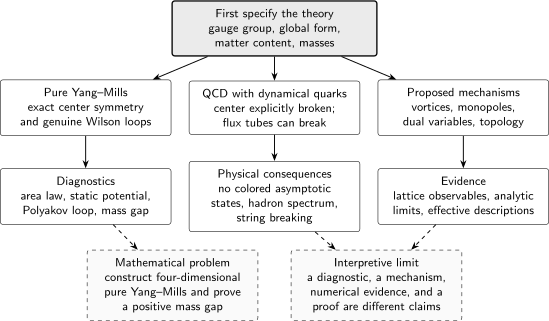
Confinement question map. Pure Yang–Mills and QCD with dynamical quarks have different exact symmetries and line diagnostics; proposed mechanisms and numerical evidence can support bounded physical claims but do not by themselves solve the axiomatic mass-gap problem. The diagram is schematic.
Definitions and tests
Section titled “Definitions and tests”The following matrix prevents a statement about one target from being promoted into another.
| Claim | Mathematical content | Suitable support | Evidential ceiling |
|---|---|---|---|
| Real-QCD color confinement | No isolated colored asymptotic states; only gauge-invariant hadronic states enter the physical -matrix | Hadron phenomenology plus nonperturbative calculations of color-singlet observables | Does not identify a unique mechanism or construct continuum QCD axiomatically |
| Pure-gauge static confinement | Nonzero asymptotic string tension for unscreened -ality | Wilson-loop limits with continuum and infinite-volume control | Does not cover dynamical fundamental quarks or imply a local spectral gap |
| Center realization | Broken or unbroken exact one-form or thermal center symmetry | Transformation law and an order parameter in the required limits | Exists only for the specified global form and matter content |
| Yang–Mills mass gap | above the vacuum in a constructed pure gauge theory | A proof satisfying the axioms in the official problem statement | Does not itself establish an area law or explain QCD hadronization |
| Infrared mechanism | Gauge-invariant dynamics producing specified observables | A controlled limit plus successful consequences beyond its defining diagnostic | Extrapolation outside that limit remains a hypothesis |
| Numerical determination | Regulated estimates of spectral, static, or topological quantities | Controlled volume, spacing, operator, and continuum systematics | Numerical evidence is not an axiomatic existence proof |
The matrix also separates definition from diagnostic: one may define the target as absence of colored asymptotic states and then use static energies, center symmetry, spectral functions, or numerical spectra as partial diagnostics. A mechanism must explain why the diagnostics cohere; a proof must meet the hypotheses of a theorem.
What proposed mechanisms establish
Section titled “What proposed mechanisms establish”No mechanism name is a conclusion by itself. Each proposal must be tagged by its controlled regime, gauge-invariant observables, treatment of dynamical matter, and known failure tests.
| Framework | Controlled foothold | Observable connection | Required qualification |
|---|---|---|---|
| Strong-coupling lattice expansion | Small plaquette coupling at fixed cutoff | Wilson-loop area law and flux-tube expansion | The continuum limit lies at a different end of bare-coupling space; persistence to that limit needs an independent argument |
| Dual superconductivity and monopole condensation | Abelian Higgs models and special supersymmetric or semiclassical theories | Electric flux tubes, magnetic disorder operators, string tension | Abelian projection is gauge dependent unless recast in gauge-invariant data; screening by dynamical matter must be included |
| Center-vortex disorder | Vortex ensembles and center-sensitive effective descriptions | -ality dependence and Wilson-loop disorder | Projection procedures and ensemble assumptions are not a continuum proof; local spectra and string breaking require separate checks |
| Semiclassical compactification | Small-circle theories with suitable deformation or matter and calculable topological saddles | Mass scales, center realization, and sometimes area laws | Adiabatic continuity to undeformed QCD is an additional dynamical claim |
| Functional and Gribov-region scenarios | Truncated continuum equations or gauge-fixed configuration-space restrictions | Gauge-fixed propagators, vertices, and selected bound-state kernels | Gauge-dependent infrared behavior is not itself a gauge-invariant confinement criterion |
For example, center-stabilized Yang–Mills theory on a small circle admits weak-coupling semiclassical control while retaining center symmetry Ünsal and Yaffe 2008, §§2–4. That is a controlled result in a related regime. Extending it continuously to large-circle pure Yang–Mills requires checking that no intervening transition or change of relevant degrees of freedom invalidates the continuation.
Similarly, Wilson’s strong-coupling expansion proves an area law in a lattice regime Wilson 1974, pp. 2445–2452. Asymptotic freedom places the continuum limit near weak bare coupling, so the strong-coupling series cannot simply be relabeled a continuum proof.
Failure tests for overstrong claims
Section titled “Failure tests for overstrong claims”Apply these tests before accepting a confinement or gap argument.
- Matter test: Can dynamical fields screen the probe representation? If yes, an asymptotic string tension for that probe is not an exact criterion.
- Gauge test: Is the proposed observable gauge invariant, or has a gauge-dependent quantity been mistaken for a physical conclusion?
- Limit test: Are infinite Euclidean time, large separation, thermodynamic volume, continuum spacing, chiral mass, and regulator removal taken in a stated order?
- Counterexample test: Would the same argument label a Higgs regime “confining,” or exclude a confining theory with massless color-singlet Goldstones?
- Continuity test: If a calculable deformation is used, what forbids a phase transition or change of operator content on the path to the target theory?
- Construction test: Does a claimed proof construct the continuum theory with the axioms required by the theorem, or only compute within a formal path integral?
Passing these tests does not select a unique mechanism; it states precisely what has and has not been established.
Typed continuations
Section titled “Typed continuations”- For mechanism-by-mechanism derivations, continue to Proposed Confinement Mechanisms and Their Observables.
- For the spectral problem itself, continue to The Non-Abelian Mass Gap as a Spectral Statement.
- For a comparison of evidence and open assumptions, continue to Confinement: Evidence, Mechanisms, and Open Problems.
- For regulated numerical diagnostics, continue to Wilson and Polyakov Loops, Static Energies, and Screening Diagnostics.
- For the axiomatic target and its exact hypotheses, continue to Yang–Mills Existence and Mass Gap.
Common pitfalls
Section titled “Common pitfalls”Equating a mass scale with the mass-gap theorem. Dimensional transmutation produces a renormalization-group scale, but showing that every nonvacuum physical state lies a positive distance above the vacuum is a nonperturbative spectral problem.
Treating agreement among gauge-fixed correlators as proof. Such correlators can be indispensable computational inputs. Their gauge dependence means the bridge to a gauge-invariant spectrum or line diagnostic must still be demonstrated.
Using “confinement” without a noun after it. Say whether the claim concerns colored asymptotic states, a static source of specified -ality, a center symmetry, a spectral gap, or a phenomenological hadronization model.
References
Section titled “References”- Fradkin, Eduardo, and Stephen H. Shenker. “Phase Diagrams of Lattice Gauge Theories with Higgs Fields.” Physical Review D 19 (1979): 3682–3697. DOI.
- Greensite, Jeff. An Introduction to the Confinement Problem. Lecture Notes in Physics 821. Berlin: Springer, 2011. DOI.
- Jaffe, Arthur, and Edward Witten. “Quantum Yang–Mills Theory.” In The Millennium Prize Problems, edited by James Carlson, Arthur Jaffe, and Andrew Wiles, 129–152. Providence, RI: American Mathematical Society and Clay Mathematics Institute, 2006; problem released 2000. Official PDF.
- Ünsal, Mithat, and Laurence G. Yaffe. “Center-Stabilized Yang–Mills Theory: Confinement and Large Volume Independence.” Physical Review D 78 (2008): 065035. DOI.
- Wilson, Kenneth G. “Confinement of Quarks.” Physical Review D 10 (1974): 2445–2459. DOI.