

Chiral Effective Theory and Nonlinear Symmetry
Chiral effective theory is the low-energy expansion for Goldstone bosons of a spontaneously broken approximate symmetry. Its fields are coordinates on the vacuum manifold, its symmetry acts nonlinearly on those coordinates, and its small parameters are derivatives and explicit-breaking scales divided by the first omitted scale. For low-energy QCD this architecture produces the pion Lagrangian and its loop expansion; it does not by itself determine how shallow nuclear channels must be iterated.
Required background. A Map of Effective-Theory Architectures supplies the common architecture card. Cosets and Nonlinear Realizations supplies the construction and compensating unbroken transformation used below.
Helpful background. Explicit Breaking and Pseudo-Goldstone Modes explains why weak breaking gives the Goldstones small masses rather than removing the nonlinear realization.
Goldstone coordinates turn symmetry into an expansion
Section titled “Goldstone coordinates turn symmetry into an expansion”Take two-flavor QCD in the limit . Ignoring the anomalous singlet axial transformation, its global chiral group and spontaneous breaking pattern are
The three pion fields coordinatize . A convenient matrix coordinate is
where are Pauli matrices and is the pion decay constant in the chiral limit. Another regular coordinate—stereographic coordinates, a square-root field with , or a different exponential convention—describes the same on-shell physics. The pion fields themselves are chart coordinates, not invariant observables.
In the exact symmetry limit, no nonconstant potential can be invariant under independent and : reduces every derivative-free invariant to a constant. Goldstone interactions therefore vanish with momentum. At two-derivative order the parity-even invariant is, up to normalization,
With no external sources, . Background left- and right-handed sources replace the ordinary derivative by a chiral covariant derivative, allowing current correlation functions and Ward identities to be generated without choosing a pion-field coordinate as an observable. Leutwyler proves that, subject to locality, clustering, Lorentz invariance, and the stated anomaly qualification, the low-energy generating functional can be represented by such a symmetry-invariant Goldstone action to all orders in the derivative expansion in Leutwyler 1994, §§ 2–9, printed pp. 2–26, Open PDF.
This is the nonlinear symmetry manifold branch of the architecture map. The branch selects the form of the fields and invariants, but the complete card still needs counting, matching inputs, an observable, an uncertainty, and a breakdown condition.
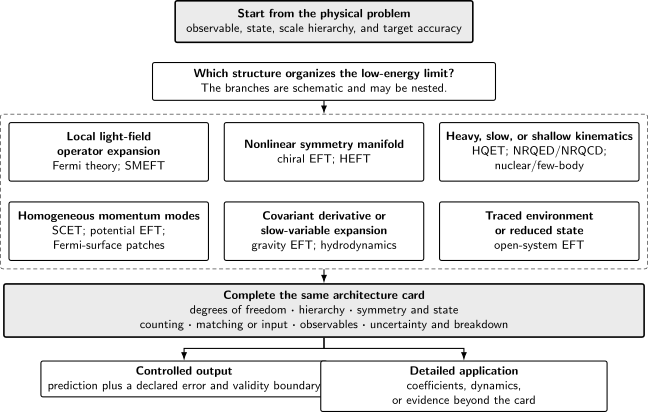
An EFT name is not a construction. Starting from the observable, state, scale hierarchy, and target accuracy, identify the dominant low-energy organizing structure, then declare degrees of freedom, symmetry and state, counting, matching or input, observables, uncertainty, and breakdown. Branches may be nested; the diagram is schematic and not to scale.
Explicit breaking is a spurion expansion
Section titled “Explicit breaking is a spurion expansion”The light-quark mass term couples left- and right-handed quarks,
Temporarily assign the mass matrix the transformation
One may then build formally invariant operators and only afterward set to its physical constant value. Define
where is a low-energy constant. The complete leading even-parity meson Lagrangian is
The spurion is a construction device, not a claim that the physical mass matrix transforms. Once it is frozen, it records precisely how the symmetry is broken and prevents symmetry-violating operators from appearing with unrelated coefficients. Leutwyler derives this extension of the invariance argument and the assignment of explicit-breaking parameters as spurions in Leutwyler 1994, § 10, printed pp. 27–29, Open PDF.
For the isospin-symmetric choice , expand to quadratic order:
Because an on-shell pseudo-Goldstone obeys , chiral counting assigns
Thus two derivatives and one quark-mass insertion enter at the same chiral order. For unequal masses the same spurion operator produces isospin breaking; electromagnetic sources and other weak breakings require their own transformation rules and counting. The power assignment is justified only while the induced pseudo-Goldstone masses remain well below the first omitted resonance or other non-Goldstone scale.
Chiral order closes under loops
Section titled “Chiral order closes under loops”Let a connected mesonic diagram contain loops and vertices of chiral order , where one mass-spurion insertion counts as two derivatives. Four-dimensional loop integration contributes four powers of momentum, an internal pion propagator contributes , and topology eliminates the number of internal lines. The net chiral order is
Every vertex has . Consequently only finitely many loop and vertex combinations contribute at fixed :
- consists of trees from ;
- consists of one-loop graphs made only from and trees with one insertion; and
- each additional loop raises the order by two powers of .
The one-loop divergences from are local and have the form of the symmetry-allowed operators. Their renormalized low-energy constants cancel the subtraction-scale dependence of the chiral logarithms. Schematically,
where the process-dependent tensors are fixed by the basis. The logarithm is not a complete prediction by itself: the scale-dependent local constants are required at the same order. Manohar derives the loop formula, its topological reduction, and the estimate in Manohar 1996, §§ 11–13, printed pp. 34–45, Open PDF.
A practical expansion parameter is
with set by the lowest omitted resonance, inelastic threshold, or other state rather than automatically by . A truncation claim should vary the kinematics and compare successive orders; changing only probes part of the omitted contribution. An anomaly can also require a Wess–Zumino–Witten term whose transformation reproduces the microscopic anomaly. It is an allowed, quantized addition to the architecture, not a failure of nonlinear symmetry.
First application: the leading pion amplitude
Section titled “First application: the leading pion amplitude”The construction can now be tested without fitting an operator list. Expanding the unique Lagrangian through four pion fields gives the tree amplitude
with
Here and are leading-order parameters; replacing them by physical and consistently shifts terms at higher order. This result passes four independent checks:
- Crossing: the three Kronecker structures permute with , , and .
- Soft behavior: in the chiral limit the amplitude vanishes when an external momentum is taken soft, reflecting derivative Goldstone couplings.
- Dimensions: is dimensionless, as a four-dimensional scattering amplitude must be in this normalization.
- Coordinate independence: a regular redefinition of changes off-shell vertices but not this on-shell amplitude.
Gasser and Leutwyler organize the current generating functional, the leading effective Lagrangian, its one-loop completion, and pion scattering in Gasser and Leutwyler 1984, §§ 3–7 and 17–18, pp. 147–159 and 179–182. The detailed extraction of , , higher-order constants, quark-mass information, and comparison with hadron data belongs to Chiral Lagrangians and Low-Energy QCD.
The chiral architecture card and its boundary
Section titled “The chiral architecture card and its boundary”This card specializes the common fields in the architecture comparison matrix to the Goldstone regime.
| Entry | Chiral-EFT choice |
|---|---|
| Degrees of freedom | Goldstone fields on , with matter fields added only when the target process requires them. |
| Hierarchy and state | , including derivatives and explicit-breaking scales, about the symmetry-breaking vacuum. |
| Symmetry and locality | Nonlinear realization of with local invariants and spurions for controlled explicit breaking. |
| Power counting | Derivatives, light masses, loops, and any declared matter-field expansion are assigned a homogeneous chiral order. |
| Matching and inputs | Low-energy constants are matched to the microscopic theory, lattice calculations, or data at a stated scale and scheme. |
| Observables | Soft amplitudes, current matrix elements, and low-energy hadronic observables within the declared field content. |
| Uncertainty | First omitted chiral order, low-energy-constant inputs, numerical errors, and the proximity of omitted resonances or inelastic thresholds. |
| Detailed application | Chiral Lagrangians and Low-Energy QCD. |
Nonlinear chiral symmetry continues to constrain theories containing nucleons, but it no longer supplies the entire infrared organization. A single baryon introduces a large mass and recoil expansion. Two or more nucleons can introduce anomalously large scattering lengths and shallow poles, so reducible diagrams are enhanced and selected interactions must be iterated. The counterterms required by that iteration depend on the few-body counting and regulator analysis, not on the pion derivative expansion alone.
This is why “chiral EFT” and “nuclear EFT” are not interchangeable. The former statement identifies Goldstone symmetry, spurions, and chiral order. The latter must additionally state whether pions are explicit, which channels are nonperturbative, how forces and currents are ordered, and how cutoff independence is demonstrated. Epelbaum, Hammer, and Meißner separate the natural mesonic hierarchy from the infrared enhancement of nuclear amplitudes in Epelbaum, Hammer, and Meißner 2009, §§ I.D and II.A, pp. 1778–1780 and 1784–1787. The next architecture is developed on Nuclear and Few-Body Effective Theory.
The same caution applies across subjects. HEFT also uses a nonlinear symmetry manifold, but its electroweak coset, scalar content, hierarchy, and loop counting differ from those of low-energy QCD; see SMEFT and HEFT: Linear versus Nonlinear Electroweak Realizations. Sharing a CCWZ construction does not make two EFTs the same architecture card.
Common pitfalls
Section titled “Common pitfalls”Writing a pion potential in the exact symmetry limit. A nonconstant derivative-free function of violates the independent left–right action. A potential becomes allowed only through spurions or other declared explicit breaking.
Counting quark masses as one derivative. Pseudo-Goldstone masses obey , so and count as . Counting them as destroys the loop hierarchy and mixes nominal orders.
Keeping only chiral logarithms at next order. One-loop logarithms and renormalized local constants occur together. The logarithm alone is generally scale dependent and is not a complete amplitude.
Treating a field parametrization as physical. Exponential and other regular coordinates change off-shell vertices. Only invariant currents, on-shell amplitudes, and consistently transformed sources may be compared.
Exporting mesonic counting unchanged to nuclei. Chiral symmetry still constrains operators, but shallow poles and reducible propagation can promote interactions and require iteration. That additional infrared decision belongs to the nuclear/few-body architecture.
References
Section titled “References”-
Epelbaum, Evgeny, Hans-Werner Hammer, and Ulf-G. Meißner. 2009. “Modern Theory of Nuclear Forces.” Reviews of Modern Physics 81 (4): 1773–1825. DOI. Open PDF.
-
Gasser, Jürg, and Heinrich Leutwyler. 1984. “Chiral Perturbation Theory to One Loop.” Annals of Physics 158 (1): 142–210. DOI. CERN record.
-
Leutwyler, Heinrich. 1994. “On the Foundations of Chiral Perturbation Theory.” Annals of Physics 235 (1): 165–203. DOI. Open PDF.
-
Manohar, Aneesh V. 1996. “Effective Field Theories.” Lectures at the Schladming Winter School. arXiv:hep-ph/9606222. Open PDF.