

Wilson and Polyakov Loops, Static Energies, and Screening Diagnostics
Wilson loops, Polyakov loops, and static-source correlators probe related but nonidentical physics. A large rectangular Wilson loop can yield a static energy; a Polyakov loop winds around Euclidean time and can diagnose center symmetry; a variational basis containing both flux-tube and two-hadron operators can reveal string breaking. None is a universal one-number definition of confinement on every finite lattice.
Required background. Use the path orientation and representations from links, plaquettes, and gauge invariance and the ensemble measure from the Wilson gauge action.
Helpful background. Genuine line spectra fix the global operator content, while confinement definitions and their non-equivalence prevent one loop diagnostic from being universalized.
Rectangular loops and the static spectrum
Section titled “Rectangular loops and the static spectrum”Local convention and regulator card. State the source representation , normalized trace, spatial and temporal spacings, boundary conditions, matter content, and every link-smearing or operator-basis choice. Quote and first in lattice units, retain the additive static-source convention, and distinguish zero-temperature rectangles from loops winding around a temporal extent .
For a rectangular contour of spatial extent and Euclidean-time extent ,
Transfer-matrix reasoning gives a spectral sum
when the action and operator admit that interpretation. The effective estimator
approaches the lowest static energy only after excited-state contamination is negligible. Spatial-link smearing changes the overlaps , not the exact energy spectrum, provided temporal transport and the action are left consistent.
contains a regulator-dependent static-source self energy. Its additive divergence cancels in forces, differences, or consistently defined subtractions. A fit such as
is a model over a stated distance window, not an identity at all .
The transfer interpretation and regulator-dependent static potential follow the Wilson-loop construction of Wilson 1974, pp. 2445–2459; high-precision static-potential analyses illustrate why correction terms and fit windows must remain explicit Bali, Schilling, and Wachter 1997, pp. 2566–2589.
Creutz ratios and their limitations
Section titled “Creutz ratios and their limitations”The Creutz ratio
cancels leading perimeter factors and approaches for sufficiently large, nearly square loops in an area-law regime. At finite loop size it retains corner, excitation, and cutoff corrections. Correlated loop measurements must be resampled together; treating the four logarithms as independent produces the wrong uncertainty.
An area law in a convergent strong-coupling region is an important regulated result. Extending it to the continuum requires evidence that the relevant phase connects to the chosen continuum trajectory without an obstructing transition and that the physical string tension scales correctly.
Polyakov loops and center symmetry
Section titled “Polyakov loops and center symmetry”At temperature , the temporal Polyakov loop is
In a pure gauge theory, a center transformation can multiply by a center phase while leaving the action invariant. In infinite volume, spontaneous breaking of that symmetry can distinguish thermal phases. On a finite lattice, exact symmetry gives unless a sector is selected; distributions, susceptibilities, and finite-size scaling are more informative than a raw mean.
Dynamical matter with nonzero center charge explicitly breaks this symmetry, so ceases to be an exact order parameter. It still relates to the free energy of a static probe after renormalization, but screening and string breaking change the interpretation.
The relation between Polyakov-loop observables, center symmetry, finite volume, and thermal QCD is reviewed in Philipsen 2013, pp. 55–107.
The correlator
also needs multiplicative Polyakov-loop renormalization or an equivalent additive convention for the static free energy.
String breaking needs an operator basis
Section titled “String breaking needs an operator basis”With dynamical matter, the ground-state static energy at large separation can be a pair of screened static-light states. A Wilson loop may have very small overlap with that state and show an apparent linear potential beyond the true avoided crossing. Use a correlation matrix containing both flux-tube and two-hadron operators,
then solve a generalized eigenvalue problem and check basis stability. String breaking is evidenced by the resolved spectrum and changing overlaps, not merely by failure to see an area law in one operator.
Which diagnostic supports which claim?
Section titled “Which diagnostic supports which claim?”| Observable | Direct finite-lattice information | Required qualification |
|---|---|---|
| Static-source spectral sum | Excited states, self energy, representation | |
| Creutz ratio | Perimeter-cancelled loop combination | Loop-size and cutoff corrections |
| distribution | Center-sector response around Euclidean time | Matter content, volume, renormalization |
| correlator | Static-pair free energy in a convention | Temperature, subtraction, screening |
| Flux-tube plus two-hadron matrix | Avoided crossing and state overlaps | Basis rank and finite volume |
| Strong-coupling area law | Controlled result in its convergence domain | Connection to continuum trajectory |
The map shows why all these loop observables remain on one branch while topology, flow, and gauge-fixed correlators answer different questions.
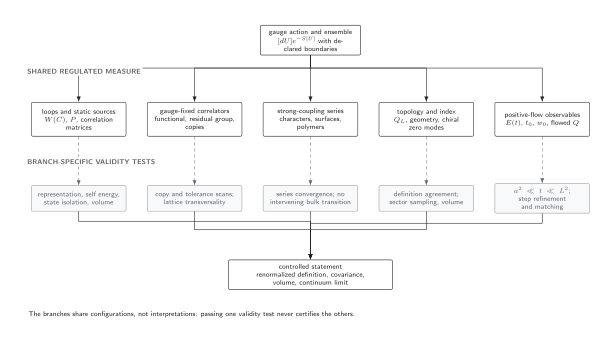
The loop branch requires representation, self-energy, state-isolation, and volume controls before a static or thermal interpretation. Other branches use the same configurations but cannot replace these tests. The diagram is schematic and not to scale.
Adversarial failure: a false string plateau from a nearly blind operator
Section titled “Adversarial failure: a false string plateau from a nearly blind operator”Let the true screened ground state have energy and the flux-tube state have , but let a Wilson loop overlap with the screened state only by :
The lower energy dominates only after
If noise ends the usable range before , can show a smooth, apparently stable linear plateau above the true ground state. More Wilson-loop smearing need not repair the missing overlap; adding screened two-hadron operators and resolving the avoided crossing is the adversarial test.
Observable-level validation checklist
Section titled “Observable-level validation checklist”- Check the Wilson-loop effective energy under later windows, several smearings, and a larger correlation-matrix basis.
- Remove or consistently parameterize the static self energy and verify forces or energy differences close under the chosen convention.
- Resample all four loops in a Creutz ratio jointly and vary the loop aspect ratio and minimum size.
- For Polyakov loops, inspect sector distributions and finite-size scaling, and state whether dynamical matter explicitly breaks center symmetry.
- For string breaking, demonstrate basis-rank stability of the two lowest energies and their overlaps near the avoided crossing.
Common pitfalls
Section titled “Common pitfalls”Calling a Polyakov loop a universal confinement order parameter. It is exact only when an appropriate center symmetry is exact and the infinite-volume limit is treated.
Reading a Wilson-loop plateau too early. A smooth effective energy can be an excited-state plateau. Vary , the smearing, and the operator basis.
Ignoring representation and screening. Sources with different center charge can be screened differently. State the representation and dynamical matter content.
Learning outcomes
Section titled “Learning outcomes”- From a rectangular-loop correlator, construct an effective static-energy estimator and diagnose self-energy, excited-state, loop-size, and covariance contamination.
- Given matter content and a set of loop and two-hadron correlators, distinguish a center-symmetry diagnostic, screening, and string breaking and specify the evidence needed for each claim.
Exercises
Section titled “Exercises”- If , find the leading correction to for time step .
Solution
Expanding the logarithm gives .
- Explain why on a finite pure-gauge lattice can coexist with a double- or multi-peaked center-sector distribution.
Solution
Finite-volume sampling restores the exact symmetry by visiting all center-related sectors, whose contributions cancel in the mean. The distribution and its volume dependence retain the phase information.
The chapter’s gauge convention table records the representation, contour, subtraction, and limiting procedure behind a loop observable.
References
Section titled “References”- Bali, G. S., Schilling, K., and Wachter, A. (1997). Complete corrections to the static interquark potential from SU(3) gauge theory. Physical Review D, 56, 2566–2589. DOI.
- Philipsen, O. (2013). The QCD equation of state from the lattice. Progress in Particle and Nuclear Physics, 70, 55–107. DOI.
- Wilson, K. G. (1974). Confinement of quarks. Physical Review D, 10, 2445–2459. DOI.