

Heavy-Particle EFT and HQET Architecture
Heavy-particle EFT retains a nearly on-shell heavy particle while removing the fluctuations tied to its rest mass. Writing with and , a phase removes the rapid rest-mass oscillation and velocity projectors separate the heavy-quark component from a component with an energy gap . Eliminating the latter gives the static HQET Lagrangian plus a controlled expansion. Because the split between and is redundant, reparameterization invariance relates different orders and fixes the kinetic coefficient.
Required background. A Map of Effective-Theory Architectures supplies the architecture-card test. The Dirac Field supplies the spinor projectors and propagator. Integrating Out Heavy Fields supplies the exact-elimination-then-local-expansion logic used for the small component.
Helpful background. One-Particle States: Mass, Spin, and Relativistic Normalization fixes the meaning of a timelike reference velocity. Decoupling Theorems and Threshold Corrections contrasts a retained heavy external line with a heavy species removed from low-energy states.
Reference velocity and residual motion
Section titled “Reference velocity and residual motion”Consider one heavy quark in QCD with mass parameter , moving inside a state whose soft momenta are characterized by a scale . Its momentum is decomposed as
The label is a future-directed unit four-velocity, while is residual momentum. Soft interactions change by but change the velocity only by . The choice of is part of this definition: replacing by shifts by and can be represented by a residual-mass term in the EFT. Matching coefficients and matrix elements must therefore use a compatible heavy-mass convention.
Using the inherited convention, define
The Clifford algebra and give
Remove the rest-mass phase and project the full Dirac field :
Both projected fields retain mass dimension . In the frame , contains the upper two components and describes a forward-propagating heavy quark with soft residual energy. The field contains the complementary components and carries an energy gap . This is a mode separation, not the claim that the physical state has lost its heavy quark.
Neubert constructs this split and its scale hierarchy in Neubert 1996, § 3.1, printed pp. 18–21, Open PDF.
Eliminating the gapped spinor component
Section titled “Eliminating the gapped spinor component”Define the transverse derivative
Substitution into gives
The equation for the gapped field is
so exact Gaussian elimination yields the gauge-covariant but nonlocal expression
The functional integral also produces a determinant of . In the single-heavy sector it can be regulated gauge covariantly and absorbed into normalization and hard matching; closed heavy-quark loops are short-distance contributions rather than loops of a velocity-conserving field.
The inverse is an operator, so its order between the two transverse derivatives matters. For residual derivatives much smaller than ,
With and , projection gives
Thus the renormalized HQET Lagrangian through first order in can be written
At tree level . Hard loops at the scale change this coefficient and the coefficients of currents; their logarithms are evolved to a lower renormalization scale. The kinetic coefficient remains one in a reparameterization-invariant formulation. Neubert derives the nonlocal action, local expansion, and dimension-five operator basis in Neubert 1996, §§ 3.1 and 4.1–4.3, printed pp. 18–23 and 28–35, Open PDF.
The leading term,
contains no heavy-quark mass and no spin matrix in its gluon coupling. For several heavy flavors at the same velocity, the soft dynamics is therefore invariant under rotations of the heavy spin and, at leading order, under changes of heavy flavor. The kinetic operator breaks flavor symmetry through ; the chromomagnetic operator also breaks spin symmetry. This symmetry statement concerns the soft EFT. It does not make the hard matching coefficients independent of the heavy flavor.
The HQET architecture card
Section titled “The HQET architecture card”This card specializes the common fields in the architecture comparison matrix to a retained heavy quark with small residual momentum.
| Card entry | HQET declaration |
|---|---|
| Degrees of freedom | A velocity-labelled heavy field , light quarks and gluons, and any additional light fields required by the observable; the gapped component and hard heavy loops are matched out. |
| Hierarchy and state | One or more heavy external lines with , usually ; each velocity sector and allowed momentum transfer are declared. |
| Symmetry | Gauge invariance, leading heavy-quark spin–flavor symmetry, and reparameterization invariance linking neighboring velocity labels. |
| Counting | Residual derivatives and soft masses count as ; local operators are ordered in , while hard coefficients also carry perturbative and logarithmic expansions. |
| Matching or input | Match QCD at a scale of order ; combine Wilson coefficients with renormalized hadronic matrix elements in the same scheme and mass convention. |
| Observables | Heavy-light amplitudes, current matrix elements, spectra, and decay expansions in a bounded recoil region. |
| Uncertainty | Missing orders, perturbative matching and running, matrix-element inputs, mass-scheme conversion, and any recoil or additional-scale expansion. |
| Validity boundary | Stop when residual or transferred momentum is not small relative to , pair creation becomes dynamical, or a heavy-pair hierarchy requires separate soft and ultrasoft modes. |
The figure places HQET on the heavy/slow/shallow branch. Inspect the shared card after that branch: retaining a heavy field does not remove the matching, uncertainty, and breakdown obligations.
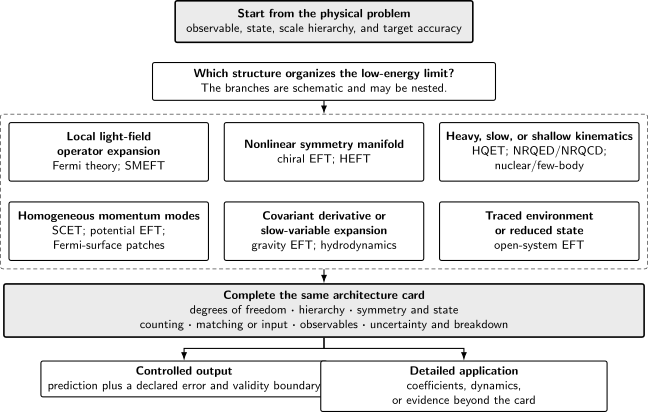
An EFT name is not a construction. Starting from the observable, state, scale hierarchy, and target accuracy, identify the dominant low-energy organizing structure, then declare degrees of freedom, symmetry and state, counting, matching or input, observables, uncertainty, and breakdown. Branches may be nested; the diagram is schematic and not to scale.
Reparameterization invariance fixes the kinetic term
Section titled “Reparameterization invariance fixes the kinetic term”The physical momentum does not determine and separately. For a soft four-vector ,
leaves unchanged. The field transformation includes the phase and a spin rotation that preserves the new projector. This redundancy is reparameterization invariance, the remnant of Lorentz invariance after introducing a velocity label.
A convenient covariant combination is
Under the simultaneous shift of the label and residual derivative, is invariant. Consequently the static term and kinetic correction cannot acquire unrelated coefficients. Modulo operators proportional to the leading equation of motion,
is the beginning of one reparameterization-invariant structure. A regulator and subtraction prescription preserving this redundancy therefore enforce
to all orders. Reparameterization invariance does not similarly fix , because the spin-dependent operator is not the required recoil completion of the static term.
Luke and Manohar derive the label shift, the invariant , and the nonrenormalization of the kinetic coefficient in Luke and Manohar 1992, §§ 1–4, pp. 2–8, Open PDF.
First application and independent checks
Section titled “First application and independent checks”The decomposition itself supplies the first application: starting from a massive Dirac field, the component survives at leading order and its Lagrangian is . Three checks expose normalization or sign errors.
Projected propagator. The full free propagator is
Set , project both ends with , and expand at fixed :
This is the propagator generated by the static Lagrangian. It also shows why the rest mass is absent without deleting the heavy state.
Recoil dispersion. For a free field, the static plus kinetic inverse propagator is
The full mass shell gives . Since on shell, , reproducing the EFT pole through . In the rest frame this becomes , fixing the sign of the kinetic term under the (+---) metric.
Symmetry breaking. At , the heavy spin does not occur in the interaction. The chromomagnetic term contains and is suppressed by , so it is the first local Lagrangian term that can resolve the heavy spin. This provides a structural check on the operator classification.
Detailed heavy-hadron symmetry relations, current matching, and phenomenology belong to Heavy-Quark Symmetry and HQET.
Heavy-light motion is not a heavy-pair potential regime
Section titled “Heavy-light motion is not a heavy-pair potential regime”HQET, ordinary decoupling, and nonrelativistic pair EFT answer different state questions.
| Situation | Correct low-energy treatment | Decisive feature |
|---|---|---|
| A heavy mediator never appears in low-energy external states | Integrate out the whole heavy field | All relevant invariants lie far below its pole and threshold. |
| A hadron or amplitude contains one nearly on-shell heavy quark coupled to soft fields | HQET or a related heavy-particle EFT | Keep the forward heavy line, remove its rest-mass oscillation, and expand in residual momentum over mass. |
| A heavy particle–antiparticle pair is near threshold | NRQED, NRQCD, and possibly a potential EFT | Pair creation channels and the scales , , and must be separated. |
| Momentum transfer changes the heavy velocity by order one | Multiple velocity sectors and hard current matching | A single residual-momentum expansion cannot absorb the recoil. |
In particular, the field integrated out above is not permission to omit a near-threshold antiquark when the target state actually contains a heavy pair. That regime is organized on NRQED, NRQCD, and Potential EFT Architecture.
Common pitfalls
Section titled “Common pitfalls”Treating as the only large scale statement. A large mass does not select HQET by itself. The target state must contain a nearly on-shell heavy particle whose residual and transferred momenta remain small relative to that mass.
Dropping the heavy field completely. HQET removes the rest-mass fluctuation and the gapped spinor component, not the external heavy quark. Removing the entire field gives a different EFT and cannot describe a heavy hadron.
Using and as independent observables. Only is physical. Dependence on the arbitrary split beyond the claimed order signals a violation of reparameterization invariance or inconsistent truncation.
Renormalizing the kinetic and static terms independently. In an invariant formulation their coefficients are related. The chromomagnetic coefficient can run, but the kinetic coefficient is fixed to one.
Applying HQET to quarkonium. A slow heavy pair has potential, soft, and ultrasoft scales and retains both particle and antiparticle sectors. Its architecture is NRQCD or a potential EFT, not single-line HQET.
References
Section titled “References”-
Luke, Michael E., and Aneesh V. Manohar. 1992. “Reparameterisation Invariance Constraints on Heavy Particle Effective Field Theories.” Physics Letters B 286 (3–4): 348–354. DOI. Open PDF.
-
Neubert, Matthias. 1996. “Heavy-Quark Effective Theory.” CERN-TH/96-281. Lectures presented at the 34th International School of Subnuclear Physics, Erice. arXiv record. Open PDF.