

Supercurrent Multiplets, Improvements, Anomalies, and Background Sources
The stress tensor, supersymmetry current, and often an current are not independent operators: supersymmetry packages them into a real vector superfield subject to a conservation equation. The most general standard four-dimensional package is the S-multiplet. It can be improved to the smaller Ferrara–Zumino multiplet only when a local, gauge-invariant, globally defined improvement removes its chiral spinor source; it can be improved to an -multiplet only when an exact continuous symmetry exists. FI terms and non-exact Kähler forms are genuine global obstructions to the usual Ferrara–Zumino representative.
This page supplies the flat-space operator data needed by rigid-background analyses. It does not construct dynamical supergravity or claim that a formal local improvement is globally admissible.
Required background. Gauge–Matter Systems, F- and D-Term Potentials, and FI Data supplies the Kähler and FI examples. Current Sources and Generating Functionals supplies the source definition of currents.
Helpful background. Spacetime Currents, Stress Tensors, and Charge Algebras and Contact Terms, Equal-Time Commutators, and Schwinger Terms clarify improvements and quantum contact terms.
The S-multiplet is the general current equation
Section titled “The S-multiplet is the general current equation”In four-dimensional superspace, let be real and let and obey
These equations contain a symmetric conserved stress tensor and a conserved supersymmetry current , together with additional operators that record traces, brane currents, and possible improvements. Conservation of the integrated charges still requires boundary fluxes to vanish. Defects or extended charged objects can make the additional closed-form currents physical rather than removable. Their relation to string and domain-wall charges is classified in Dumitrescu and Seiberg 2011, §§2–3, arXiv v4, Open PDF.
For any real superfield , the transformation
preserves the conservation equation in the convention above. In components it shifts and by identically conserved derivatives. The integrated charges agree only if the corresponding surface terms vanish. More importantly, must be a well-defined local operator on the whole field space, invariant under gauge transformations and compatible with boundaries. A nonlocal solution of the improvement equation is not an allowed current improvement.
The S-multiplet, its components, and these coefficients are derived in Komargodski and Seiberg 2010, §§1–2, arXiv v4, pp. 2–9, especially eqs. (1.11), (2.1), and (2.6), Open PDF. Their paper uses Wess–Bagger conventions; the displayed equation has been kept as a complete convention package rather than mixing individual signs with another source.
The map below follows the two improvement questions separately. Inspect the condition on each arrow: solving for locally is only the first step, and a blocked branch leaves the larger S-multiplet as valid physical data.
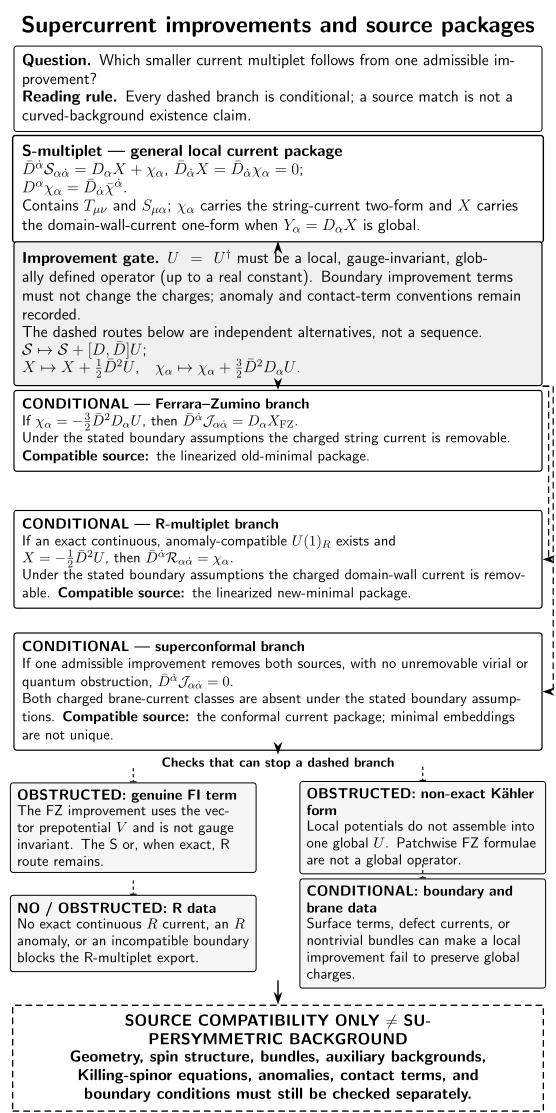
A real improvement must be local, gauge invariant, globally defined, and compatible with boundary fluxes. Removing gives the FZ branch and removes its charged string-current class under those surface hypotheses; removing with an exact anomaly-compatible symmetry gives the R branch and removes its charged domain-wall-current class under the analogous hypotheses. The source matches are linearized compatibility statements, not claims that a particular curved background preserves supersymmetry.
Structured relationships and obstruction statuses provide the nonvisual equivalent of every branch.
Ferrara–Zumino and R multiplets are conditional improvements
Section titled “Ferrara–Zumino and R multiplets are conditional improvements”The important special cases are:
Ferrara–Zumino multiplet. If a well-defined real solves
then the improved spinor source vanishes and
This is the Ferrara–Zumino (FZ) multiplet. It packages operators and is the current source compatible with the standard old-minimal linearized background. The original current multiplet was constructed in Ferrara and Zumino 1975, pp. 207–220.
R-multiplet. If a well-defined real solves
then the improved chiral scalar source vanishes and
Its bottom component is a conserved continuous current. Conversely, an exact continuous symmetry gives an R-multiplet under the usual locality and operator assumptions. This multiplet is the source compatible with the new-minimal linearized background.
Old- and new-minimal here name linearized source packages, not a proof that a chosen curved metric preserves a supercharge. Freezing supergravity auxiliaries to obtain a rigid background is a separate step; see Festuccia and Seiberg 2011, §§1–2, arXiv v2, Open PDF.
Superconformal representative. If allowed improvements remove both source superfields, the supercurrent can be made gamma-traceless and the stress tensor traceless. In a unitary theory this is the current structure of a superconformal fixed point, subject to the usual assumptions excluding an unremovable virial obstruction. Scale invariance or a vanishing beta function written in one scheme is not by itself the required operator statement.
Global obstructions decide which multiplet exists
Section titled “Global obstructions decide which multiplet exists”For chiral fields with Kähler potential and superpotential , a local FZ expression contains . Under a Kähler transformation , the change is locally an improvement. If the Kähler form is not exact, no single global exists, so the proposed improvement operator fails to patch globally. The sigma-model action remains valid, but the global FZ operator does not.
For an Abelian FI term, the natural FZ expression is not gauge invariant: the needed improvement contains the vector prepotential , which shifts under a gauge transformation. Again the rigid action can be well-defined while the smaller current multiplet is obstructed. These two obstructions and their infrared consequences are established in Komargodski and Seiberg 2010, §§3–4, arXiv v4, pp. 10–17, Open PDF.
An exact symmetry can still permit the R-multiplet in some such theories. If neither a global FZ improvement nor an exact symmetry exists, retain the S-multiplet. It is not a failure or an anomaly; it is the correct larger operator package.
Two models make the improvement test concrete
Section titled “Two models make the improvement test concrete”For chiral fields with Kähler potential and superpotential , one convention-compatible S-multiplet is
In a canonical Wess–Zumino model, is one globally defined, gauge-invariant operator. The choice
therefore gives
The model admits an FZ multiplet. An R-multiplet is a separate question: the superpotential and quantum theory must possess an exact continuous .
Now take the anomaly-free Abelian pair from the gauge–matter page, with charges , , and the genuine FI term in the site convention. The same formal FZ choice contains
Because shifts under a chiral supergauge transformation, is not a gauge-invariant operator when . Thus the S-multiplet exists but the standard FZ representative is obstructed. The classical assignment preserves and makes the matter contribution to the mixed – anomaly vanish; an R-multiplet is nevertheless recorded as conditional until the full quantum anomaly, regulator, boundary, and contact-term checks are supplied. This example shows why one must decide the FZ and R branches independently.
Background and twist eligibility record
Section titled “Background and twist eligibility record”“Conditional” means the named operator and global checks must be supplied; it never means “true in a convenient patch.” A flat-space multiplet can provide input for a later twist or rigid background, but it cannot settle the Killing-spinor, bundle, contour, or global-geometry tests by itself.
| Theory assumptions | S-multiplet status and reason | FZ status and reason | Exact R symmetry and R-multiplet status and reason | String-current status | Domain-wall-current status | Admissible linearized source package | Anomaly and contact-term status | Boundary and bundle status | Twist input status — not a verdict | What to carry forward and what remains open |
|---|---|---|---|---|---|---|---|---|---|---|
| Ordinary Wess–Zumino model; one global canonical ; no FI term; exact continuous symmetry not assumed | yes — the local S equation exists and contains the conserved stress tensor and supercurrent | yes — is local, gauge invariant, and global in this model | conditional — an R-multiplet exists only after an exact continuous, anomaly-compatible and its global improvement are supplied | no — an admissible FZ multiplet removes the charged string-current class when the stated surface terms vanish | conditional — superpotential vacua can support walls unless an admissible R-multiplet removes their charged current | yes — FZ data admit the old-minimal linearized source; R data admit the new-minimal source only when the conditional check passes | conditional — fix the composite-operator scheme, local counterterms, and any quantum anomaly | conditional — require trivial improvement patching and vanishing improvement flux at the boundary | conditional — an exact current is a possible input; geometry, bundles, and a preserved supercharge remain untested | conditional — carry forward the S and FZ multiplets; still determine whether an exact R symmetry exists and fix anomalies, contact terms, boundaries, and background geometry |
| Nonlinear sigma model with non-exact Kähler form; local Kähler potentials only; exact continuous symmetry not assumed | yes — the S-multiplet is global even though a single Kähler potential is not | obstructed — the required fails to patch globally, so a patchwise FZ formula is not a global operator | conditional — an exact continuous, anomaly-compatible action and one global R improvement must be exhibited | conditional — the nontrivial Kähler class permits a string-current obstruction, but an actual charged string is model dependent | conditional — determined by the superpotential and by whether a valid R improvement exists | conditional — use an R/new-minimal source if the R check passes; otherwise retain the larger S source package rather than a minimal FZ source | conditional — operator mixing and local counterterms must respect Kähler patching; anomalies remain separate | obstructed — the FZ bundle patching fails; boundary and defect fluxes still require an independent check | conditional — exact R data may be exported, but neither twist nor curved-background existence follows from the flat-space row | conditional — carry forward the S-multiplet and the Kähler-class obstruction to FZ; still establish exact R data, anomalies, boundaries, and background geometry |
| Abelian gauge theory with a genuine FI term and an exact continuous, anomaly-compatible | yes — the gauge-invariant S-multiplet remains the general current package | obstructed — the needed improvement contains the gauge-variant prepotential | yes — the assumed exact continuous current supplies a gauge-invariant R-multiplet | conditional — the FI obstruction permits a charged string current; an actual vortex and its charge require the model and boundary conditions | no — an admissible R-multiplet removes the charged domain-wall-current class when surface terms vanish | yes — R data admit the new-minimal linearized source; the S package is the nonminimal fallback, not an FZ source | conditional — anomaly freedom is assumed, but contact terms and counterterms must still be frozen | conditional — gauge bundles, vortex flux, and surface terms must be supplied explicitly | conditional — an exact current is present, but the twist homomorphism and preserved-supercharge equations remain untested | conditional — carry forward the S and R multiplets and the FI obstruction to FZ; still fix bundle and vortex sectors, contact terms, boundaries, and background geometry |
| Abelian gauge theory with a genuine FI term and no exact continuous | yes — the S-multiplet is the correct indecomposable current package | obstructed — the FZ improvement is gauge variant because it contains | no — by assumption there is no exact continuous current and hence no R-multiplet | conditional — an FI string-current class is allowed, while charged strings depend on the spectrum, vacuum, and boundary data | conditional — the S package does not by itself remove the domain-wall-current class | conditional — neither minimal source applies; only the larger linearized S source package with its extra chiral or linear field is a candidate | conditional — the classical FI obstruction is not an anomaly; quantum contact terms and gauge anomalies are separate inputs | conditional — gauge-bundle, defect, and boundary-flux data are required | no — the standard continuous- twist input is absent; other twisting structures are outside this row | conditional — carry forward the S-multiplet, the FI obstruction to FZ, and the absence of continuous R symmetry; still resolve anomalies, bundles, boundaries, the nonminimal source, and background geometry |
| Pure four-dimensional Yang–Mills; classical broken quantum mechanically to a discrete subgroup | yes — the local S equation and its conserved stress tensor and supercurrent exist | yes — a gauge-invariant FZ representative exists | no — the anomalous continuous current does not define an exact R-multiplet | no — the FZ representative excludes a charged string-current class when the boundary assumptions hold | yes — the gapped vacua of simply connected support stable domain walls Delmastro and Gomis 2021, abstract, consistently obstructing an R-multiplet | yes — FZ data admit the old-minimal linearized source; an R/new-minimal source is unavailable | yes — the continuous anomaly is material and must remain in the operator and contact-term record | conditional — wall sectors and charge normalization require asymptotic vacua and boundary conventions | no — the standard continuous- twist input is absent; a discrete symmetry is not a replacement | conditional — carry forward the S and FZ multiplets, the continuous-R anomaly, and the domain-wall sector; still fix contact terms, boundary data, and background geometry |
| Unitary superconformal theory with one admissible global improvement removing both source superfields; no unremovable virial obstruction | yes — the S package exists before improvement | yes — the common improvement yields an FZ representative | yes — the same admissible improvement supplies the exact superconformal current and R-multiplet | no — the charged string-current class is removed under the boundary assumptions | no — the charged domain-wall-current class is removed under the boundary assumptions | yes — the conformal current package is admissible; old- and new-minimal embeddings are available but are not unique background choices | conditional — Weyl and ‘t Hooft anomalies and contact terms remain even when the flat-space current is superconformal | conditional — global bundles, defects, and boundary conditions can still modify the export | conditional — exact data are available, while the twist map and Killing-spinor problem remain separate | conditional — carry forward the superconformal, FZ, and R representatives; still determine anomaly-polynomial, contact-term, bundle, boundary, and background-geometry data |
| Any bulk theory whose boundary, defect, bundle, or asymptotic flux data have not been specified | conditional — the local bulk S equation exists, but the exported conserved charges require a boundary completion | unknown — a bulk FZ improvement is insufficient until its surface term and global patching are checked | unknown — exact bulk data are insufficient until anomaly inflow and boundary conservation are checked | unknown — defect and surface contributions can change the integrated charge | unknown — wall and junction currents depend on the missing asymptotic and boundary data | unknown — no source package should be selected from incomplete global data | unknown — anomaly inflow, local counterterms, and contact prescriptions are missing | unknown — this is the blocking field of the row | unknown — do not export a twist input until the missing global data are supplied | unknown — the current-multiplet choice remains open; still supply anomalies, contact terms, bundles, defects, boundaries, and background geometry |
Each row additionally requires a conserved stress tensor and supercharge, boundary conditions with no unwanted flux, and a regulator/renormalization scheme in which the operator equations and contact terms are defined.
Improvements do not erase anomalies or contact terms
Section titled “Improvements do not erase anomalies or contact terms”At the quantum level, and can contain trace, -current, and supersymmetry anomaly operators. Their precise decomposition depends on improvements, composite-operator mixing, local counterterms, and contact-term conventions. A beta function may appear in a component of an anomaly multiplet, but one cannot identify the full multiplet from a beta function alone.
To define the current operators, couple the theory to background sources and differentiate the renormalized generating functional. Then record:
- which background fields source , , and any current;
- the local counterterms that shift contact terms and improvements;
- perturbative and global anomalies of the background symmetries;
- boundary inflow or defect currents; and
- whether the conservation equation holds as an operator identity, inside separated-point correlators, or only modulo contact terms.
This prevents an allowed improvement at separated points from being mistaken for equivalence of all generating functionals on curved or topologically nontrivial backgrounds.
A selection procedure
Section titled “A selection procedure”For a specified theory, use this order:
- Construct or identify the S-multiplet and verify its conservation equation.
- List FI terms, Kähler patches, defects, boundaries, and gauge/global data.
- Ask whether a local, gauge-invariant, global removes . If so, an FZ multiplet exists.
- Independently ask whether an exact continuous, anomaly-compatible exists and whether a global removes . If so, an R-multiplet exists.
- Record residual improvements and the boundary terms they induce.
- Carry forward the selected multiplet, obstruction, anomaly, and contact-term data—never just the name “FZ” or “R.”
The later rigid-background analysis uses these data. It must not infer a background formulation from local flat-space equations alone.
Common pitfalls
Section titled “Common pitfalls”Treating improvement as algebraic equation solving. A formal may be nonlocal, gauge variant, or defined only on one Kähler patch. Any of those failures blocks the improvement as an operator statement.
Calling absence of the FZ multiplet an anomaly. FI and Kähler obstructions can be present already classically. They say that a smaller current package is not global, not that supersymmetry is broken.
Equating an R-charge assignment with an exact R symmetry. The superpotential, gauge anomalies, mixed anomalies, quantum measure, and boundary conditions must all preserve the current.
Exercises
Section titled “Exercises”1. Improve the S equation. Verify that the three shifts preserve .
Solution
Apply to and use the superspace derivative algebra. The result splits into and , exactly the shifts of and . Because is real, the linear constraint on is preserved as well.
2. Diagnose a patchwise Kähler potential. Why does preserve the action but not automatically give a global FZ improvement?
Solution
The full superspace integral of a holomorphic plus antiholomorphic function is a boundary term, so the local actions patch. An improvement requires one globally defined operator . If the Kähler class is nontrivial, the local potentials do not assemble into such an operator; the FZ representative is therefore obstructed even though the metric and action are global.
Where the compatibility data go
Section titled “Where the compatibility data go”Supercurrent Multiplets and Rigid-Background Compatibility maps this flat-space record to nondynamical backgrounds. Rigid Supersymmetry on Curved Backgrounds then tests whether a chosen background preserves a supercharge. Dynamical supergravity remains outside this chapter.
References
Section titled “References”- Delmastro, Diego, and Jaume Gomis. “Domain Walls in 4d Supersymmetric Yang–Mills.” Journal of High Energy Physics 2021, no. 3 (2021): 259. DOI. Open PDF, arXiv v2.
- Dumitrescu, Thomas T., and Nathan Seiberg. “Supercurrents and Brane Currents in Diverse Dimensions.” Journal of High Energy Physics 2011, no. 7 (2011): 095. DOI. Open PDF, arXiv v4.
- Ferrara, Sergio, and Bruno Zumino. “Transformation Properties of the Supercurrent.” Nuclear Physics B 87, no. 2 (1975): 207–220. DOI.
- Festuccia, Guido, and Nathan Seiberg. “Rigid Supersymmetric Theories in Curved Superspace.” Journal of High Energy Physics 2011, no. 6 (2011): 114. DOI. Open PDF, arXiv v2.
- Komargodski, Zohar, and Nathan Seiberg. “Comments on Supercurrent Multiplets, Supersymmetric Field Theories and Supergravity.” Journal of High Energy Physics 2010, no. 7 (2010): 017. DOI. Open PDF, arXiv v4.
Further reading
Section titled “Further reading”- Weinberg, Steven. The Quantum Theory of Fields, Volume III: Supersymmetry. Cambridge: Cambridge University Press, 2000, §§26.6–26.7, pp. 86–101. DOI.