

Coulomb Branches and the Abelian Low-Energy Theory
At a generic point of a rank- Coulomb branch, the nonabelian gauge group is broken to . The light two-derivative Wilsonian theory contains abelian vector multiplets. Its couplings vary holomorphically over the branch, but a local electric description fails wherever an omitted charged state becomes massless.
Required background. multiplets and branches supplies the microscopic fields, and singular loci and light degrees of freedom supplies the EFT diagnostic. Helpful background. Moduli-space metrics and corrections distinguishes the classical quotient metric from the quantum one.
Abelianization at a regular point
Section titled “Abelianization at a regular point”Let the semiclassical adjoint expectation value be . A root vector has mass set by
with the proportionality fixed by the gauge-field normalization. Away from root hyperplanes and matter mass loci, every non-Cartan field is massive. At energies
integrate those fields out and retain abelian vector multiplets.
Gauge-invariant coordinates on the Coulomb branch are not generally the scalar fields with canonical abelian kinetic terms. On a local patch choose special coordinates , , adapted to an electric polarization. Their magnetic duals are . On a weak-coupling patch the approach a declared linear normalization of ; away from that limit they are periods and should not be identified with adjoint eigenvalues.
The condition “regular point” includes more than a smooth coordinate: the discriminant is nonzero, the chosen light-field set is complete, and is positive.
The two-derivative Wilsonian action
Section titled “The two-derivative Wilsonian action”In superspace, combine each abelian vector with a chiral field . A local holomorphic prepotential gives
One conventional normalization is
It yields scalar metric
and Maxwell/theta couplings from the real and imaginary parts of . The factor and the ordering of are conventions; period, charge, and action normalizations must be translated together.
The prepotential controls the Wilsonian two-derivative vector-multiplet action. It does not encode generic four-derivative interactions, the complete BPS spectrum, hypermultiplet metrics, or the theory exactly at a singular point. The abelian action and its special-coordinate interpretation are developed in Seiberg and Witten 1994, §2.3.
Wilsonian versus 1PI descriptions
Section titled “Wilsonian versus 1PI descriptions”Choose a Wilsonian scale satisfying
Integrating out modes above produces a local derivative expansion. The holomorphic coupling in this action can be singular as because the scale window collapses.
The 1PI action also integrates over massless photons and can contain nonlocal infrared terms. Calling every coupling “the effective prepotential” hides this difference. Seiberg–Witten geometry determines the exact two-derivative Wilsonian couplings on regular patches; infrared observables may require additional massless-loop resummation.
Central charges and light particles
Section titled “Central charges and light particles”Electric and magnetic charges form an integral lattice. In a local basis,
where are flavor charges. The central charge is
and a BPS particle, if present, has
The exact periods make this an exact mass formula conditional on state existence and stability. The lattice alone does not assert a state for every . A textbook treatment of the effective action, central charges, and duality is given in Weinberg 2000, chs. 27–29.
If , the corresponding BPS state can become massless. Mutually local light hypermultiplets can be made electric and included in a local QED patch, which is regular even though the photon-only coupling has a logarithm. Massless charged vector multiplets instead require restoring the nonabelian gauge multiplets that were integrated out. If light charges are mutually nonlocal, no single ordinary electric Lagrangian contains them all.
The next figure separates the base coordinate, fiber data, periods, local prepotential, and transported charge. Follow the solid arrows to see which quantities determine the two-derivative EFT, then follow the dashed patch-change arrow to see why the central charge remains invariant.
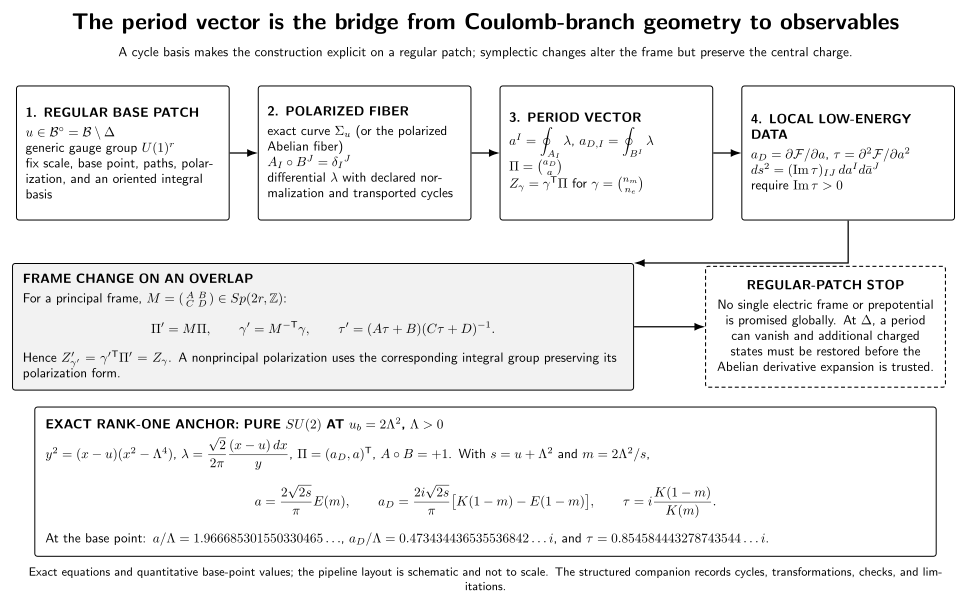
On a regular patch, the curve, differential, oriented cycles, and normalization produce , from which , , and the metric follow locally. Across a symplectic patch change, and , so is unchanged. The rank-one inset uses the chapter’s frozen pure- convention; the diagram is schematic, while its equations and checks are available in the structured period-map record.
One-loop asymptotics
Section titled “One-loop asymptotics”For pure at large , the charged multiplets give
up to convention-dependent quadratic terms and the normalization of . Hence
again modulo an allowed term proportional to from the declared lattice-compatible theta-angle shear. Instanton corrections are suppressed by powers of .
The logarithm predicts monodromy around infinity. It does not locate the strong-coupling singularities by itself; global holomorphy, discrete symmetries, and the exact periods complete the solution.
Global form and charge normalization
Section titled “Global form and charge normalization”The Lie algebra determines the local Coulomb-branch dimension, but the global gauge group determines allowed Wilson–’t Hooft charges. Choosing versus changes the genuine-line lattice and the subgroup of electromagnetic transformations acting within a fixed theory.
The low-energy gauge fields therefore come with an integral polarization inherited from the ultraviolet theory. A real linear change of photon basis that does not preserve the lattice is not an allowed quantum duality frame.
Patch validity
Section titled “Patch validity”A local abelian patch is valid when:
- every omitted charged mass is larger than the Wilsonian scale;
- all retained light charges are mutually local in the chosen polarization;
- is positive;
- the derivative expansion is controlled;
- the patch does not cross a branch intersection requiring hypermultiplet moduli;
- period and charge bases are continued consistently.
Violating the second condition can signal a strongly interacting singularity rather than a missing weakly coupled field.
Common pitfalls
Section titled “Common pitfalls”Using as if it were the special coordinate. In pure , only asymptotically; the exact relation is corrected.
Calling the photon-only action singular physics. A divergent coupling often means a charged state that was integrated out has become massless.
Treating the prepotential as global. Monodromy mixes and , so different patches can require different polarizations and prepotentials.
Exercises
Section titled “Exercises”Assume rank one with and constant . For charge :
- write the central charge;
- find the locus where it vanishes;
- explain why this constant-coupling toy model cannot describe an isolated finite Coulomb-branch singularity unless .
Solution
Since are real integers and , cannot vanish for nonzero . Thus only at . An isolated singularity at some other requires nontrivial variation and monodromy of the periods; a globally constant coupling cannot supply it.
References
Section titled “References”- Seiberg, Nathan, and Edward Witten. “Electric–Magnetic Duality, Monopole Condensation, and Confinement in Supersymmetric Yang–Mills Theory.” Nuclear Physics B 426 (1994): 19–52; erratum 430 (1994): 485–486. arXiv:hep-th/9407087.
- Weinberg, Steven. The Quantum Theory of Fields, Volume III: Supersymmetry. Cambridge University Press, 2000, chs. 27–29. doi:10.1017/CBO9781139644198.