

The Witten Index, Vacuum Counting, and Its Failure Modes
The Witten index is a signed count of supersymmetric ground states, not an ordinary count and not automatically a well-defined trace. Under precise trace-class or Fredholm hypotheses it is independent of Euclidean time and of supersymmetry-preserving deformations. A nonzero value proves that supersymmetry is unbroken; a zero value proves nothing by itself.
Required background. The spectral-pairing theorem supplies the cancellation of positive-energy states. Helpful background. The Fredholm index gives the operator-theoretic formulation, while Morse deformation and the continuum and boundary analysis exhibit the principal ways a naive counting argument can fail.
The graded heat trace
Section titled “The graded heat trace”Let
with self-adjoint, , and . For , define
This definition is literal if is trace class. More generally, one may define a relative supertrace after specifying a regulator and proving that the even–odd difference has a regulator-independent limit. Without one of these statements, the displayed expression is only formal.
For the closed differential used throughout this chapter,
If is Fredholm, its range is closed and its kernel and cokernel are finite dimensional. Its analytic index is
Whenever the graded heat trace exists and the positive spectrum is paired without a contribution from infinity,
The first equality is the spectral version of the Fredholm index theorem in this setting; the assumptions that make it legitimate are as important as the formula. See Cooper, Khare, and Sukhatme 1995, §2.2, arXiv PDF pp. 23–25 and Weinberg 2000, §29.1, pp. 248–255.
Why positive energies cancel
Section titled “Why positive energies cancel”Suppose first that has discrete spectrum of finite multiplicity and that the heat trace converges. The pairing maps
are inverse up to the factor for every . Thus , and the contribution of that eigenspace to is zero. Only
survives. This eigenbasis proof is often safer than manipulating unbounded supercharges inside a trace.
There is also a useful formal calculation. Where differentiation and graded cyclicity are justified,
The last equality uses that is odd and commutes with : graded cyclicity changes the sign of one term and cancels the other. For unbounded , one must first know that the relevant products admit trace-class closures. The slogan “the supertrace of a supercommutator vanishes” is not a substitute for that analytic check.
Spectral pairing and the index flow
Section titled “Spectral pairing and the index flow”The figure follows a state from exact positive-energy pairing to the protected zero-mode difference, and then marks the continuum threshold where an eigenstate-by-eigenstate trace argument stops. Inspect which arrows are exact Hilbert-space maps and which conclusions require a regulator or Fredholm hypothesis.
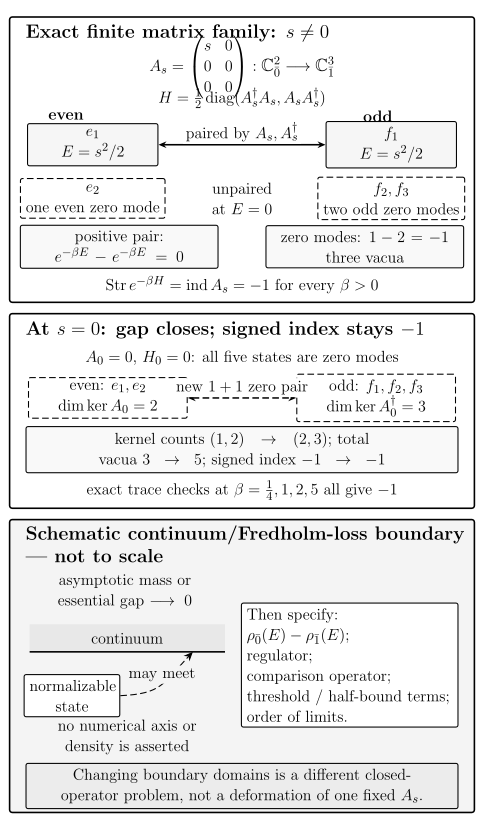
The first two panels are exact for the displayed finite matrix family: on its isolated eigenspaces, and are inverse isometries, while its normalizable kernel states remain unpaired and give . The continuum panel is schematic and not an energy-level plot to scale. There generalized states are not Hilbert-space vectors; a matched relative regulator, scattering normalization, and threshold prescription are part of the index statement.
The semantic table separates the exact statements from their failure modes:
| Spectral regime | Supersymmetric map | Contribution to the graded trace | Strongest justified conclusion |
|---|---|---|---|
| Isolated eigenspace | and are inverse isometries | Equal even and odd multiplicities cancel | Positive-energy pairing is exact on the stated domains. |
| Normalizable states | and need not pair | This equals when is Fredholm. | |
| Continuous family of Fredholm operators | Kernel dimensions may change by even–odd pairs | The analytic index remains locally constant | Total vacuum degeneracy may change even though the signed index does not. |
| Continuum or closing threshold | Polar decomposition pairs positive spectral subspaces, but box-normalized densities can differ | A relative density integral and threshold terms replace a literal trace | The result may depend on or the regulator; no index claim is valid until the prescription is fixed. |
Deformation invariance and its hypotheses
Section titled “Deformation invariance and its hypotheses”Let be a differentiable family of densely defined closed odd differentials with a fixed grading. Require and for every . Assume also a compatible common invariant core on which , , and the composite operators below are defined, and let
On that core,
If the composite domains define self-adjoint , the domains vary smoothly in a controlled quadratic-form sense, the heat-kernel derivatives are trace class, and a uniform trace bound permits Duhamel differentiation, one must also justify the heat-semigroup commutation relations
on the products entering the trace. Nilpotence gives the formal commutators; the domain and trace assumptions make them operator identities usable under graded cyclicity. Under all these hypotheses,
Equivalently, a gap-continuous family of closed Fredholm differentials—or a norm-continuous family of their bounded transforms—has constant Fredholm index. These are two versions of the same stability statement. The original use of this protected count to constrain supersymmetry breaking is developed in Witten 1982, §§1–2, pp. 253–271.
The conclusion can fail when any hypothesis fails:
- an asymptotic mass tends to zero and ceases to be Fredholm;
- a normalizable zero mode escapes to infinity or merges into a continuum;
- the boundary condition, and hence the operator domain, changes;
- the zero-energy kernel becomes infinite dimensional;
- the regulated even and odd traces exist separately only after incompatible subtractions; or
- a limit in volume, , or deformation parameter is interchanged without uniform convergence.
The Gaussian deformation on the line is a concrete warning: conjugation by an unbounded function can create an zero mode even though the deformed complexes are algebraically isomorphic on compactly supported forms.
Three models with two index values
Section titled “Three models with two index values”The index distinguishes a signed imbalance, not the total number of vacua.
| Model | Even zero modes | Odd zero modes | Index | Supersymmetry |
|---|---|---|---|---|
| Harmonic superpotential , | 1 | 0 | Unbroken | |
| de Rham complex of | 1 | 1 | Unbroken | |
| on | 0 | 0 | Broken |
For , the constant function and constant one-form are both harmonic. Their contributions cancel, so the index is the Euler characteristic even though there are two supersymmetric vacua.
For , write
The formal even and odd zero modes are and . Each decays at one end of the line and grows at the other, so neither lies in . The zero index now accompanies broken supersymmetry. Thus the same value realizes opposite physics.
What vacuum counting can establish
Section titled “What vacuum counting can establish”When the index is defined,
Consequently:
- guarantees at least supersymmetric vacua and rules out spontaneous supersymmetry breaking.
- allows either no supersymmetric vacuum or equal nonzero numbers of even and odd vacua.
- an undefined or regulator-dependent “index” supports neither conclusion.
The index can remain constant while the total number of ground states changes: an even–odd pair may meet zero energy or leave it together. Detecting that extra information requires the cohomology groups themselves, a refined index, or additional quantum numbers—not the ordinary signed trace.
Periodic fermions, not a thermal partition function
Section titled “Periodic fermions, not a thermal partition function”In a Euclidean path-integral representation, taking the trace identifies the bosonic endpoint. Inserting changes the fermionic gluing from antiperiodic to periodic:
Periodic fermions preserve the constant supersymmetry parameter and expose fermion zero modes. This is why localization and semiclassical deformation can compute the index. It is also why should not be called a thermal partition function: the physical thermal trace has antiperiodic fermions. The boundary-condition distinction is derived in Cooper, Khare, and Sukhatme 1995, §8, arXiv PDF pp. 79–85.
Continuous spectra require a relative statement
Section titled “Continuous spectra require a relative statement”If scattering states are present, the even and odd heat traces are generally infinite. A regulator may leave
The density difference is a boundary-at-infinity effect invisible to the normalizable eigenstate pairing argument. It can make the regulated answer dependent or contribute a threshold term. Its value depends on the specified comparison operator, scattering normalization, and order of limits. Continuum and boundary contributions. A continuum or boundary index claim is incomplete until the Hilbert space, self-adjoint domains and boundary conditions, comparison regulator, scattering normalization, threshold terms, and order of limits have all been fixed. The continuum and boundary page supplies that data, derives the phase-shift formula, and evaluates an exact open-line benchmark.
Exercises
Section titled “Exercises”For each case below, state whether the index is nonzero, zero by cancellation, zero by absence of vacua, or undefined. Then state the strongest conclusion about supersymmetry.
- on with .
- The de Rham complex of a compact circle.
- on with .
- A scattering problem in which neither sector heat trace is trace class and no relative regulator or comparison operator has been specified.
Solution
| Case | Vacuum data | Index status | Conclusion |
|---|---|---|---|
| Linear oscillator | One even and no odd zero mode | Nonzero index proves unbroken supersymmetry. | |
| Circle | One even and one odd zero mode | by cancellation | Supersymmetry is unbroken despite the zero index. |
| Neither formal zero mode is normalizable | by absence | The discrete ground energy is positive, so supersymmetry is broken. | |
| Unregulated scattering problem | No legitimate trace or relative trace has been defined | Undefined | No conclusion about vacuum existence or breaking follows from the formal symbol . |
References
Section titled “References”- Cooper, Fred, Avinash Khare, and Uday Sukhatme. “Supersymmetry and Quantum Mechanics.” Physics Reports 251, no. 5–6 (1995): 267–385. doi:10.1016/0370-1573(94)00080-M. Open PDF.
- Weinberg, Steven. The Quantum Theory of Fields, Volume III: Supersymmetry. Cambridge: Cambridge University Press, 2000. doi:10.1017/CBO9781139644198.
- Witten, Edward. “Constraints on Supersymmetry Breaking.” Nuclear Physics B 202, no. 2 (1982): 253–316. doi:10.1016/0550-3213(82)90071-2.