

Line Operators, Global Forms, and Discrete Theta Data
A gauge algebra and a value of do not yet define a globally complete theory. One must decide which Wilson–’t Hooft lines are genuine, which are attached to surfaces, which bundles enter the path integral, and which discrete topological phase weights those bundles. For these choices admit a particularly explicit finite-lattice description.
Required background. The theory card supplies the local action. Genuine line spectra and discrete theta data supplies the global-theory criterion used here.
Helpful background. Electric–magnetic charge lattices and global form derives Abelian dualization with integral fluxes. Electric and magnetic one-form symmetries explains the background fields detected by line operators.
Wilson–’t Hooft charge classes
Section titled “Wilson–’t Hooft charge classes”A Wilson line is labeled by an electric weight and an ’t Hooft line by a magnetic cocharacter. Before screening and center reduction, the pair therefore lives in a weight–coweight lattice, modulo the simultaneous Weyl action. Adjoint fields screen electric root charges; quotienting the electric weights by roots and the magnetic weights by coroots leaves the finite center classes. For a fixed algebra , they can be written
We put the electric entry first and freeze the antisymmetric pairing as
Transporting the second line once around the first gives the phase
which must be unity for a mutually local set. A complete spectrum of genuine charge classes is therefore a maximal isotropic subgroup : the pairing vanishes on , and no further independent class can be added while retaining mutual locality. Because the pairing on is nondegenerate, ; a maximal isotropic subgroup has exactly elements. The weight–coweight classification and its Dirac condition are developed in Kapustin 2006, §§2–4 and Aharony, Seiberg, and Tachikawa 2013, §§1.1–1.2.
The word “genuine” is essential. A line charged under a gauged one-form symmetry may require a topological surface ending on it. Such a line is a useful relative defect but is not an isolated operator of the four-dimensional theory.
The SU(N)/ℤₖ family
Section titled “The SU(N)/ℤₖ family”Let divide and set . On a spin four-manifold, the theory conventionally denoted
has the genuine charge subgroup
The first generator is the smallest genuine purely electric class. The second is a minimally magnetic line dressed by electric charge . Their pairing is , hence zero modulo , and contains charge classes. This realizes a maximal isotropic subgroup.
The limiting cases are instructive:
| global theory | generators of | interpretation |
|---|---|---|
| all center Wilson classes are genuine | ||
| a purely magnetic generator is genuine | ||
| the minimal magnetic line is dyonically dressed |
The integer records the line-spectrum and topological-phase choice. It changes the genuine dyonic line even though the perturbative adjoint-field Lagrangian is unchanged. A shift of the ordinary theta angle can permute the values of ; only the part not reachable by such shifts is an independent discrete theta-like parameter. A systematic derivation appears in Aharony, Seiberg, and Tachikawa 2013, §§2.3–2.4.
For the smallest example, has three maximal choices:
These theories share the same local fields but have different genuine probes.
What a complete theory card contains
Section titled “What a complete theory card contains”For the present chapter, the minimum global theory data are
Here fixes the allowed bundles and Wilson representations; fixes the complete mutually local genuine-line spectrum; fixes discrete topological phases; and records the response to background two-form gauge fields, including any anomaly or local counterterm choice. In the theories above, the one-form symmetry acting faithfully on the genuine charge classes is the Pontryagin dual , although whether it is called electric, magnetic, or dyonic depends on the embedding Gaiotto et al. 2015, §§4–5.
Neither nor alone is always sufficient. On a spin four-manifold the subgroup captures the familiar choices, but coupling to background fields can require a quadratic refinement and a specified local counterterm. On a non-spin manifold, line statistics and the allowed topological phases require additional data. Every duality arrow must declare the domain in which its theory card is complete.
Modular transport of the lattice
Section titled “Modular transport of the lattice”Use
Because the matrix has determinant one, two independent charges and their transformed charges , for , obey
so mutual locality is preserved. Define by the displayed charge matrix. The transformed subgroup defines the target theory. For the generators
The sign in the action is the passive convention of this chapter. In the common active convention the line is transformed in the opposite direction and the electric shift has the opposite sign.
For , reduction modulo two gives
and
Thus is not an internal symmetry of the theory with its standard Wilson spectrum: it points to the theory. A modular word is a loop only if its final line subgroup and discrete data agree with its initial values.
The same convention makes the Witten effect on the general family explicit. Since sends the magnetic generator to ,
Thus a shift of can move between distinct theory cards. The shift orbit has length ; equivalently, the invariant residue labels the distinct orbits that cannot be connected by the ordinary theta shift. At the level of these spin-manifold line spectra, the minimal shift that returns to itself is
on the stated spin-manifold domain. Extra background counterterms can further refine the transformation of the complete theory card. The primary source often uses the active convention, for which the same line-lattice relation reads .
For , one can compute the target rather than merely assert that it exists. Let and choose integers with
Then
Changing the Bézout pair changes only by the equivalences of the target lattice. In particular, gives and ; the special case exchanges with . For composite , the full set of theory cards need not form one orbit; a common divisor of all electric and magnetic classes is preserved. This is why an orbit diagram must show the actual lattices, not just a ring of global-form names Aharony, Seiberg, and Tachikawa 2013, §2.4.
The diagram below makes the rank-one case concrete. Read the left panel first to see which screened charge classes are genuine, then follow the source-labeled and arrows in the middle panel. The torus panel explains why the same passive transformation preserves both the intersection pairing and the BPS norm.
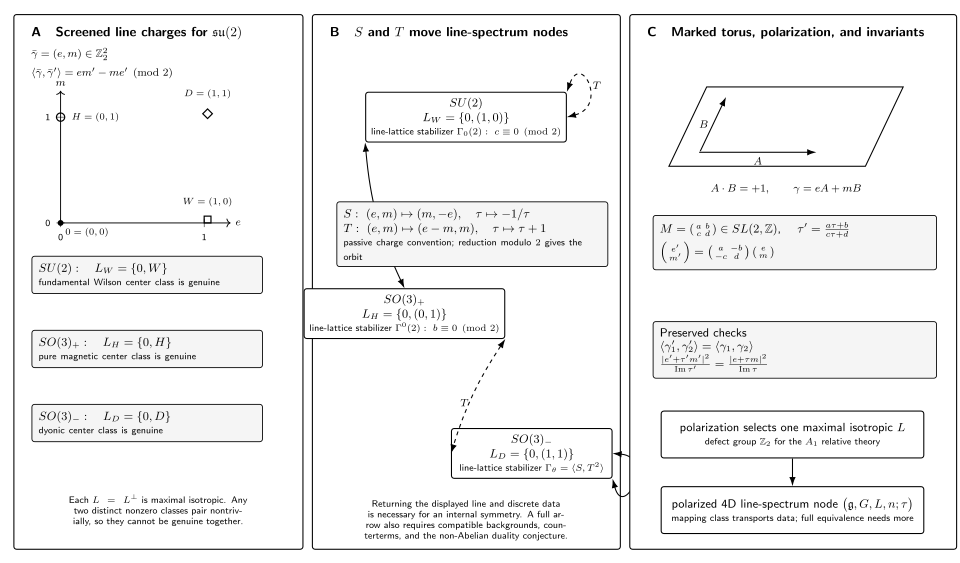
On a spin four-manifold, the three maximal-isotropic subgroups of select , , and . The solid arrows and dashed arrows give exact transport of and the screened genuine-line lattice in the chapter’s passive convention; only a node’s line-lattice stabilizer can be an internal modular subgroup, and only after the remaining background and counterterm data also return. The marked-torus panel shows the geometric origin of the same charge map after a polarization is chosen. This is a schematic, not-to-scale classification: exact lattice transport does not by itself prove the conjectured equivalence of all non-Abelian observables. Select the figure for full-size inspection, or read the structured charge-lattice and orbit record (JSON).
One-form symmetry and background dependence
Section titled “One-form symmetry and background dependence”Genuine lines are charged objects for one-form global symmetries. Gauging an electric subgroup changes the global gauge group and introduces magnetic sectors; a discrete theta term can produce a mixed electric–magnetic anomaly. The background-field formulation of these operations is given in Gaiotto et al. 2015, §§4–6.
This background dependence is physically measurable. Partition functions on manifolds with nontrivial two-cycles can be resolved by ’t Hooft flux. Surface operators can detect whether a line is genuine, and interfaces must say how one-form backgrounds are transmitted. Local correlators of adjoint operators on generally miss this information.
Scope and refinements
Section titled “Scope and refinements”The finite description records charges after adjoint screening; it does not replace the full weight and coweight labels of individual line operators. Operator ordering, monopole bubbling, spin, and supersymmetric dressing add further data.
The formula is stated for spin four-manifolds, appropriate to a theory with fermions. On non-spin manifolds, line spins, quadratic refinements, and theta periodicities can change the classification. Background two-form fields can also reveal anomalies invisible in the bare subgroup .
For a non-simply-laced algebra, electric and magnetic root systems differ in length and the Langlands-dual algebra need not equal the original algebra. The naive action must then be replaced by the appropriate subgroup and lacing-number transformation.
Exercises
Section titled “Exercises”1. Check isotropy. Prove that any two elements of have vanishing Dirac pairing modulo .
Solution
Write the two elements as and . Their pairing is , which vanishes modulo .
2. Recover the three theories. Evaluate for .
Solution
For the generator is , giving . For the nonzero generator is , giving . For it is , giving .
3. Find the line-spectrum theta period. For and , determine the number of shifts required to return to itself.
Solution
Here . Each passive shift changes by modulo . Since , four shifts are required, and the fixed-card theta period is .
4. Compute a nontrivial target. Apply the displayed Bézout formula to .
Solution
, so . Choose and , and note that . Then . Therefore
Directly, sends the generators and to and modulo four; these generate the same subgroup as , the target.
References
Section titled “References”- Aharony, Ofer, Nathan Seiberg, and Yuji Tachikawa. “Reading between the Lines of Four-Dimensional Gauge Theories.” Journal of High Energy Physics 08 (2013): 115. doi:10.1007/JHEP08(2013)115.
- Gaiotto, Davide, Anton Kapustin, Nathan Seiberg, and Brian Willett. “Generalized Global Symmetries.” Journal of High Energy Physics 02 (2015): 172. doi:10.1007/JHEP02(2015)172.
- Kapustin, Anton. “Wilson–’t Hooft Operators in Four-Dimensional Gauge Theories and S-Duality.” Physical Review D 74 (2006): 025005. doi:10.1103/PhysRevD.74.025005.