

Kähler and Hyperkähler Quotients in Supersymmetric QFT
Supersymmetry equips many vacuum spaces with more than a complex structure. Four-dimensional Higgs branches arise locally as Kähler quotients, while eight-supercharge Higgs branches arise as hyperkähler quotients. The quotient equations determine the inherited geometry at the classical level; nonrenormalization requires a separate argument and depends on the number of supercharges and on which branch is studied.
Required background. F- and D-flatness supplies the vacuum equations, and moment maps supplies symplectic reduction. Helpful background. Kähler sigma models explains how the quotient metric becomes a low-energy kinetic term.
Kähler reduction from four supercharges
Section titled “Kähler reduction from four supercharges”Let a compact group act holomorphically and isometrically on a Kähler manifold . For generators , a moment map satisfies
The minus sign is fixed by this volume’s simultaneous choices , , and . Sources that define use the opposite moment-map sign and must also reverse the quoted level.
At a regular central geometric level , with acting freely and properly, the quotient
is Kähler. Its tangent space at an orbit can be represented by vectors orthogonal to both the orbit directions and their complex partners . Restricting to this horizontal subspace gives the quotient metric. This is the smooth reduction theorem of Hitchin, Karlhede, Lindström, and Roček 1987, § 3C, Theorem 3.1, pp. 547–548, after reversing their moment-map sign to the convention displayed above. The appearance of Kähler target geometry in four-supercharge sigma models is the result of Zumino 1979, pp. 203–206.
In an gauge theory, first restrict to the F-flat locus. When that locus is a smooth -invariant complex submanifold, the D equation and compact quotient produce its Kähler reduction. If the action has stabilizers or the level is not regular, smooth reduction no longer applies. For compact and a proper moment map, singular reduction instead decomposes into symplectic orbit-type pieces; Sjamaar and Lerman 1991, Introduction, pp. 376–377, § 2, Theorem 2.1 and proof, pp. 382–388, and § 6, Theorem 6.11 gives the decomposition and its stratification. Under the additional hypotheses that the action extends globally and holomorphically to and that the required analytic quotient exists, the orbit-type strata are complex and their reduced forms are Kähler; see Sjamaar 1995, § 2.1, Theorem 2.9, pp. 108–109. Outside these hypotheses, regularity and separation properties must be checked directly.
A useful local calculation integrates out a massive vector multiplet in superspace. For chiral fields with charges and an abelian vector ,
This is the preceding chapter’s convention: , , and the geometric level is . At energies below the vector mass and neglecting its derivative terms,
is precisely . Substituting the solution back into produces a Kähler potential for the quotient in a chosen patch. Different gauge choices change this potential by Kähler transformations while leaving the metric invariant.
Example: the Fubini–Study metric
Section titled “Example: the Fubini–Study metric”For the classical reduction of charge-one fields at , the vector equation reads
This is only a classical Kähler-reduction fixture: the all-charge-one spectrum has a four-dimensional gauge anomaly (and a mixed gravitational anomaly), so a quantum gauge-theory realization needs anomaly-free spectator or completion data that preserve the displayed quotient sector.
Choose the complex gauge patch and define for . Solving the vector equation and discarding a constant and a Kähler transformation gives
Thus the quotient metric is the Fubini–Study metric on with Kähler class proportional to :
The coordinate patch fails where , but the metric does not. On overlaps, the local Kähler potentials differ by .
For a mixed-charge, anomaly-free example, the same reduction also displays a global chamber transition. In the figure, compare the two nonzero-level Kähler quotients before following their dashed contractions: stability keeps a different exceptional on either side of , whereas the zero-level affine invariant quotient collapses it and develops the conifold singularity. This is an ordinary Kähler quotient; no hyperkähler structure is being assumed.
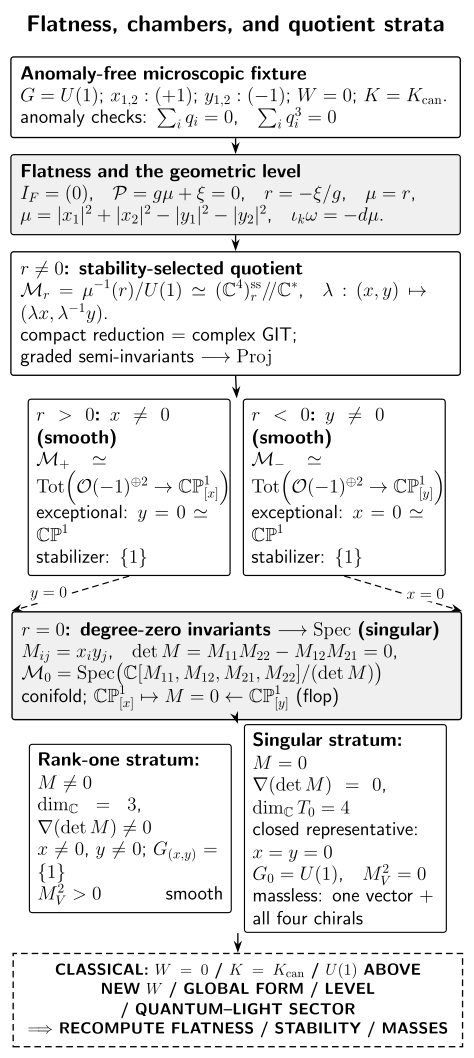
Exact classical quotient fixture for with charges , canonical , and . In the site convention , D-flatness is with . The and stability choices give the two smooth small resolutions; degree-zero invariants at give . The rank-one stratum has complex dimension three and trivial stabilizer, whereas at the origin the determinant Jacobian vanishes and the vector plus all four charged chirals are massless. The canonical derivation and primary-source locator accompany this fixture. The drawing is schematic and not to scale. Exact equations, adjacency, and independent checks (JSON).
Three moment maps and hyperkähler reduction
Section titled “Three moment maps and hyperkähler reduction”A hyperkähler manifold has a metric and complex structures obeying the quaternionic relations, with closed two-forms . A tri-holomorphic action has three moment maps
The hyperkähler quotient is
Here denotes the three geometric moment-map levels. For the displayed quotient by all of , must be fixed by the coadjoint action (equivalently, it lies in the central part of ), so that preserves the level set. FI parameters in a gauge theory obey this centrality condition, and only those central levels are considered below. At a non-invariant value, only the common stabilizer preserves the fibre; quotienting by that subgroup is a different reduction problem and is not covered by the HKLR theorem or the count used here. Each component must also be translated from the microscopic FI coupling using the action’s sign and coupling normalization; is not the same symbol as .
The construction and its supersymmetric interpretation are due to Hitchin, Karlhede, Lindström, and Roček 1987, § 3D, Theorem 3.2, pp. 549–550, again translated from their opposite moment-map sign.
At a regular value and for a free action, it removes real dimensions:
In one chosen complex structure, combine two real equations into the complex moment map and retain . Then
with stability fixed by . The double slash is essential for a possibly singular quotient: semistable orbit closures meeting the same closed orbit are identified. Only when stable equals semistable and the relevant orbits are closed and free may this be replaced by an ordinary orbit space; see Sjamaar 1995, § 2.1, Proposition 2.2 and Theorem 2.3, pp. 105–107. This form closely parallels F-flatness followed by a D-term quotient.
Worked example: cotangent bundles of projective space
Section titled “Worked example: cotangent bundles of projective space”Take flat with complex coordinates . Let act with charges on and on . In complex structure , choose
With this phase of the holomorphic symplectic form, the site convention gives the unshifted maps below without an extra factor of . Their level equations are
For and , not all can vanish. The complex quotient first chooses a point ; the equation makes a cotangent vector at that point. Hence
with real dimension . For the smooth quotient is the Eguchi–Hanson space, a resolution of . Sending the triplet of FI parameters to zero collapses the exceptional two-sphere and restores the cone singularity.
What supersymmetry does and does not protect
Section titled “What supersymmetry does and does not protect”The classical quotient identifies a metric inherited from the microscopic kinetic terms; the quotient construction alone does not prove that this metric survives quantum corrections. The canonical protection table separates the assumptions and failure modes for 4d , 4d , and 3d Higgs and Coulomb branches.
In particular, hyperkähler geometry by itself does not imply an exact metric. Protection follows from how the branch coordinates and couplings sit in supersymmetry multiplets, and it can fail after compactification, flavor gauging, coupling to gravity, or branch mixing.
Common pitfalls
Section titled “Common pitfalls”Equating complex varieties with metrics. Two FI chambers can be biholomorphic in a patch yet carry different Kähler classes. Conversely, a quantum correction can change the metric without changing the complex coordinate ring.
Forgetting regularity. The dimension subtraction and smooth quotient metric assume a regular moment-map value and a locally free action. At a stabilizer jump, use a stratified quotient and inspect the light spectrum.
Calling an quotient hyperkähler. Kähler reduction needs one moment map; hyperkähler reduction needs a triplet and a tri-holomorphic action. The additional structure comes from eight supercharges or an equivalent geometric input.
Exercises
Section titled “Exercises”For the hyperkähler quotient of by above:
- Verify its real dimension.
- Show that at , , the locus is a copy of .
- Explain why this sphere collapses at .
Solution
The starting dimension is eight. Three moment-map equations and one compact quotient remove four real dimensions, leaving four. With , the real equation is ; quotienting its by gives . Its Kähler area is proportional to , so it collapses as . At the origin the stabilizer returns, and the quotient becomes the singular cone .
References
Section titled “References”- Hitchin, Nigel J., Anders Karlhede, Ulf Lindström, and Martin Roček. “Hyperkähler Metrics and Supersymmetry.” Communications in Mathematical Physics 108 (1987): 535–589. doi:10.1007/BF01214418.
- Sjamaar, Reyer. “Holomorphic Slices, Symplectic Reduction and Multiplicities of Representations.” Annals of Mathematics 141 (1995): 87–129. doi:10.2307/2118628.
- Sjamaar, Reyer, and Eugene Lerman. “Stratified Symplectic Spaces and Reduction.” Annals of Mathematics 134 (1991): 375–422. doi:10.2307/2944350.
- Zumino, Bruno. “Supersymmetry and Kähler Manifolds.” Physics Letters B 87 (1979): 203–206. doi:10.1016/0370-2693(79)90964-X.
Further reading
Section titled “Further reading”- Alvarez-Gaumé, Luis, and Daniel Z. Freedman. “Geometrical Structure and Ultraviolet Finiteness in the Supersymmetric Sigma Model.” Communications in Mathematical Physics 80 (1981): 443–451. doi:10.1007/BF01208280.