

Duality Claims, Dictionaries, Regimes, and Evidence
A duality comparison begins with two complete theory definitions and a typed map between them. “The operators match” is not enough: the claim must say which regime is shared, which sectors decouple, how parameters and backgrounds transform, and what evidence is independent. The result is a falsifiable statement rather than a resemblance between formulas.
Required background. Symmetry, redundancy, and duality distinguishes physical equivalence from gauge redundancy, and ’t Hooft anomaly matching supplies a necessary infrared test. Helpful background. Infrared phases and conformal windows illustrates why the regime must be explicit.
Define both theories as physical objects
Section titled “Define both theories as physical objects”Write a candidate duality as
where includes more than a Lagrangian density. At minimum it contains the spacetime and tangential structure, all continuous and discrete couplings, and the admissible observables and backgrounds:
The gauge entry is the global group, not only its Lie algebra. The discrete data include theta angles, spin versus nonspin dependence, quotient choices, and local counterterms for background fields. The operator spectrum includes genuine extended operators and their fusion, not merely gauge-invariant polynomials. A fixed gauge algebra can therefore define inequivalent quantum theories with different genuine-line spectra Aharony, Seiberg, and Tachikawa 2013, §§1–2, arXiv v5 PDF.
If either side is defined only as an infrared fixed point, replace a microscopic action by intrinsic CFT data plus a specification of relevant deformations. If one side contains a decoupled free or topological sector, display it:
Suppressing can preserve selected local correlators while spoiling partition functions, anomalies, or line spectra.
Build a bidirectional dictionary
Section titled “Build a bidirectional dictionary”A dictionary entry is a typed relation, not an unlabeled arrow. For every entry record source, target, quantum numbers, normalization, regime, and possible mixing.
| Type | Side A | Side B | Required checks |
|---|---|---|---|
| Parameters | functions of | dimensions, periodicities, complex conjugations, counterterms | |
| Local operators | mixing | spins, charges, dimensions, OPE and contact terms | |
| Moduli | branch and coordinates | branch and coordinates | singular strata, metrics when claimed, vacuum map |
| States | charge | charge | masses, pairings, statistics, chamber |
| Extended operators | line/surface/defect | line/surface/defect or sum | genuineness, screening, fusion, endpoints |
| Backgrounds | bundle and connection | transformed background | anomaly inflow, local counterterms, flux sectors |
Bidirectionality matters. A proposed map can be injective on a protected ring while missing an entire sector on the target side. A complete equivalence requires an inverse after null operators, gauge identifications, and decoupled factors are treated.
Operator mixing is especially important along RG flow. If several operators share quantum numbers, the infrared primary is generally a linear combination. An operator hitting a unitarity bound can become free and generate an accidental symmetry; the dictionary and anomaly computation must then be enlarged.
The operation square below assembles these requirements. Inspect the distinction between the double theory relation, the one-way operation arrows, the dotted evidence arrow, and the crossed failure gate: none of those edge types can substitute for another. The complete typed edge list and long description preserve every field independently of the drawing.
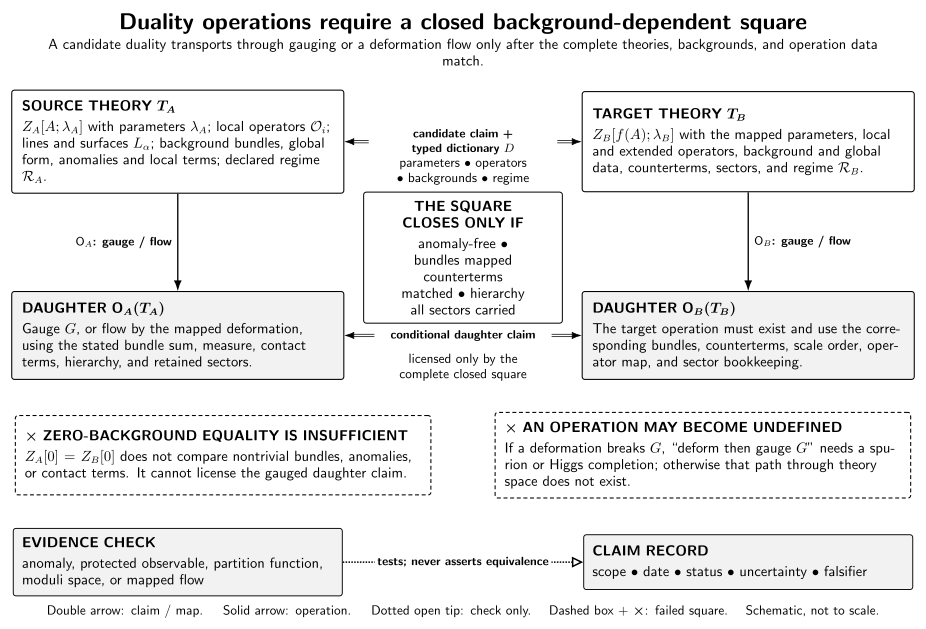
A candidate duality transports through gauging or deformation only after its typed dictionary, allowed bundles, anomaly and counterterm data, hierarchy, and retained or decoupled sectors make the two composed maps agree. Equality only at zero background cannot justify gauging, and a symmetry-breaking deformation can make one path undefined. This is a schematic logical map, not evidence for any named duality.
Name the regime and precision
Section titled “Name the regime and precision”Every claim should be expressible as a quantified statement. Examples are:
- equality of complete partition functions on all closed spin four-manifolds with matched background bundles;
- equality of correlators at separated points in the common infrared fixed point;
- equivalence of a -cohomological operator algebra;
- agreement through order in a named large- limit;
- matching of BPS indices in a specified chamber.
Words such as “exact” and “nonperturbative” are not substitutes for this domain. If equality is only known for protected quantities, say so. If a contact term is scheme-dependent, specify the allowed local counterterm rather than demanding literal equality.
The next page supplies a decision procedure for selecting the strongest justified category.
Separate predictions from correlated checks
Section titled “Separate predictions from correlated checks”Suppose an infrared R-symmetry fixes both operator dimensions and a supersymmetric partition function. Agreement of those two outputs is useful, but they share a decisive input and are not fully independent. Similarly, several anomaly coefficients may all follow from the same fermion charge table.
For each check , list its inputs . Define an overlap matrix
This numerical measure is only an organizational flag, not an evidence weight or a probability. Its value changes if one assumption is split into several labels, and one decisive shared hypothesis can matter more than many minor nonoverlapping inputs. The dependency graph and the logical question remain primary: could fail while still passes within the candidate class? If not, the two checks should not be advertised as independent confirmations.
A strong comparison combines different layers, for example:
- anomaly matching from ultraviolet charges;
- a deformation reaching the same gapped phase;
- an extended-operator and global-form match;
- an exact observable computed by different weakly coupled descriptions.
Even this collection is evidence for a stated duality, not a universal proof unless a separate theorem establishes equivalence.
The typed SQCD evidence matrix makes this separation concrete: each row distinguishes calculation inputs, the dictionary datum actually tested, interpretive hypotheses, and normalization choices, while retaining an explicit confidence ceiling.
Worked example: the structure of Seiberg duality
Section titled “Worked example: the structure of Seiberg duality”For SQCD with and flavors in the conformal window, the electric theory is proposed to share its infrared fixed point with a magnetic gauge theory. This restriction keeps the standard flavor basis; has pseudoreal fundamentals and an enhanced flavor symmetry, so it requires a separate theory card. In the displayed domain, write the electric composite, which has ultraviolet engineering dimension two, as
The magnetic theory contains and an elementary singlet normalized to represent the same ultraviolet engineering-dimension-two operator, with
Here is the matching normalization. Equivalently, the elementary field has ultraviolet engineering dimension one and gives . This distinction matters: the electric composite and a canonically normalized magnetic elementary field do not have the same ultraviolet engineering dimension. A minimal dictionary contains
plus baryon maps whose powers of the holomorphic scales fix dimensions and charges. It also contains the parameter map, global symmetry quotient, background contact terms, moduli branches, and the treatment of accidental free fields near the edge of the conformal window.
Seiberg formulates this as two distinct gauge theories with the same long-distance physics and derives the operator map and mass deformation in Seiberg 1995, §§2–3.2, arXiv PDF. The complete theory card, charges, baryon map, scale relation, and validity window are developed on the later Seiberg-duality page. Anomaly matching and chiral-ring agreement are necessary checks; the general anomaly-matching condition appears in ’t Hooft 1980, §§III.10–III.12, pp. 149–151. Mass-deforming one flavor and recovering the adjacent dual pair is another. Matching a protected index adds information only after conventions, integration contours, and decoupled factors are aligned. None of these checks licenses an exact ultraviolet equivalence: the claim is an infrared duality.
Explicit falsifiers
Section titled “Explicit falsifiers”A comparison is testable when it lists outcomes incompatible with its claimed scope. Examples include:
- an unmatched ’t Hooft anomaly after every allowed local counterterm is included;
- different genuine-line lattices under a claimed exact equivalence;
- a relevant deformation whose two endpoints have inequivalent symmetry-protected topological responses;
- an operator required by invertibility with no target and no null relation;
- different unitary fixed-point central charges after accidental sectors are included.
A failed falsifier test may reveal a missing sector or a claim that was too strong. Revise the definition and repeat all dependent checks; do not retain the original headline while silently weakening its scope.
Common pitfalls
Section titled “Common pitfalls”Comparing Lagrangians instead of theories. Field redefinitions, global quotients, counterterms, and line spectra can change the physical interpretation without changing local equations of motion.
Using one protected equality as proof. An index deliberately discards long multiplets. Its equality supports the protected-sector map unless further evidence connects the full theories.
Counting derived consequences separately. Dimensions, R-charges, and parts of a localized observable may share the same extremized R-symmetry. Track their common inputs.
Exercises
Section titled “Exercises”On oriented spin four-manifolds, a proposed infrared duality matches all continuous anomalies and a normalized supersymmetric index in the trivial background, but side B also contains the untwisted four-dimensional gauge TQFT.
- Which observables can miss the extra sector?
- Name two comparisons that can detect it.
- State the strongest safe claim if the sector is omitted from side A.
Solution
Local correlators of operators neutral under the topological sector, and a normalized index in the stated trivial sector, can miss it. Ground-state sectors on a spatial three-torus, linked line and surface operators, or partition functions with nontrivial backgrounds can detect it. Without matching or explicitly factoring out the theory, one may claim equivalence only of the tested local or protected subsector, not equality of the complete infrared theories.
References
Section titled “References”- Aharony, Ofer, Nathan Seiberg, and Yuji Tachikawa. “Reading between the Lines of Four-Dimensional Gauge Theories.” Journal of High Energy Physics 08 (2013): 115. DOI. Open PDF.
- Seiberg, Nathan. “Electric–Magnetic Duality in Supersymmetric Non-Abelian Gauge Theories.” Nuclear Physics B 435 (1995): 129–146. DOI. Open PDF.
- ’t Hooft, Gerard. “Naturalness, Chiral Symmetry, and Spontaneous Chiral Symmetry Breaking.” In Recent Developments in Gauge Theories, 135–157. Plenum Press, 1980. doi:10.1007/978-1-4684-7571-5_9.