

Gauge-Invariant Coordinates and Classical Moduli Varieties
Gauge-invariant operators turn an affine zero-level quotient of fields into an ordinary algebraic variety. Let . With trivial linearization—notably at geometric level —choose invariant generators and form
This description makes branches, intersections, and singular loci computable without choosing a gauge; its use for classical supersymmetric vacua is developed in Luty and Taylor 1996, pp. 3399–3405, arXiv:hep-th/9506098. It does not, by itself, retain stabilizers or determine the metric.
Required background. F- and D-flat quotients supplies the physical quotient, while constraints and reduction supplies the reduction logic. Helpful background. Branches and analytic continuation helps distinguish a coordinate patch from a multivalued analytic sheet. Those analytic sheets are not the irreducible algebraic components below; components are determined by ideal decomposition.
A nonzero level is different data, not a harmless change of notation. At a rational or integral level in the appropriate weight lattice, a character encodes the chosen algebraic linearization. Define the semi-invariants
The corresponding GIT quotient is
This Proj is covered by standard affine opens for nonzero homogeneous semi-invariants . Their preimages lie in the semistable locus and can contain strictly semistable points; they are not, in general, “stable affine patches.” Some sources put in the definition; the correct choice here is the one whose semistable orbit closures meet the physical level . An arbitrary real FI level selects analytic chamber data but need not itself define an algebraic character. For charge-one fields at , the ordinary invariant ring is only and its spectrum is a point, whereas the appropriate graded semi-invariant ring has projective spectrum . Thus the affine formula cannot be used to erase FI chambers. This affine-versus-linearized distinction is part of the standard GIT construction Mumford, Fogarty, and Kirwan 1994, ch. 1, Definition 1.7 and Theorem 1.10. The bridge from analytic Kähler reduction to algebraic GIT under integral, prequantized hypotheses is Sjamaar 1995, § 2.2, Theorem 2.15, pp. 113–114.
From fields to an affine invariant coordinate ring
Section titled “From fields to an affine invariant coordinate ring”For a reductive complexified gauge group, polynomial invariants are finitely generated. At zero level, a practical affine construction has four layers:
- Solve or quotient by the F-term ideal .
- Find invariant generators under .
- Determine the kernel of the map ; this kernel is the relation ideal .
- Decompose the resulting ideal when the vacuum space has distinct irreducible branches, and record their intersections.
This zero-level invariant-ring construction, including the role of closed complexified orbits and limit points, is developed for classical supersymmetric gauge theories in Luty and Taylor 1996, pp. 3399–3405, arXiv:hep-th/9506098. Nonzero levels require the graded semi-invariant refinement below; the affine theorem alone does not produce a projective chamber.
Completeness matters at both steps. A list of familiar mesons is not a coordinate system unless it generates the full invariant ring in the sector under discussion. Listing extra generators is harmless only if the full relation ideal among them is imposed. Higher syzygies enter free resolutions and derived or deformation questions; they are not additional defining equations for the ordinary affine variety.
At nonzero level, repeat the generator-and-relation analysis with the graded -semi-invariant ring, or work patch by patch after choosing a nonzero semi-invariant. Ordinary degree-zero invariants describe the affinization and may collapse a compact projective quotient.
The Zariski tangent space at a point represented by coordinates is found by linearizing generators of :
If the tangent dimension exceeds the local dimension, is singular as an algebraic variety. This test is intrinsic to the coordinate ring; whether the singularity signals extra massless particles is a separate physical question.
A determinantal cone from a U(1) theory
Section titled “A determinantal cone from a U(1) theory”Consider chiral multiplets of charge and of charge , with and vanishing FI parameter. The basic gauge invariants are the four mesons
Because is an outer product, its rank is at most one. Therefore
and
Away from the origin, one equation in gives complex dimension three. This agrees with the field count: four complex fields minus one complexified orbit. The Jacobian of the determinant is
which vanishes only at . At that point the tangent space has dimension four while the cone has dimension three, so the origin is singular.
The field representatives explain why. For , at least one and one are nonzero and the stabilizer is trivial. At , the closed orbit is represented by , whose stabilizer is the entire gauge group. The vector multiplet becomes massless there and, because , so do all four charged chiral multiplets. The algebraic singularity and the complete microscopic mass test agree in this example, but that agreement was checked rather than assumed.
The figure puts this affine cone beside the two nonzero-level linearized quotients of the same fields. Inspect the chamber labels before following the dashed arrows: graded semi-invariants retain an exceptional in either smooth chamber, while degree-zero invariants contract that curve to the single affine point . The lower boxes then compare the cone’s intrinsic Jacobian data with the microscopic stabilizer and spectrum.
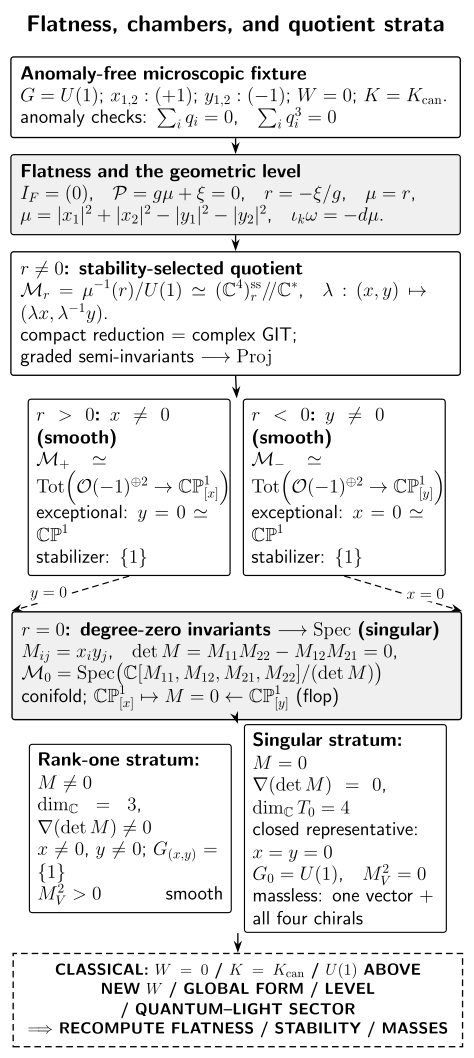
Exact classical quotient fixture for with charges , canonical , and . In the site convention , D-flatness is with . The and stability choices give the two smooth small resolutions; degree-zero invariants at give . The rank-one stratum has complex dimension three and trivial stabilizer, whereas at the origin the determinant Jacobian vanishes and the vector plus all four charged chirals are massless. The canonical derivation and primary-source locator accompany this fixture. The drawing is schematic and not to scale. Exact equations, adjacency, and independent checks (JSON).
For , a smooth patch is parametrized by with
This formula is not valid at ; the apparent denominator is a patch boundary, not an additional component. Covering the variety by analogous patches prevents a coordinate artifact from being mistaken for a branch.
Mesons, baryons, and rank conditions in SQCD
Section titled “Mesons, baryons, and rank conditions in SQCD”In four-dimensional gauge theory with flavors and , classical invariants include
and, when , baryons and antibaryons built from quarks using the epsilon tensor. The matrix inequality
imposes vanishing minors. Baryons satisfy further relations with mesons. For , for example,
classically Seiberg 1994, § 2, Eq. (2.8). Quantum dynamics instead gives Seiberg 1994, § 4, Eq. (4.1); the word classically is therefore part of the statement, not decorative qualification.
Rank strata organize the physics. A generic point of one stratum has a fixed stabilizer and a predictable number of massive vector multiplets. Lower-rank loci may have enhanced stabilizers and extra light fields. The invariant equations show where strata meet, while a representative field configuration and its mass matrix identify the actual low-energy degrees of freedom.
Branches and scheme-theoretic cautions
Section titled “Branches and scheme-theoretic cautions”Suppose an F-term equation is . Its zero set is the union of the branches and , meeting at the origin. Replacing the equation by the two simultaneous equations would destroy both branches. More subtly, an ideal such as has the same set of complex points as but a different nonreduced scheme: nilpotent directions retain information about infinitesimal deformations and can affect deformation theory.
For most first-pass vacuum analyses, the reduced variety is adequate. A claim about tangent complexes, obstructions, chiral-ring multiplicities, or derived intersections is not. State explicitly whether the object is the set of vacua, its reduced coordinate ring, or the full scheme defined by the F-term ideal.
Cross-checks that should agree
Section titled “Cross-checks that should agree”A robust classical answer passes three independent comparisons:
- Dimension. The invariant-ring dimension agrees with the quotient count on each smooth stratum, including stabilizer corrections.
- Patches. Gauge fixing and invariant coordinates give mutually invertible descriptions where both are valid.
- Singular strata. Jacobian rank loss is compared with stabilizer enhancement and the quadratic mass matrix.
The comparisons can fail for an instructive reason: an affine quotient may collapse nonclosed orbits, a chosen set of invariants may be incomplete, or a particular FI chamber may use a different stable locus. Such a failure diagnoses missing input rather than an inconsistency of the physical theory.
Common pitfalls
Section titled “Common pitfalls”Treating generators as independent coordinates. Invariants nearly always obey rank, determinant, or Plücker-type relations. Ignoring them gives the wrong dimension and erases singular strata.
Inferring a residual gauge group from invariants alone. Distinct stabilizer types can map to the same invariant point. Choose a closed-orbit representative and compute its stabilizer directly.
Confusing a classical relation with the exact chiral ring. Strong dynamics may deform a constraint or generate a superpotential. First use Quantum Chiral Rings and Konishi-Type Anomalies for the general operator and anomaly logic; the later four-dimensional gauge-dynamics chapter supplies theory-specific realizations.
Exercises
Section titled “Exercises”For the hypersurface in :
- Find its singular locus using the Jacobian criterion.
- Show that the patch is smooth by solving for .
- Parametrize the surface by and identify the discrete identification.
Solution
The gradient is , so it vanishes on the hypersurface only at the origin. On , , leaving the smooth coordinates . The parametrization is invariant under and is otherwise generically two-to-one before quotienting, so the surface is . The fixed point of the action maps to the singular origin.
For classical SQCD with , arrange the quarks and antiquarks as two-by-two matrices and and define
- Derive the relation among , , and .
- Compare the invariant-ring dimension with the quotient count.
- Find the singular locus and identify its compact-gauge stabilizer.
Solution
Multiplicativity of the determinant gives
The four entries of together with and give six generators subject to one relation, so the hypersurface has complex dimension five. Microscopically there are eight complex scalar components. Quotienting by removes its three complex orbit directions at a generic fully Higgsed point, again leaving .
For , the gradient consists of the cofactors of and . Every component vanishes only at
This is the singular origin. Its closed representative is , so the compact stabilizer is all of and the vector multiplet is massless. At every nonzero D-flat point in this fixture, the fundamental expectation values break the compact gauge group completely.
References
Section titled “References”- Luty, Markus A., and Washington Taylor IV. “Varieties of Vacua in Classical Supersymmetric Gauge Theories.” Physical Review D 53 (1996): 3399–3405. arXiv:hep-th/9506098.
- Mumford, David, John Fogarty, and Frances Kirwan. Geometric Invariant Theory. 3rd ed. Ergebnisse der Mathematik und ihrer Grenzgebiete 34. Berlin: Springer, 1994, ch. 1. Springer.
- Seiberg, Nathan. “Exact Results on the Space of Vacua of Four-Dimensional SUSY Gauge Theories.” Physical Review D 49 (1994): 6857–6863. arXiv:hep-th/9402044.
- Sjamaar, Reyer. “Holomorphic Slices, Symplectic Reduction and Multiplicities of Representations.” Annals of Mathematics 141 (1995): 87–129. doi:10.2307/2118628.
Further reading
Section titled “Further reading”- Procesi, Claudio. Lie Groups: An Approach through Invariants and Representations. Springer, 2007. doi:10.1007/978-0-387-28929-8.