

Off-Shell Closure and Auxiliary Fields
Auxiliary fields extend a component transformation system so that supersymmetry closes without using equations of motion. They are nonpropagating in a specified action and are eliminated algebraically, but their primary representation-theoretic role is to supply the missing off-shell components and cancellations. This mechanism works finitely for the four-dimensional chiral and vector multiplets; degree counting flags incomplete proposals, yet equality of counts alone neither constructs auxiliaries nor proves a no-go theorem.
Required background. Component Multiplets and Closure Records supplies the chiral closure calculation. The superfield constraints and closure comparison supplies the vector prepotential, Wess–Zumino compensation, and standard component counts.
Helpful background. The BRST Differential and the Gauge-Fixed Complex helps distinguish gauge and ghost variables from supersymmetry auxiliaries.
What “off shell” means
Section titled “What “off shell” means”Let denote all fields in a proposed representation. The strongest local closure statement is
for arbitrary field configurations. For a gauge system, the appropriate statement is
with displayed and no field equation used. A kinematic constraint may define the field space, but a term proportional to
makes the reduced algebra on shell.
An auxiliary field has two linked properties in a given formulation:
- its transformation participates in off-shell closure;
- the action contains no kinetic operator for , so is algebraic.
Neither property alone is enough. A gauge-removable component can be nonpropagating without being auxiliary; a Lagrange multiplier can impose a constraint; a compensator restores a gauge choice; a ghost belongs to the gauge-fixed complex. The name follows the full transformation-and-action record.
The chiral auxiliary completes the algebra
Section titled “The chiral auxiliary completes the algebra”For ,
The variation cancels the nontranslation part produced when two transformations act on . The result is
without dynamics. The off-shell count is
For canonical Kähler kinetic terms and superpotential , the part of the Lorentzian Lagrangian involving has the schematic convention-compatible form
Its algebraic equations are
Substitution gives the scalar potential
After substituting into , the commutator on contains a term proportional to its interacting Euler–Lagrange equation. The same action-level supersymmetry survives, but the reduced field transformations form an on-shell representation. This is why eliminating an auxiliary and then reporting the original off-shell closure is incorrect. The calculation is explicit in Weinberg 2000, § 26.4, pp. 75–82.
The vector auxiliary and gauge closure
Section titled “The vector auxiliary and gauge closure”For the Abelian vector multiplet ,
Use also the Lorentzian-conjugate transformation for ; in particular, its auxiliary term is .
The real cancels a specific gaugino-equation remainder. Varying in gives
where varying the explicit term supplies
Thus the two routes cancel off shell. In the commutator on , the terms reduce to the Bianchi identity , while the terms produce the translation. No Maxwell or gaugino equation is used. The complete result is
Thus the vector multiplet closes off shell modulo gauge. In Wess–Zumino gauge the component transformations already include the compensating supergauge transformation that restores the gauge slice. The original auxiliary vector multiplet is given in Wess and Zumino 1974, pp. 42–48; Gates, Grisaru, Roček, and Siegel 1983, §§ 3.9–3.10, pp. 108–119 separates the physical, auxiliary, gauge, and compensating components in superspace notation.
With matter, enters algebraically and is sourced by the moment map. Eliminating it produces a -term potential. The exact sign and factor of the gauge coupling depend on whether is placed in , the covariant derivative, or the gauge kinetic term, so they belong to the action convention on the next chapter.
The count is
This local count refers to a generic nonzero Fourier mode; global zero modes and boundary data require separate treatment. Removing leaves only three bosonic off-shell functions after the gauge quotient, which flags the missing completion before the commutator is calculated.
For pure Abelian super-Yang–Mills theory,
Deleting from the field space also removes from . The connection still closes modulo gauge, but the reduced gaugino commutator is
It vanishes only when and its conjugate . Setting after calculating the full commutator therefore differs from deleting before calculating it.
Comparing full and reduced closure
Section titled “Comparing full and reduced closure”The chiral and vector examples have the same logical sequence: begin with a complete off-shell transformation system, eliminate an algebraic field on a regular branch, and recompute the reduced commutator. The comparison must keep a surviving gauge transformation separate from a term that vanishes only by an equation of motion.
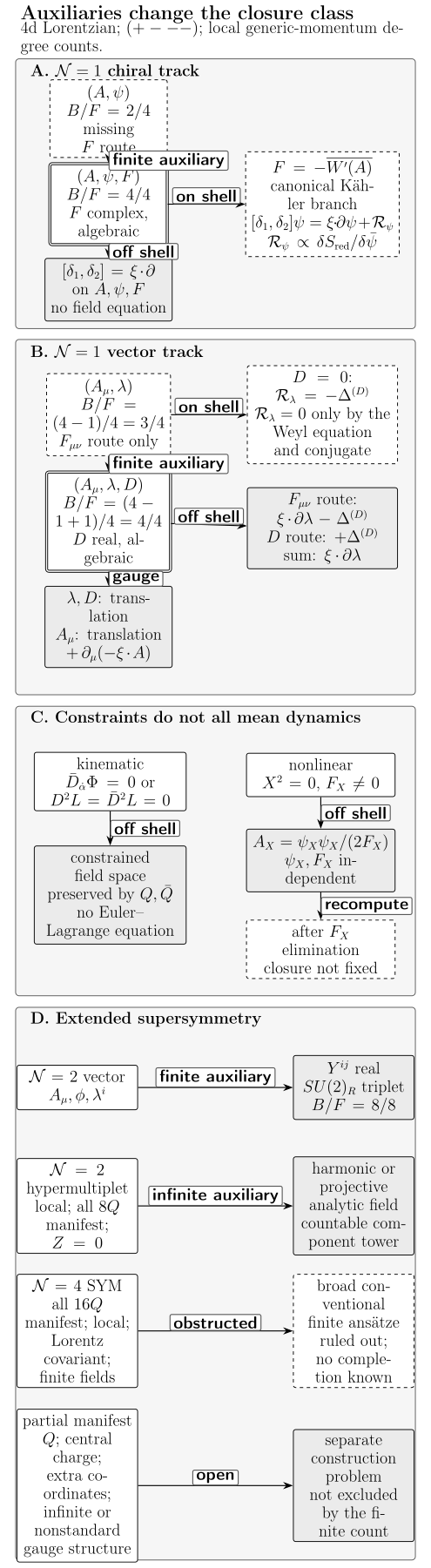
In the standard four-dimensional Lorentzian examples, the finite auxiliaries and complete the off-shell algebra; eliminating them leaves explicit fermion-equation remainders, while the vector connection still closes modulo gauge. Kinematic constraints and infinite harmonic or projective towers are separate mechanisms, and extended-supersymmetry limitations retain the assumptions printed on their branch.
Degree counting is a diagnostic
Section titled “Degree counting is a diagnostic”For a finite-dimensional off-shell representation at a generic momentum, one can choose a real linear combination of supercharges whose square is a nonzero translation. That invertible odd operator pairs the bosonic and fermionic component spaces. This motivates
after accounting for gauge equivalence and any gauge-for-gauge structure. The qualification matters:
| System | Bosonic count | Fermionic count | What must be included |
|---|---|---|---|
| Chiral | Complex auxiliary | ||
| Abelian vector | Gauge quotient and real | ||
| Real linear | Constraint |
This test can reveal an impossible proposed table, but it does not determine the Lorentz representation of the missing auxiliaries or the transformation coefficients. It also cannot by itself decide locality, covariance, finite versus infinite cardinality, or compatibility with an action.
Gauge systems require particular care. Subtracting two on-shell photon polarizations from an off-shell fermion count mixes representation spaces. One must count covariant field functions modulo gauge before field equations, or use a gauge-fixed complex including ghosts and compensating symmetries consistently.
Algebraic elimination as a controlled operation
Section titled “Algebraic elimination as a controlled operation”First take real commuting auxiliary variables . Assume that no derivative acts on them, that , and that is invertible on the chosen branch. Suppose
so their algebraic equations have the unique solution
The symmetry of is material: its antisymmetric part drops out of a quadratic expression in commuting ‘s. Complex auxiliaries require their conjugates to be varied independently. For example,
This block form, rather than the real symmetric formula, is the appropriate starting point for the complex chiral auxiliary .
The reduced action
has equivalent classical Euler–Lagrange equations for on that branch. Nevertheless, the induced reduced transformation
need not close without the equations, because
need not vanish off shell. This is the failure of the full transformation to remain tangent to the eliminated branch.
If the full transformation is a variational symmetry, substitution still preserves the reduced action:
because on that branch. Action invariance alone does not prove a closed reduced representation. When the transformations are regular and the effects of can be expressed through the remaining Euler–Lagrange derivatives, the reduced commutator closes on shell by a trivial symmetry proportional to those derivatives. That last step is not a consequence of algebraic elimination alone; it must be demonstrated, as in the chiral and vector calculations above.
Three failure cases must be separated:
- if is singular, the would-be auxiliary may instead impose a constraint or label branches;
- if quantum corrections generate derivatives of , it is no longer auxiliary in that effective description;
- if eliminating introduces inverse powers of a field that can vanish, the reduced formula and its induced transformations are only patchwise valid.
Extended supersymmetry changes the problem
Section titled “Extended supersymmetry changes the problem”Finite auxiliaries exist for many multiplets, including the standard four-dimensional vector multiplet, whose three real bosonic auxiliaries form an triplet. The ordinary hypermultiplet is different: under the conventional assumptions of locality, Lorentz covariance, no central charge, and all eight supercharges manifest, its harmonic-superspace realization is an unconstrained analytic superfield with an infinite auxiliary expansion Galperin et al. 1984, pp. 469–498. Arctic and antarctic projective multiplets likewise use an infinite holomorphic series whose higher coefficients are auxiliary Gonzalez-Rey et al. 1998, §§ 1–2, pp. 426–431. Formulations with a central charge or only partial manifest supersymmetry lie outside this statement.
For four-dimensional Yang–Mills, no finite set of conventional Lorentz-covariant auxiliary fields is known that makes all sixteen supercharges manifest off shell. Siegel and Roček’s counting argument rules out a broad class of previously known finite constructions Siegel and Roček 1981, pp. 275–277. Its conclusion must retain its assumptions: it is not a theorem forbidding every formulation with infinite towers, extra coordinates, partial manifest supersymmetry, nonstandard gauge structure, or weakened locality.
Harmonic and projective superspaces relocate the auxiliary data into functions of additional bosonic coordinates. This is a genuine off-shell construction for important systems, but “one analytic superfield” does not mean finitely many component auxiliaries. The next extended-superspace page makes the tower explicit.
Closure checks
Section titled “Closure checks”Before accepting an auxiliary completion, perform these checks in order:
- state dimension, signature, real form, and supersymmetry count;
- list every independent field and gauge equivalence;
- count off-shell bosonic and fermionic functions on the same space;
- calculate every component commutator;
- label translations, gauge transformations, constraints, and equations of motion separately;
- identify which fields are algebraic in the named action;
- eliminate them only on a branch where the algebraic system is invertible;
- recompute the reduced commutator rather than inheriting the old label;
- state whether the auxiliary set is finite, infinite, or formulation dependent.
The strongest justified conclusion is the weakest closure class found among the components.
Common pitfalls
Section titled “Common pitfalls”Auxiliary elimination is not an invertible field redefinition. It uses an Euler–Lagrange equation. The reduced action can be classically equivalent while the reduced transformations close only on shell.
Gauge-fixing variables are not supersymmetry auxiliaries. A Nakanishi–Lautrup field belongs to the BRST gauge-fixing complex; belongs to the supersymmetry vector multiplet. Their algebraic equations serve different symmetries.
A no-go statement has hypotheses. Finite, local, Lorentz-covariant, manifest, conventional, and without central charge are material qualifiers. Dropping one can change the answer.
Exercises
Section titled “Exercises”1. Count before and after elimination
Section titled “1. Count before and after elimination”Count the off-shell chiral multiplet before and after setting .
Solution
Before elimination, and contribute two real components each, matching the four real components of . After deleting , the bosonic count is two while the fermionic off-shell count remains four. The mismatch predicts that the reduced transformations cannot close off shell; the fermion equation supplies the missing reduction on shell.
2. Distinguish gauge from dynamics
Section titled “2. Distinguish gauge from dynamics”Does
require the Maxwell equation?
Solution
No. The second term is tangent to the gauge orbit. The result is off-shell closure modulo gauge provided is displayed and no equation was used to obtain it.
3. Test an “auxiliary” matrix
Section titled “3. Test an “auxiliary” matrix”What happens if in the algebraic system has a zero eigenvalue?
Solution
The formula is invalid. Along the null direction the equation may impose a constraint on , leave an undetermined multiplier, or signal a new branch. One must solve the algebraic system by rank strata before calling every eliminated.
4. Recompute after deleting D
Section titled “4. Recompute after deleting D”For pure Abelian super-Yang–Mills theory, delete and the term in . Express the reduced gaugino commutator in terms of the route that is no longer present.
Solution
The full commutator splits as
After deletion only the first parenthesis remains:
Using the displayed transformation of , the remainder is
It vanishes on the free Weyl equation and its conjugate, so the reduced system closes on shell modulo gauge. The off-shell calculation cannot be recovered by merely evaluating the already-closed full commutator at .
Continue
Section titled “Continue”Constrained, On-Shell, and Nonlinear Superfields studies constraints that remove components, including the nilpotent goldstino multiplet. Extended Superspace Methods and Off-Shell Limits explains how harmonic and projective variables encode infinite auxiliary towers.
References
Section titled “References”-
Galperin, A. S., E. A. Ivanov, S. Kalitzin, V. I. Ogievetsky, and E. S. Sokatchev. “Unconstrained N=2 Matter, Yang–Mills and Supergravity Theories in Harmonic Superspace.” Classical and Quantum Gravity 1 (1984): 469–498. DOI.
-
Gates, S. James, Jr., Marcus T. Grisaru, Martin Roček, and Warren Siegel. Superspace, or One Thousand and One Lessons in Supersymmetry. Frontiers in Physics 58. Reading, MA: Benjamin/Cummings, 1983. Corrected open edition, 2001. arXiv:hep-th/0108200.
-
Gonzalez-Rey, Francisco, Ulf Lindström, Martin Roček, Rikard von Unge, and Stephen Wiles. “Feynman Rules in N=2 Projective Superspace I: Massless Hypermultiplets.” Nuclear Physics B 516 (1998): 426–448. DOI. arXiv:hep-th/9710250.
-
Siegel, Warren, and Martin Roček. “On Off-Shell Supermultiplets.” Physics Letters B 105 (1981): 275–277. DOI.
-
Weinberg, Steven. The Quantum Theory of Fields. Volume III: Supersymmetry. Cambridge: Cambridge University Press, 2000, §§ 26.1–26.4 and §§ 27.1–27.4. DOI.
-
Wess, Julius, and Bruno Zumino. “Supergauge Transformations in Four Dimensions.” Nuclear Physics B 70 (1974): 39–50. DOI.