

Supersymmetric Parents of Mirror, Particle–Vortex, and Bosonization Webs
Supersymmetric mirror and Chern–Simons dualities organize much of the modern three-dimensional particle–vortex and bosonization web. Their protected dictionaries fix currents, monopoles, quantized contact terms, and supersymmetric deformation maps. Breaking supersymmetry then creates a new question: do the tuned scalar and fermion theories reach the proposed continuous fixed point, or does the transition split, become first order, or acquire an extra phase? Publication-level use of the web must display that evidentiary boundary rather than turn a controlled parent flow into a proof of its nonsupersymmetric child.
Required background. We use the complete dictionaries of Aharony and Giveon–Kutasov dualities and their real-mass, FI, and compactification flows. Helpful background. Duality checks and failure modes explain why phase and anomaly matching are necessary but not sufficient.
Protected parents and conjectural descendants
Section titled “Protected parents and conjectural descendants”The simplest useful parent is three-dimensional chiral mirror symmetry. Set the background field to zero for the following compact display. A free chiral coupled to is dual in the infrared to gauge theory with one chiral of gauge charge :
The half-level terms are shorthand for gauge-invariant regulated fermion determinants, not standalone bosonic actions. Restoring the background also restores the supersymmetric and mixed BF contacts. This relation is an exact infrared claim for the supersymmetric theories, supported by protected operator and partition-function tests; it is not an equality of the two ultraviolet Lagrangians Kachru et al. 2017, §II.
Soft deformations separate the scalar and fermion masses that supersymmetry tied together. If corresponding relevant operators are denoted by and , then
defines a candidate pair of flows, but the parent does not determine the full nonsupersymmetric beta functions. A descendant fixed-point claim additionally requires:
- one continuous transition on each side rather than a first-order surface or two separated transitions;
- no unmatched relevant singlet, accidental symmetry, or symmetry-breaking vacuum;
- identical adjacent gapped phases, including residual TQFTs and gravitational response;
- the proposed order-parameter and monopole operators to retain the required charges, spin, and statistics.
The status of the main steps is therefore:
| step | strongest justified status | what still has to be checked |
|---|---|---|
| or mirror pair | supersymmetric infrared duality with protected tests | global form, contacts, and the stated parameter domain |
| Giveon–Kutasov parent | supersymmetric infrared duality with localization and flow tests | small-rank exceptions, two levels, and monopole dressing |
| or applied to a complete seed | exact algebraic operation, conditional on the seed | charge lattice, bundle sum, spin refinement, and invertible factors |
| massive phase matching | controlled necessary test | it does not establish the intervening critical CFT |
| soft flow to a finite-rank bosonization fixed point | nonsupersymmetric infrared conjecture | continuity, relevant operators, and direct dynamical evidence |
| planar non-Abelian bosonization from a supersymmetric parent | conditional equality of planar single-trace correlators | effects and finite-rank global data |
The last distinction is sharp: the planar result follows from a double-trace flow if the supersymmetric parent is assumed, whereas the corresponding finite- fixed-point equivalence remains conjectural Gur-Ari and Yacoby 2015, §§1–3.
S and T act on a complete U(1) generating functional
Section titled “S and T act on a complete U(1) generating functional”Let be a three-dimensional theory with a compact background connection and a fixed charge lattice. With
define
promotes the full background connection to a dynamical field, couples its flux to the new background , and introduces a topological current . changes the contact-term representative. For an ordinary bosonic theory on a manifold without a chosen spin structure, the level-one operation need not be available; on a spin theory it is, but can leave an invertible spin factor. Similarly, gauging rather than changes allowed bundles, monopoles, and genuine lines.
Once these global data are fixed, acts as charge conjugation and the modular relations hold up to the corresponding gravitational or invertible factor. Applying or to both sides of a valid equality is exact as a path-integral operation. It does not increase the evidence for the seed equality itself Witten 2003, §§2–3. Applied to the regulated Abelian seed below, this construction generates particle–vortex and fermionic QED forms Karch and Tong 2016, §§2–3.
A regulated Abelian bosonization seed
Section titled “A regulated Abelian bosonization seed”Work first on a closed oriented spin manifold. Let be an ordinary compact background connection and define the charge-one Dirac theory by the gauge-invariant eta-invariant regulator
The familiar notation “Dirac fermion minus ” is a local shorthand for this regulated object. In the same orientation and regulator convention, the Abelian bosonization seed is
where and is tuned to the Wilson–Fisher critical surface. On the right, is a compact dynamical connection. Orientation reversal changes every Chern–Simons and BF sign; a different fermion regulator adds a common integral background counterterm. The critical equivalence is a finite-rank nonsupersymmetric conjecture, albeit one with unusually strong parent, phase, and web consistency checks Seiberg et al. 2016, §2.1.
Varying the common background gives the current map
A unit -monopole carries one unit of electric charge from the level-one Chern–Simons Gauss law. It is not itself gauge invariant. The charge scalar insertion supplies the dressing, so in these conventions
The charge–monopole angular momentum gives this composite spin . “Fermion equals a bare vortex” misses the dressing, the spin transmutation, and the background response Seiberg et al. 2016, §2.1.
The two massive chambers
Section titled “The two massive chambers”For a fermion mass , the regulated determinant has the responses
where is normalized as in Seiberg et al. On the bosonic side, condenses and Higgses , whereas leaves massive and the spin Chern–Simons field unHiggsed. Thus the signed map is
| fermion chamber | boson chamber | bosonic vacuum | complete response |
|---|---|---|---|
| , Higgsed | |||
| massive, remains |
The second row follows by completing the square:
The factor represented by has a one-dimensional state space on every closed spatial surface, but it is an invertible spin theory rather than an empty theory. Its Wilson line is the transparent spin- line, and its framing response is in this convention. Dropping the factor would match the Hall response while missing the transparent line and thermal Hall or framing response. Agreement of both rows is a decisive necessary check; it still does not prove that the two critical theories coincide.
The dimension-labelled anomaly, contact, and duality comparison preserves these limitations of the three-dimensional result alongside the distinct two-dimensional anomaly calculation.
A reproducible route through the Abelian web
Section titled “A reproducible route through the Abelian web”The shortest route from a protected seed to the displayed conjecture has four logically different edges.
- Supersymmetric parent. Start from chiral mirror symmetry with its half-level, BF, , and gravitational contacts. This is the protected infrared duality.
- Soft mass splitting. Add corresponding deformations that independently tune scalar and fermion masses. Their exact map away from conserved-current multiplets can receive strong infrared corrections.
- Critical slice. Keep one light Dirac field on one side and one Wilson–Fisher scalar coupled to on the other; integrate out every other superpartner and retain its contact terms. Equality of this slice is the new nonsupersymmetric conjecture.
- Modular descendants. Apply to gauge , or to change its contact representative. The resulting particle–vortex, fermion–fermion, and QED forms are exact algebraic descendants conditional on the conjectural seed and its global formulation.
Every graphical arrow should carry the same data as these sentences: deformation and sign, selected vacuum, induced gauge/background/gravitational terms, endpoint fields and TQFT, global form, and evidence status. An unlabeled arrow from “mirror” to “bosonization” is not reproducible.
Supersymmetric routes to Abelian and non-Abelian descendants
Section titled “Supersymmetric routes to Abelian and non-Abelian descendants”Mirror parents. mirror symmetry exchanges flavor and topological currents, Higgs and quantum Coulomb operators, and real masses and FI parameters. Reducing to and softly splitting superpartner masses gives a multicritical phase diagram. In the chiral-mirror example above, four massive parent chambers have matching background responses. Individual critical boundaries motivate a free-Dirac/gauged-Wilson–Fisher pair, ordinary particle–vortex duality, and fermionic QED variants Kachru et al. 2017, §§III–V. The phase calculation is controlled; the assertion that each boundary contains one continuous finite-rank fixed point is the additional dynamical input.
Chern–Simons parents. Giveon–Kutasov duality exchanges rank and level while retaining mesons and a complete background-contact dictionary. Softly massing the gaugino and one matter superpartner can leave a critical scalar coupled to one Chern–Simons theory and critical fermions coupled to its level/rank partner. The exact formula depends on whether the group is or
because the two levels control different line and monopole data. In a bosonic Chern–Simons presentation the quotient requires ; a matter theory with half-integral fermionic bare levels must instead state its regulator convention before this condition is applied to the effective levels.
For example, in the Yang–Mills regulator convention with and restricted to , one representative local core of the proposed finite-rank web is
The is the parity-anomaly shift in the quoted fermionic bare level. This formula is not yet a complete generating-functional equality: background flavor and gravitational contacts, the common-center quotient, mass-sign convention, and any invertible spin factor must be appended. The displayed conjecture is restricted to Benini, Hsin, and Seiberg 2017, Eq. (1.1) and pp. 2–3; for , one must supply a separate phase-structure card rather than extrapolate this two-phase formula. At its topological endpoint reduces to the established level/rank pair ; that endpoint check does not prove the matter critical point. The baryon maps to a gauge-invariant dressed monopole of the theory, while the global-form choice decides which Wilson and ‘t Hooft lines are genuine Aharony 2016, §§2–4.
It also matters whether any fermionic level denotes a bare regulator level or the level after integrating out a chosen mass sign. Large- correlators and conditional supersymmetric flows give strong evidence Aharony, Gur-Ari, and Yacoby 2012, §§1 and 5.2; Gur-Ari and Yacoby 2015, §§1 and 5.2. They do not erase finite-rank global-form or transparent-sector qualifications.
In either route, the parent fixes quantized response inherited by the light fields. It does not guarantee that a nonsupersymmetric scalar quartic has the sign and basin needed for the proposed CFT, nor that no extra relevant operator is generated.
The diagram below condenses the chapter-wide logic. Read the upper panel from left to right: a regulator-complete theory card and a gauge-invariant monopole sector are prerequisites for an infrared dictionary. The lower panel keeps the N=4 mirror fixture separate; the Aharony fixture continues through a selected Giveon–Kutasov mass flow and only then reaches non-Abelian bosonization through a dashed soft-breaking arrow.
On a narrow screen, swipe or use the Left and Right arrow keys to pan across the figure. Home and End move to its edges. A full-size link is also available.
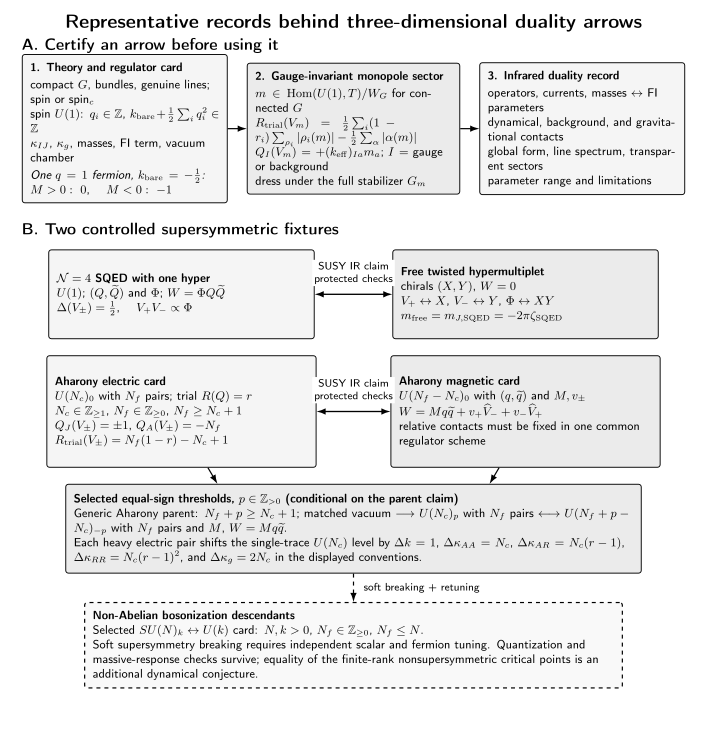
A fully specified three-dimensional duality arrow would need its global form, regulator, monopole dressing, complete relative contact matrix, deformation chamber, and limitations. This figure supplies representative checks rather than that exhaustive matrix. The single-headed arrows in panel A are required record-assembly gates, not physical implications; double-headed solid arrows are labelled supersymmetric infrared claims with protected checks; single-headed arrows into the mass-flow card are exact thresholds conditional on the parent claim; and the dashed arrow requires retuning plus an additional finite-rank dynamical conjecture. The black-and-gray diagram is schematic and not to scale.
Text equivalent: records and edges
Section titled “Text equivalent: records and edges”The following ordered list is the representative minimum encoded by the diagram at narrow width, in print, or without seeing it. It flags where the full theory-specific record must still be supplied.
- Theory and regulator card → monopole sector. Fix the compact global gauge group, bundles, genuine lines, spin or spin structure, the full dynamical/background/gravitational Chern–Simons matrix, masses, FI term, regulator, and vacuum chamber. In the displayed compact- one-chiral check, charges are integral and gives for and for ; the zero level alone does not diagnose a gapped phase. The displayed one-chiral calculation is exact; the arrow itself is only a required record-assembly gate, not an RG claim.
- Monopole sector → infrared record. For connected compact , choose ; disconnected groups require additional bundle and twisted-sector data. Impose the supersymmetric flux boundary condition and compute matter and root zero modes. In the displayed / convention, every gauge or background current labelled by assigns the bare monopole ; the gauge entries must be cancelled by dressing to a singlet under the full stabilizer , while background entries are its global charges. Zero-mode vacuum charges and an effective level containing the same determinant are alternative bookkeeping schemes; adding both double counts the fermion.
- Basic N=4 mirror. The protected infrared pair is SQED with one hypermultiplet and versus a free twisted hypermultiplet with chirals . The map is , , and , with and . In the frozen current convention, the free twisted hyper’s ordinary mass is the SQED topological mass, . This is an infrared mirror dictionary with protected checks, not equality of ultraviolet Lagrangians.
- Generic Aharony pair. For integers , in the generic range , with pairs maps to with dual pairs, meson , electric-monopole singlets , and . Every displayed monopole formula is a trial charge; it becomes an exact dimension only after current mixing, accidental symmetries, and decoupled free sectors are resolved. The contact representatives agree only after the common regulator scheme is fixed. The endpoint and lower-flavor confining or runaway regimes require separate cards.
- Equal-sign mass flow. Begin with the generic Aharony parent and matched-vacuum flow satisfying and ; the equality instead requires its separate confining card. Give the pairs a common positive axial mass and select the correlated magnetic vacuum before taking the heavy limit. The representative endpoint is . Per heavy electric pair, the frozen single-trace level shifts by —simultaneously shifting its central coefficient by —while , , , and . These are only the electric heavy-pair contributions: magnetic determinants, Higgsed blocks, topological and non-Abelian flavor contacts, the relative gravitational term, and invertible sectors must still be evaluated in the matched vacuum. A rank-zero gauge factor can leave meson singlets.
- Non-Abelian soft-breaking descendant. Starting from the Giveon–Kutasov route, tune scalar and fermion masses independently and retain the inherited tangential structure, common-center quotient, and all background and gravitational contacts. For and with , a representative local core is with critical scalars versus with critical Dirac fermions. The topological endpoint, level quantization, massive responses, baryon-to-dressed-monopole map, and conditional planar correlators are strong checks. They do not prove equality of the finite-rank matter critical points, which remains conjectural; requires a separate phase-structure analysis rather than continuation of this card.
The Abelian particle–vortex route is deliberately not drawn in this representative figure. Its regulated seed maps the Dirac operator to and the fermion current to . The two massive checks are with a Higgsed gauge field and zero response, and with the invertible spin sector and response . Applying or is algebraically exact only conditional on this globally defined conjectural seed.
The structured record for the diagram (JSON) supplies its complete conventions, primary-source chain, machine-checkable fixtures, and failure boundaries. The other focused derivations live on the chapter pages for parity and contacts, monopole operators, N=4 mirror symmetry, and Aharony and Giveon–Kutasov dualities.
Spin, spin-c, global form, and transparent sectors
Section titled “Spin, spin-c, global form, and transparent sectors”The spin-manifold seed above is one global formulation. For an electronic theory obeying the spin/charge relation, the electromagnetic background is naturally a spin connection. The fermion determinant and its eta phase can then be defined without choosing an independent spin structure, and the bosonic dual must use the same spin background and correlated gravitational term. Replacing “ordinary on a spin manifold” by “spin ” is not a typographical change; it changes which counterterms and bundles are allowed Seiberg et al. 2016, §§1.3 and 2.1.
Likewise, a pure Chern–Simons block can be invertible while retaining a framing anomaly, and two presentations can differ by a transparent fermion or another invertible spin TQFT. Such a factor changes the partition function, chiral central charge, and line category even when it introduces no new bosonic local operator. State explicitly whether the equality is of spin theories, spin theories, or bosonic theories after tensoring with and quotienting by a transparent sector.
Global form controls the magnetic lattice. Gauging a common center or a one-form symmetry can turn a previously genuine line into a non-genuine one, change the minimum flux, and alter which monopole dressing is local. A finite-rank non-Abelian bosonization formula written only with Lie algebras and levels is therefore incomplete.
On a manifold with boundary, every bulk Chern–Simons term produces anomaly inflow. A boundary duality also needs matched boundary conditions and edge degrees of freedom. On an unorientable spacetime, a Pin refinement is additional data; oriented-manifold phase matching does not supply it.
How much does each check establish?
Section titled “How much does each check establish?”The evidence should be read in layers:
- charge quantization, bundle sums, and the algebraic construction are exact once their global definitions are fixed;
- chiral rings, indices, localized partition functions, and BPS mass–FI maps are protected tests of the supersymmetric parent;
- matching massive TQFTs, Hall and gravitational response, anomalies, and operator quantum numbers are strong necessary checks of a descendant;
- planar correlators establish a controlled large- sector under the assumptions of the parent flow;
- equality of nonsupersymmetric finite-rank critical exponents and correlators remains the conjectural core.
Likely failure modes are a first-order transition, an intervening symmetry-breaking phase, a dangerously irrelevant coupling, an accidental symmetry, or a missed topological factor. The relativistic web also does not by itself identify a microscopic quantum-matter realization: lattice symmetry, filling, electromagnetic normalization, and disorder belong to that separate application.
Common pitfalls
Section titled “Common pitfalls”Writing a half-level polynomial as an autonomous bosonic action. Keep the regulated fermion determinant or eta invariant with its counterterm. The local half-level notation alone does not define the global path integral.
Mapping the fermion to a bare monopole. Chern–Simons Gauss law charges the monopole. Determine its electric charge and supply the required matter or Wilson-line dressing.
Calling a phase match a proof of critical duality. The two adjacent TQFTs can agree even if the transition splits or becomes first order.
Gauging without changing the operator spectrum. introduces a new compact gauge field, flux sectors, monopoles, and lines. Recompute the global form and genuine operators.
Dropping an invertible sector because it has no anyons. Its gravitational response and spin dependence can be precisely the datum that makes the two phases agree.
Exercises
Section titled “Exercises”- Integrate out the topological field in and include the invertible endpoint.
Solution
Complete the square:
The local equation gives the background term , but the compact path integral also sums the bundles. In the stated spin convention that invertible factor contributes . The complete endpoint is therefore .
- A positive-flux monopole in the level-one bosonic seed has gauge charge . Which local operator maps to the fermion, and why can it have spin ?
Solution
has gauge charge , so is gauge neutral. The electric charge of the dressing and magnetic flux of the monopole carry half-integral charge–monopole angular momentum in three dimensions. The composite therefore has the spin and statistics of the fermion even though itself is bosonic.
- Apply twice to a theory with a compact current. Why is the result charge conjugation, and what qualifications survive this local derivation?
Solution
The two applications introduce two dynamical fields with successive BF couplings. Integrating out the first constrains the second background connection to be the negative of the original, so all charges reverse. The statement also depends on gauging the full compact lattice; quotient gauging changes it. Spin or spin refinements and an invertible gravitational factor must be carried through the two bundle sums.
- Which part of the Abelian seed is tested by the two massive rows, and which part is not?
Solution
The rows test the mass-sign map, Higgs versus unHiggsed vacuum, background Hall response, the invertible sector, and gravitational response. They do not determine the beta function at . In particular, they cannot exclude a first-order transition or an intermediate phase, so equality of the critical finite-rank CFTs remains an additional conjecture.
References
Section titled “References”- Aharony, O. (2016), “Baryons, Monopoles and Dualities in Chern–Simons–Matter Theories,” Journal of High Energy Physics 2016(02), 093. doi:10.1007/JHEP02(2016)093. Open PDF
- Aharony, O., Gur-Ari, G., and Yacoby, R. (2012), “Correlation Functions of Large Chern–Simons–Matter Theories and Bosonization in Three Dimensions,” Journal of High Energy Physics 2012(12), 028. doi:10.1007/JHEP12(2012)028. Open PDF
- Benini, F., Hsin, P.-S., and Seiberg, N. (2017), “Comments on Global Symmetries, Anomalies, and Duality in (2+1)d,” Journal of High Energy Physics 2017(04), 135. doi:10.1007/JHEP04(2017)135. Open PDF
- Gur-Ari, G., and Yacoby, R. (2015), “Three Dimensional Bosonization from Supersymmetry,” Journal of High Energy Physics 2015(11), 013. doi:10.1007/JHEP11(2015)013. Open PDF
- Kachru, S., Mulligan, M., Torroba, G., and Wang, H. (2017), “Nonsupersymmetric Dualities from Mirror Symmetry,” Physical Review Letters 118, 011602. doi:10.1103/PhysRevLett.118.011602. Open PDF
- Karch, A., and Tong, D. (2016), “Particle–Vortex Duality from 3d Bosonization,” Physical Review X 6, 031043. doi:10.1103/PhysRevX.6.031043. Open PDF
- Seiberg, N., Senthil, T., Wang, C., and Witten, E. (2016), “A Duality Web in 2+1 Dimensions and Condensed Matter Physics,” Annals of Physics 374, 395–433. doi:10.1016/j.aop.2016.08.007. Open PDF
- Witten, E. (2003), “SL(2,) Action on Three-Dimensional Conformal Field Theories with Abelian Symmetry,” in From Fields to Strings: Circumnavigating Theoretical Physics, vol. 2, pp. 1173–1200. doi:10.1142/9789812775344_0028. Open PDF
Further reading
Section titled “Further reading”- Aitken, K., Karch, A., and Robinson, B. (2018), “Master 3d Bosonization Duality with Boundaries,” Journal of High Energy Physics 2018(05), 124. doi:10.1007/JHEP05(2018)124. Open PDF