

Product-Group and Quiver Gauge Dynamics
In a product-group theory, one multiplet can be charged under several gauge nodes. That simple fact couples their anomaly conditions, holomorphic scales, center symmetries, and strong-coupling limits. Sequential confinement or duality is reliable only when a declared hierarchy makes one node strong while its neighbors are weakly gauged flavor symmetries; the resulting composites must then be re-entered into the neighboring theory card.
Required background. Quantum-modified moduli and s-confinement supplies the exact single-node constraints, and holomorphic decoupling and scale matching fixes threshold powers. Helpful background. Chiral-theory anomaly constraints provides the node-by-node consistency workflow.
A two-node bifundamental theory
Section titled “A two-node bifundamental theory”Consider four-dimensional theory with
and a vectorlike bifundamental pair
The cubic anomaly of each node cancels. Each node sees flavors, since the other node’s index supplies copies, and therefore
There are two independent theta angles and hence two complex holomorphic scales. Treating “the strong scale” as a single number already discards physical information.
The diagonal center element acts trivially on and . For the simply connected product gauge group it generates a diagonal electric one-form symmetry. Quotienting the gauge group by that diagonal center instead changes the genuine line lattice and introduces discrete-theta choices; it is a different theory even though the local fields are unchanged.
A baryon symmetry may be normalized as , . Its order- subgroup overlaps a gauge-center transformation, so its faithful action is . Choosing the -symmetric representative with no baryon mixing gives : for either node, . The general anomaly-free basis is ; all downstream R-anomaly entries use . These finite quotients and the diagonal one-form symmetry must be carried through any claimed infrared description.
Sequential strong dynamics
Section titled “Sequential strong dynamics”Assume
Near the scale , node 2 is weak and may be treated as a weakly gauged subgroup of the flavor symmetry of node 1. Node 1 then has the exact composite coordinates
obeying
transforms by conjugation under and decomposes into an adjoint plus a singlet; the two baryons are node-2 singlets. A dimension-one holomorphic coordinate may be written as , but this notation does not assert canonical normalization: its Kähler metric is noncalculable near the quantum region. The exact constraint and its mass-deformation checks are established in Seiberg 1994, pp. 6857–6863.
Rebuilding the neighboring theory card now gives
where is written in the ultraviolet normalization . The adjoint is a real representation, so the node-2 cubic anomaly vanishes. Its one-loop coefficient and mixed gauge– anomaly are
The equality is a nontrivial bookkeeping check, not a claim that the elementary and composite Kähler metrics agree. Because the surviving node-2 matter is adjoint or neutral, its center acts trivially on all local infrared fields. The original diagonal therefore becomes the center one-form symmetry of the remaining node. Likewise, the baryons have covering-space charges , precisely as required by the ultraviolet quotient.
Sequential-confinement theory-card flow
Section titled “Sequential-confinement theory-card flow”The figure summarizes what changes at and what must be recomputed. Inspect especially the center-symmetry line: confinement of node 1 does not erase the ultraviolet diagonal one-form symmetry; it changes how that symmetry is represented.
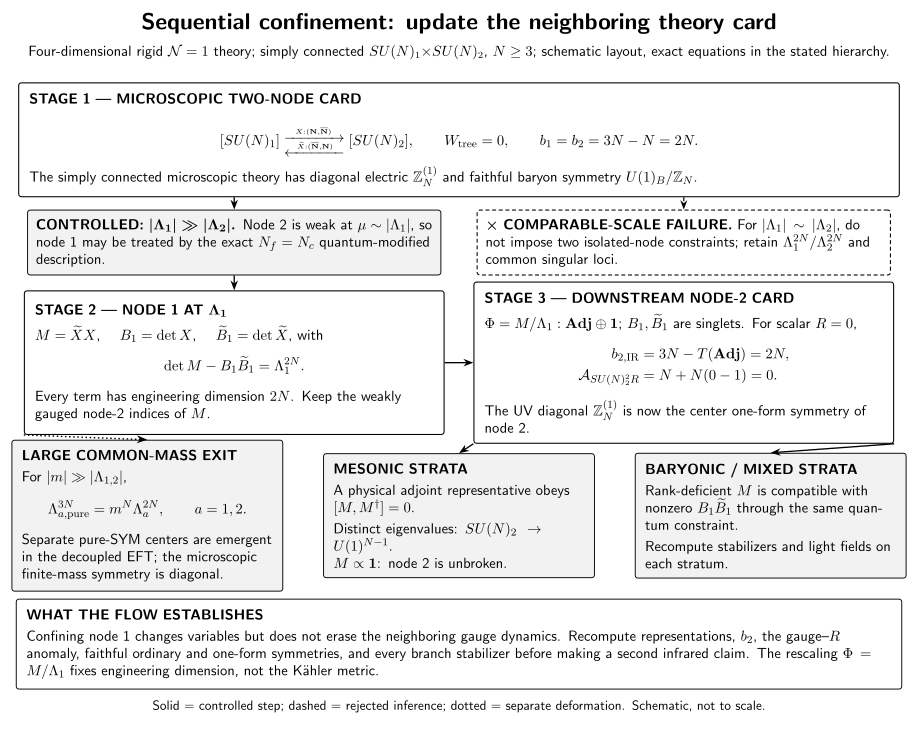
Sequential confinement for . Node 1 is replaced by , , and subject to ; node 2 then sees an adjoint-plus-singlet and retains and the inherited . The diagram is schematic and not to scale. Its crossed-out inset marks a failure of the sequential approximation when the two strong scales are comparable, not a claim that the full theory is inconsistent.
The same content is available without the image:
| Stage | Active variables under node 2 | Exact relation or check | One-form symmetry | Domain of control |
|---|---|---|---|---|
| Ultraviolet | and : flavor pairs | Diagonal | Microscopic theory card | |
| At | , , | Same diagonal symmetry | ||
| Below | ; baryons are singlets | and | Center of the remaining node | Composite Kähler metric not fixed |
| Large common mass | Two pure-SYM nodes | Exact diagonal subgroup; separate centers only in the decoupled EFT |
Structured data for the sequential-confinement figure (JSON)
The branches are physically distinct. A physical vacuum must satisfy the node-2 terms. For an adjoint expectation value this requires a normal representative, , which can be diagonalized by a unitary gauge transformation. A generic such representative with distinct eigenvalues breaks to its maximal torus. Merely being diagonalizable by the complexified group is not enough to establish this physical Higgs pattern. At , node 2 remains unbroken. At baryonic points the constraint can be satisfied with rank-deficient and nonzero . A formula derived on one stabilizer stratum cannot be extended through an enhanced-symmetry locus without adding the degrees of freedom that become light there.
Why two independent constraints are generally wrong
Section titled “Why two independent constraints are generally wrong”If one instead starts with , the same reasoning gives a node-2 quantum constraint in an oppositely ordered description. The two descriptions concern the same microscopic fields and overlapping composites. When and are comparable, it is not valid to impose two single-node constraints as if the nodes had independent flavor fields. Holomorphic quantities may depend on the dimensionless ratio , and additional singular loci can occur when the hierarchy is removed.
The correct statement is limited but useful: each sequential description is exact in its holomorphic variables within a regime where the neighboring gauge coupling is parametrically weak at the first strong scale. Continuing between the two regimes requires anomaly matching, branch tracking, and control of every singularity; it is not guaranteed by writing both limiting answers on the same line. For linear mooses, Chang and Georgi 2003, §§ 3–8, arXiv PDF derive local quantum-modified splitting relations. For ring mooses, Hailu 2003, §§ 6–7, arXiv PDF finds a Coulomb phase and singular loci depending on all node scales. These are concrete demonstrations of combined-scale dynamics, but the ring result is an analogue, not an exact solution of the present model. Successive node dualization in theories with additional matter is tested by Poppitz, Shadmi, and Trivedi 1996, §§ 2–4, arXiv PDF; that paper supports the method, not every claim about this minimal bifundamental ring.
A clean mass-threshold check
Section titled “A clean mass-threshold check”Add the gauge-invariant deformation
For , all flavor pairs are integrated out from both nodes. Each node becomes pure SYM. Since and , holomorphic matching gives independently
The exponent counts massive flavor pairs at that node. In the large-mass decoupling theory, each pure node has gaugino-condensate phases, giving holomorphic vacua before identifications from an alternative global-form choice. At any finite microscopic mass, the bifundamental pair breaks the two separate center one-form symmetries to the exact diagonal subgroup. The separate pure-node centers are therefore emergent symmetries of the decoupled low-energy theory, not additional exact ultraviolet symmetries.
The same threshold can be approached from the confined variables when, for example, is crossed first. Then lifts composite directions and the quantum constraint selects isolated branches. Matching the final pure-node scales must reproduce the boxed formula, but intermediate masses depend on the normalization of and its Kähler potential. Using the elementary mass in the holomorphic relation is robust; declaring a canonically normalized composite mass without the Kähler metric is not.
What a node duality must update
Section titled “What a node duality must update”The preceding example is a worked confinement step. The following is a bookkeeping checklist for a general duality step, not a claim that the minimal two-node model above has been dualized. Dualizing an node with effective flavors replaces it by , adds mesons made from every length-two path through that node, and adds superpotential couplings between those mesons and magnetic bifundamentals. Four updates are compulsory:
- Recompute the cubic and mixed anomalies of the neighboring gauge nodes.
- Recompute each neighboring beta-function coefficient using the new charged fields.
- Match holomorphic scales with the duality normalization scale and every massive threshold.
- Recompute the faithful ordinary symmetry and genuine line operators; local anomaly matching alone does not fix global form.
Different dualization orders can give different ultraviolet quivers that are proposed to share an infrared limit. Agreement of anomalies, moduli spaces, deformations, and scale relations is strong duality evidence, but it does not make either ultraviolet Lagrangian a weakly coupled description everywhere. Explicit product-group examples and their renormalization-flow qualifications are analyzed in Poppitz, Shadmi, and Trivedi 1996, pp. 125–169.
Common pitfalls
Section titled “Common pitfalls”Counting a bifundamental once. For the beta function, its index gives copies, and conversely. Missing this multiplicity changes both and anomaly coefficients.
Forgetting the diagonal one-form symmetry. Matter breaks the two center symmetries down to the subgroup acting trivially on every bifundamental. Quotienting by that subgroup changes the theory’s line operators.
Sequentially confining without a hierarchy. The first node may be treated as an isolated strong sector only if every neighboring gauge coupling is weak at that scale. Comparable scales require a simultaneous analysis or a dual description with its own stated regime.
Exercises
Section titled “Exercises”1. Center and beta functions
Section titled “1. Center and beta functions”For the two-node theory, derive and find the subgroup of left unbroken by the matter.
Solution
Each node sees fundamentals and antifundamentals, whose total Dynkin index is , hence . A center element acts on as and on inversely. Both are invariant precisely when , leaving the diagonal for the simply connected product.
2. Match the massive theory
Section titled “2. Match the massive theory”Derive the pure-node scale relation after adding , and explain why it holds for both nodes even when .
Solution
At either node, integrating out flavor pairs changes from to . Holomorphic matching at the common mass threshold gives . The two complex scales remain independent; the shared mass does not identify their couplings or theta angles.
3. Rebuild the neighboring theory card
Section titled “3. Rebuild the neighboring theory card”After node 1 confines, derive the representations and baryon charges of , , and . Then compute , the mixed gauge– anomaly, and the surviving one-form symmetry.
Solution
transforms by conjugation and hence is ; the two determinants are node-2 singlets with covering-space baryon charges . Therefore
Adjoint and singlet matter cannot screen node-2 center charge. The ultraviolet diagonal is consequently represented below as the center one-form symmetry of the remaining node.
4. Diagnose the comparable-scale failure
Section titled “4. Diagnose the comparable-scale failure”Why can the two hierarchy-limit quantum constraints not simply be imposed simultaneously when ? Give one concrete datum that a simultaneous description must retain.
Solution
The two nodes do not possess independent flavor fields: both limiting constraints are built from the same and . Imposing them independently therefore duplicates shared composite coordinates and can assign incompatible relations to the same microscopic operators. A simultaneous description must retain at least the complex ratio , together with the common branch coordinates and any singular loci where additional states become light. The hierarchy limits constrain such a description but do not determine it by themselves.
References
Section titled “References”- Chang, Spencer, and Howard Georgi. “Quantum Modified Mooses.” Nuclear Physics B 672 (2003): 101–122. DOI; arXiv.
- Hailu, Girma. “ Supersymmetric Moose Theories.” Physical Review D 67 (2003): 085023. DOI; arXiv.
- Poppitz, Erich, Yael Shadmi, and Sandip P. Trivedi. “Duality and Exact Results in Product Group Theories.” Nuclear Physics B 480 (1996): 125–169. DOI; arXiv.
- Seiberg, Nathan. “Exact Results on the Space of Vacua of Four-Dimensional SUSY Gauge Theories.” Physical Review D 49 (1994): 6857–6863. DOI; arXiv.