

Two-Dimensional Mirror Symmetry and Object-Level Dictionaries
Two-dimensional mirror symmetry exchanges the chiral and twisted-chiral sectors of theories. In its strongest form it is an infrared QFT equivalence; in practical calculations one often establishes only a protected ring, vacuum, partition-function, or brane correspondence. A testable mirror claim must therefore give an object-level dictionary, match global and anomaly data, and state the evidence level rather than treating “Kähler moduli become complex-structure moduli” as a complete definition.
Required background. We use the GLSM phase construction and quantum discriminant and the framework for duality claims, dictionaries, and evidence. Helpful background. A- and B-twists identify the protected sectors exchanged by the mirror map.
Minimum mirror dictionary
Section titled “Minimum mirror dictionary”For theories and , a mirror proposal should specify at least:
| Object in | Mirror object in | Check |
|---|---|---|
| chiral multiplet data | twisted-chiral data | superspace constraints and R charges |
| vector R symmetry | axial R symmetry | anomaly coefficients and surviving subgroup |
| complex FI–theta parameter | affine constraint or exponential coefficient | theta periodicity, singular divisors, monodromy |
| A-model ring | B-model Jacobi or complex-structure ring | relations, grading, pairing, correlators |
| massive vacua | critical points or dual vacua | multiplicity, central values, monodromy |
| A-branes | B-branes | morphisms, gradings, central charges |
| line or defect operator | dual defect | fusion and action on states |
| protected partition function | corresponding partition function | contact terms and regulator convention |
| relevant deformation | mapped deformation | endpoint and symmetry breaking |
Matching one row is evidence only for that row. A full equivalence also requires compatible Hilbert spaces, locality, operator products, and unprotected observables—or a derivation that implies them.
Abelian dualization and its scope
Section titled “Abelian dualization and its scope”Suppose a chiral field has a periodic phase, locally , and that the action has the corresponding compact Abelian isometry. Gauge the shift and impose flatness of the auxiliary gauge field with a Lagrange multiplier. In superspace the field strength of that auxiliary vector multiplet is twisted chiral, so its Lagrange multiplier is twisted chiral. Integrating out returns the original first-order path integral; integrating out the gauge field produces the dual periodic scalar.
Classically, the dual imaginary part obeys
The exponential is therefore single-valued. A charged field can vanish, however, so its phase circle need not define a free global isometry. The naive Buscher dual is then only a patchwise description. In an Abelian GLSM, vortex sectors complete it and generate terms proportional to . This is the mechanism behind the Hori–Vafa construction Hori and Vafa 2000, §§3.1–3.3 and 3.7 (PDF).
For a GLSM with fields of charges , dualize each charged phase to a periodic twisted chiral . Use the neighboring page’s mass convention
A standard mirror twisted superpotential is then
The sign of the last term is tied to the definition of ; Hori and Vafa use the opposite sign for their mass parameter. Only masses for the flavor quotient are physical: a shift can be absorbed into the origin of .
Integrating out imposes
leaving a twisted Landau–Ginzburg model on a complex torus. Integrating out the instead gives
and reproduces the logarithmic effective twisted superpotential of the GLSM. This mutual reduction checks the mass signs, FI–theta periodicities, and vacuum equations Hori and Vafa 2000, §3.7, eqs. (3.83)–(3.86) (PDF).
This construction does not generically identify an FI parameter with a twisted mass. In this Abelian dictionary, enters the affine constraints while enters linearly in . A mass–FI exchange belongs to other mirror families only when their gauge and flavor symmetries supply that explicit parameter map. The displayed twisted superpotential is protected; its Kähler potential and a finite-scale metric are D-term data and are not fixed by the same argument. Non-Abelian dualization and singular noncompact directions also require separate input.
Worked mirror: CP¹
Section titled “Worked mirror: CP¹”The GLSM has two charge-one chirals and vanishing twisted masses. With and
its Coulomb ring in the chapter’s renormalization convention is
The mirror constraint is modulo . Set ; then and
The critical equation is
Thus the dimensionally consistent operator map
matches the ring and its two vacua. The critical values are
so winding once around zero exchanges the vacua and reverses the square-root branch. The GLSM theta-angle monodromy produces the same permutation.
This example establishes more than a slogan:
| GLSM quantity | Twisted LG quantity |
|---|---|
| coefficient of | |
| dimensionless Coulomb operator | torus coordinate at criticality |
| two massive vacua | two critical points |
| theta monodromy | square-root monodromy |
| A-model quantum cohomology | B-type Jacobi ring |
It still does not, by itself, compare every unprotected scattering amplitude. The Hori–Vafa dualization supplies the stronger dynamical derivation.
The diagram below deliberately keeps two controlled fixtures separate rather than pretending that every arrow belongs to one RG flow. The upper panel certifies the two quintic semiclassical chambers and the finite Coulomb obstruction between them. The lower panel follows the exact protected relation through its Toda mirror, critical values, monodromy, and gapped ground-state bundle. Inspect the solid and dashed arrows: they distinguish a derived relation from a continuation that still needs a regime or gap hypothesis.
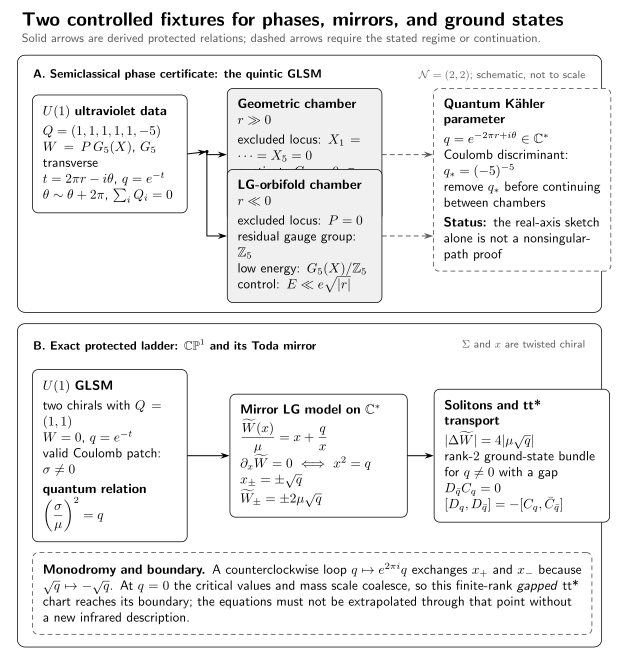
Two complementary fixtures. For the quintic, and produce the quintic and LG-orbifold descriptions, but continuation in must avoid in the displayed scheme. For , maps to , giving two critical values and a rank-two gapped tt* bundle for . Solid arrows are protected calculations; dashed arrows retain their stated continuation or gap assumptions. Schematic; not to scale.
Semantic route through the diagram
Section titled “Semantic route through the diagram”The visual remains optional: the ordered table contains every input, relation, and stopping condition. A complete structured equivalent is also available as JSON.
| Fixture or condition | Derived content | Status and boundary |
|---|---|---|
| Quintic UV data | ; ; with transverse ; ; ; | Fixed input. The zero charge sum removes the perturbative FI running and axial gauge-anomaly coefficient. |
| Quintic, | Exclude ; quotient to | Semiclassical geometric description for . |
| Quintic, | Exclude ; leaves ; low energy is | Semiclassical LG-orbifold description for . |
| Complex quintic parameter | Continue in and remove | Conditional continuation in the fixed one-loop scheme. A real-axis phase sketch alone is not a nonsingular-path proof. |
| Coulomb patch | Two charge-one chirals, , , and | Exact protected relation on the patch; the omitted massless point is not licensed by the derivation. |
| Twisted LG mirror | on ; ; ; | Exact critical-point and critical-value calculation. It does not by itself compare every unprotected observable. |
| Monodromy, solitons, and tt* | One counterclockwise loop about exchanges and ; ; and | Rank-two description where the two ground states are normalizable and spectrally isolated. At the displayed mass scale coalesces, so this gapped chart stops. |
The phase rows follow Witten 1993, §§3–4 (PDF); the mirror row follows Hori and Vafa 2000, §3 (PDF); and the ground-state compatibility row is developed on the chapter’s tt* page from the original Cecotti–Vafa construction.
Rings, pairings, and correlators
Section titled “Rings, pairings, and correlators”A ring isomorphism must preserve more than generators and relations. A topological field theory also has a trace pairing
and higher correlators. On the LG side these are residues involving the Hessian of ; on the sigma-model side they are Gromov–Witten invariants or their GLSM continuation. Field redefinitions can rescale generators, so numerical correlators test the normalization of the mirror map.
For , the Jacobi ideal is generated by . Because the target is , one works in Laurent polynomials:
Forgetting that is invertible changes the behavior at and loses the correct noncompact domain.
Global data and orbifolds
Section titled “Global data and orbifolds”The charge matrix alone does not determine a mirror. The global gauge group fixes:
- the cocharacter lattice summed over in gauge flux sectors;
- theta-angle periodicities;
- periodic identifications of the dual ;
- residual orbifold groups after solving the constraints;
- genuine line operators and one-form symmetries.
If a subgroup acts trivially on all matter, dualization can produce disconnected sectors rather than a single LG theory. Discrete theta angles weight those sectors differently. A correct mirror must reproduce this information, not erase it by replacing a global group with its Lie algebra.
Orbifold mirrors require twisted sectors on both sides. The invariant Jacobi ring is only the untwisted piece; state-space dimension, R grading, and discrete torsion require the full orbifold construction.
Deformations and singular loci
Section titled “Deformations and singular loci”Mirror symmetry should commute with controlled deformations. In the Abelian construction above, FI–theta data fixes the linear constraint, flavor twisted masses become linear terms, and the field-dependent Coulomb-branch masses appear as exponential coordinates through . Ordinary chiral-superpotential deformations require their own operator map; they must not be relabeled as twisted masses by analogy. To test a proposed map:
- deform away from a singular point so vacua are isolated;
- map every coupling with its periodicity and R charge;
- compare vacuum equations and critical values;
- follow monodromy around the discriminant;
- take the singular limit only after the massive comparison is understood.
A mirror map is often multivalued on coordinates but single-valued on the moduli stack. Branch cuts are bookkeeping; monodromy around the discriminant is physical.
Branes and defects
Section titled “Branes and defects”The closed-string ring sees only part of the theory. The broader geometric and categorical dictionary is developed in Hori et al. 2003. In particular, mirror symmetry exchanges A-branes and B-branes:
For an LG model, a B-brane can be represented by a matrix factorization satisfying ; for a sigma model it becomes a complex of holomorphic bundles in suitable regimes. On the A side, disk instantons correct the naive Lagrangian geometry. A serious categorical claim states the category, grading, coefficient ring, compactness condition, and whether it concerns a wrapped or compact Fukaya category.
Defects provide an even sharper test. A duality wall should map local operators, act consistently on branes, and compose to the identity defect up to the stated topological equivalence. Matching partition functions without matching defect fusion can miss global identifications.
Partition functions and evidence levels
Section titled “Partition functions and evidence levels”Protected partition functions can test a mirror map quantitatively. Depending on background and supercharge, one may compare sphere partition functions, hemisphere amplitudes, elliptic genera, or twisted correlators. The comparison must allow local supersymmetric counterterms: contact terms can multiply a partition function by a holomorphic factor without changing separated-point physics.
Use the following evidence ladder:
| Evidence | Supports | Does not alone establish |
|---|---|---|
| same vacuum count | Witten index in a massive compact regime | ring multiplication or full spectrum |
| isomorphic ring | protected local algebra | pairing, branes, or unprotected sector |
| matching correlators | protected TFT equivalence | complete physical QFT |
| matching anomalies and genera | global protected spectrum | continuum-insensitive full equivalence |
| matching brane/defect categories | protected open and extended sectors | ordinary metric data without further input |
| derivation by exact dualization | full equivalence within derivation hypotheses | regimes where the path-integral manipulations fail |
Failure modes
Section titled “Failure modes”Noncompactness. Exponential LG potentials can have asymptotic valleys. Vacuum wavefunctions, residues, and elliptic genera then need integration cycles or infrared regulators.
Singular fibers. At a discriminant, extra states become massless and a massive canonical-vacuum description can fail. GLSMs make these singular divisors and their phase continuation explicit Witten 1993, §§3–4 (PDF); matching only away from the divisor does not automatically determine the singular theory.
Partial topological agreement. A-model/B-model equality is a protected statement. Enhancing it to a full QFT equivalence requires a dualization, a broader observable set, or additional structural evidence.
Hidden global quotient. Dropping an orbifold or changing the flux lattice alters the theory even when local superpotentials agree.
Exercises
Section titled “Exercises”- Derive the Hori–Vafa mirror.
Solution
Start with periodic variables and
Integrating out imposes . Set for ; then . Thus
The critical equations make all equal to a common with , matching under .
- Explain why a ring map must also compare the trace pairing.
Solution
Two abstract algebras can be isomorphic while defining different Frobenius algebras. Sphere correlators use the nondegenerate trace . Rescaling operators or choosing a different residue measure changes this pairing, so matching it tests physical normalization and topological correlators.
- List three checks beyond that strengthen the mirror claim.
Solution
Examples include matching the two critical values and their monodromy, the topological residue pairing, supersymmetric sphere partition functions up to contact terms, A-branes with LG thimbles, and the elliptic genus in a regulated compact setting. Any three, with conventions and domains stated, strengthen the claim.
References
Section titled “References”- Cecotti, S., and Vafa, C. “Topological–Anti-Topological Fusion.” Nuclear Physics B 367 (1991): 359–461. doi:10.1016/0550-3213(91)90021-O.
- Hori, K., Katz, S., Klemm, A., Pandharipande, R., Thomas, R., Vafa, C., Vakil, R., and Zaslow, E. Mirror Symmetry. Clay Mathematics Monographs 1. Providence, RI: American Mathematical Society and Clay Mathematics Institute, 2003, chs. 11–14. Clay Mathematics Institute book page.
- Hori, K., and Vafa, C. “Mirror Symmetry.” arXiv:hep-th/0002222, 2000. Open PDF.
- Witten, E. “Phases of Theories in Two Dimensions.” Nuclear Physics B 403 (1993): 159–222. doi:10.1016/0550-3213(93)90033-L. Open PDF.