

F- and D-Flatness and Gauge Quotients
A supersymmetric vacuum is not merely a zero of the scalar potential. It is a zero-energy field configuration modulo gauge transformations, together with the stabilizer that records which gauge symmetry remains unbroken. For four-dimensional gauge theories with canonical kinetic terms, this becomes the concrete problem
where is the compact gauge group and, in the convention inherited from the preceding chapter, . A Fayet–Iliopoulos parameter is allowed only for an Abelian factor. For such a factor it is convenient to call
the geometric moment-map level, so that is . A complexified quotient is often more efficient, but it is equivalent only after the appropriate stability condition is imposed.
Required background. Use F- and D-term potentials for auxiliary-field elimination, constraints and reduction for quotient logic, and moment maps for Hamiltonian group actions. Helpful background. Gauge orbits and stabilizers explains why orbit dimension can jump.
Zero energy and the vacuum equations
Section titled “Zero energy and the vacuum equations”Let chiral scalars transform unitarily in a representation of . With Kähler metric and gauge kinetic matrix , the auxiliary fields give
Positivity therefore makes the vacuum equations transparent:
The first equations define the F-flat locus . Algebraically, its coordinate ring is the polynomial or holomorphic function ring divided by the F-term ideal . The second equations select a level set of the real moment map. Neither step has yet removed gauge redundancy. For an Abelian factor with , the second equation may equivalently be written with . The symbols and must not be interchanged: they have opposite sign and differ by the coupling in this normalization. This auxiliary-field derivation and its gauge-theory normalization are reviewed in Weinberg 2000, ch. 27.
The physical classical vacuum space is
The last form uses the geometric level just defined. This notation includes important data that a dimension count alone loses. At , the stabilizer
is the residual gauge group. If changes, the quotient must be analyzed orbit type by orbit type and may be singular; the smooth free-action formula cannot simply be continued through the stabilizer jump. On a smooth stratum where the equations are transverse,
where denotes the smooth orbit-type stratum through . The moment-map constraints remove real directions and the quotient removes the same number of orbit directions. For a free action this reduces to . The formula requires the indicated transversality assumptions and must be applied stratum by stratum when stabilizers jump.
Compact and complexified quotients
Section titled “Compact and complexified quotients”Suppose the F-flat equations are invariant under the complexified gauge group . First assume that the fields form a finite-dimensional Hermitian representation and that is a closed -invariant affine locus. For a more general Kähler target, one needs a global holomorphic action and an admissible moment map; properness is a sufficient control condition. Under these hypotheses, the compact quotient can be compared with a complexified quotient:
The superscript is essential: is the semistable locus selected by the geometric level. When is rational or integral in the appropriate weight lattice, a character supplies an algebraic linearization and the right-hand side is a GIT quotient. An arbitrary real level still selects analytic chamber data, but need not itself define a character. A complex orbit is retained when its closure meets . When the meeting orbit is closed, the intersection is a single orbit. Nonclosed orbits flow toward a closed orbit in their closure and are not distinct vacua in the quotient. This is the finite-dimensional content of the Kempf–Ness correspondence, Kempf and Ness 1979, pp. 233–243; its application to supersymmetric vacuum varieties is given by Luty and Taylor 1996, pp. 3399–3405, arXiv:hep-th/9506098. The analytic quotient and its comparison with algebraic GIT under the integral, prequantized hypotheses are made precise in Sjamaar 1995, § 2.1, Proposition 2.2, pp. 105–106, Theorem 2.3, p. 107, and § 2.2, Theorem 2.15, pp. 113–114. These results are not permission to divide all of naively by .
For (equivalently ), affine invariant coordinates describe the categorical quotient
This construction deliberately identifies complex orbits whose closures meet. It gives the correct gauge-invariant variety, while stabilizer information must be restored separately if the low-energy spectrum is required.
The anomaly-free four-field fixture below keeps those distinctions visible in one calculation. Read downward from the flatness equations to the two stability-selected nonzero-level quotients, then follow the dashed contractions to the zero-level affinization. The final row restores the stabilizer and mass-spectrum information that invariant coordinates omit.
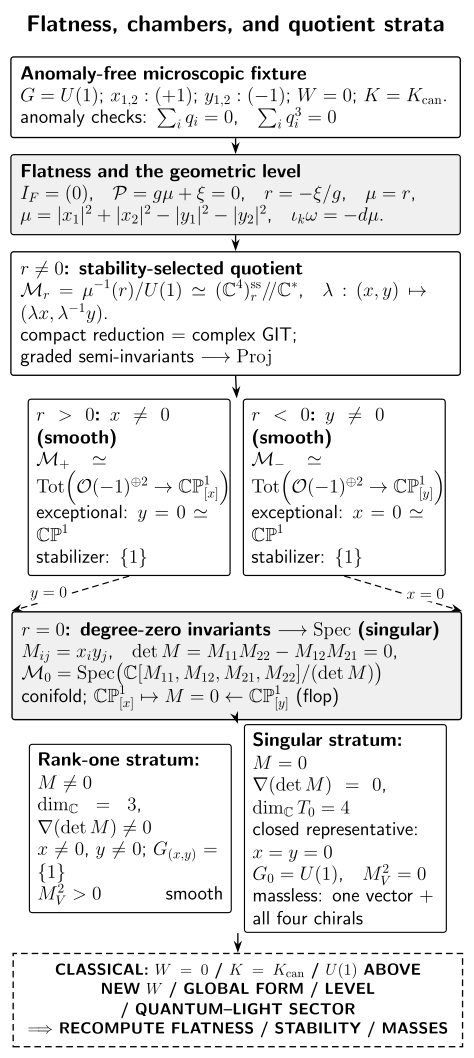
Exact classical quotient fixture for with charges , canonical , and . In the site convention , D-flatness is with . The and stability choices give the two smooth small resolutions; degree-zero invariants at give . The rank-one stratum has complex dimension three and trivial stabilizer, whereas at the origin the determinant Jacobian vanishes and the vector plus all four charged chirals are massless. The charge row and its two D-term small resolutions are tabulated and related by the flop in Morrison and Plesser 1999, § 4.2, Table 3, p. 24, and Fig. 3 with discussion, p. 26. The drawing is schematic and not to scale. Exact equations, adjacency, and independent checks (JSON).
Worked example: charged fields and FI chambers
Section titled “Worked example: charged fields and FI chambers”As a finite-dimensional classical quotient fixture, take chiral multiplets of charge under , no superpotential, and canonical Kähler potential. With and , the inherited convention gives
the vacuum equation is .
This fixture cleanly teaches symplectic reduction, but the all-positive-charge matter content has a four-dimensional gauge anomaly. It is therefore not, by itself, a complete quantum gauge theory. Quantum applications require an anomaly-free completion; the quotient calculation below is a statement about the displayed classical bosonic sector.
-
If , the level set is and the action is free. Hence
In complex language, the same space is . The origin is excluded by stability because its orbit closure cannot meet the positive moment-map level.
-
If , the only solution is . Its stabilizer is all of , so the vector multiplet is not Higgsed. With , all charged chiral multiplets are massless there as well. The quotient is a point, but the low-energy physics is not the smooth sigma model: its field content has become incomplete.
-
If , there is no solution and supersymmetry is broken in this model. A formal quotient by would miss this fact entirely.
This three-chamber calculation is the quickest diagnostic for an incorrect complex quotient: if the proposed construction gives the same answer for all , it has discarded stability data.
A reproducible quotient workflow
Section titled “A reproducible quotient workflow”For a general gauge-matter theory:
- Fix the global gauge group, matter representation, superpotential, Kähler potential, gauge kinetic matrix, and FI parameters.
- Compute and retain every irreducible branch, including intersections.
- Write the moment map with the same generator and coupling normalization used in the action.
- Solve , equivalently with for each Abelian factor, on every F-flat branch and test whether the level set is nonempty.
- Divide by the compact group, or specify the stability condition before using .
- Determine generic and special stabilizers. Check the dimension separately on each stratum.
- Compare with gauge-invariant coordinates and relations; the next page develops that independent description.
- Distinguish the classical variety from its metric and from quantum corrections. Equality of coordinate rings does not imply equality of metrics or low-energy spectra.
Common pitfalls
Section titled “Common pitfalls”Dividing by the wrong group. The compact quotient acts after the real moment-map equation; the complexified quotient acts on a stability-selected complex locus. Writing without specifying orbit closure and stability can retain excluded orbits or erase FI chambers.
Subtracting twice without checking the action. The familiar reduction by assumes a regular level and a free action. A stabilizer or dependent constraint changes the local dimension and usually signals a special stratum.
Calling every quotient singularity an interacting singularity. A coordinate presentation can be singular because a gauge orbit shrinks, but the physical interpretation requires a mass-spectrum check. The singular-locus analysis supplies that extra test.
Exercises
Section titled “Exercises”Consider two fields of charges , no superpotential, and moment-map equation .
- Determine the quotient for , , and .
- Identify the stabilizer on each branch.
- Compare with the invariant .
Solution
For , cannot vanish. Gauge-fix its phase; , so supplies one complex modulus through . Thus the quotient is . The action is free everywhere in this chamber, including at , whose representative has and . The case is symmetric: is nonzero everywhere, the quotient is again , and the stabilizer remains trivial at its point. At , nonzero solutions have and are labeled by , with trivial stabilizer. Only now does have the closed representative and stabilizer . The same invariant variety therefore hides chamber-dependent stable representatives and an unbroken-gauge point present only at the zero level.
References
Section titled “References”- Kempf, George, and Linda Ness. “The Length of Vectors in Representation Spaces.” In Algebraic Geometry, Lecture Notes in Mathematics 732, 233–243. Springer, 1979. doi:10.1007/BFb0066647.
- Luty, Markus A., and Washington Taylor IV. “Varieties of Vacua in Classical Supersymmetric Gauge Theories.” Physical Review D 53 (1996): 3399–3405. arXiv:hep-th/9506098.
- Morrison, David R., and M. Ronen Plesser. “Non-Spherical Horizons, I.” Advances in Theoretical and Mathematical Physics 3 (1999): 1–81. doi:10.4310/ATMP.1999.v3.n1.a1.
- Sjamaar, Reyer. “Holomorphic Slices, Symplectic Reduction and Multiplicities of Representations.” Annals of Mathematics 141 (1995): 87–129. doi:10.2307/2118628.
- Weinberg, Steven. The Quantum Theory of Fields, Volume III: Supersymmetry. Cambridge University Press, 2000, ch. 27. doi:10.1017/CBO9781139644198.