

The Double Copy
The double copy replaces color factors in a cubic-graph gauge-theory representation by a second set of kinematic numerators. When the duality conditions, graph representation, and tensor-product state content are controlled, the result is a specified gravity or gravity–matter amplitude. General tree-level constructions exist for declared pairs of gauge theories; loop and classical extensions have narrower, representation-dependent domains Bern et al. 2024, §§ 2.2–2.5, pp. 14–35; §§ 6–8, pp. 98–150. Nothing in the replacement implies that every gauge-theory pair produces pure Einstein gravity or that every gravity theory has a known double-copy representation.
Required background. Color–Kinematics Duality supplies cubic graphs, matched Jacobi relations, and generalized gauge freedom.
The replacement rule
Section titled “The replacement rule”Start with
For labeled tree graphs the graph symmetry factors are one. Replace by a numerator from a second gauge theory on the same graph set:
If one numerator set obeys the color-matched Jacobi relations and the other represents a valid gauge amplitude, generalized gauge shifts of the second set do not change the result under the usual assumptions. Taking both sets in dual form makes the symmetry manifest.
The normalization of depends on the gravitational action; here , in four dimensions, and . Coupling and overall- conventions must be matched before comparing formulas.
The shared figure displays the logic graph by graph. The upper relations are constraints within the gauge representation; the lower replacement is a new amplitude construction and inherits the same denominators and graph symmetry factors.
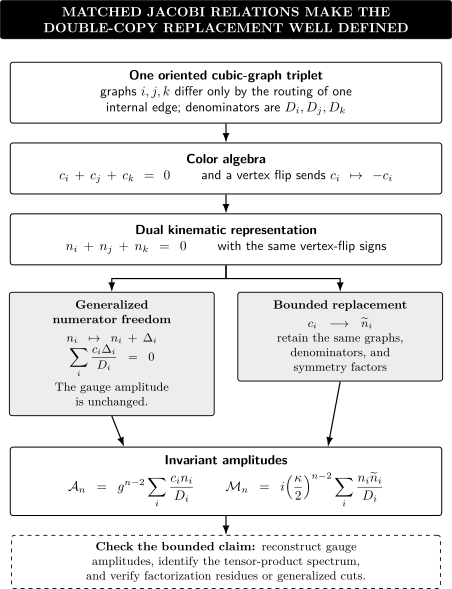
From dual gauge numerators to the double copy. The graph denominators and symmetry factors are retained while is replaced by ; the construction is valid within the stated dual representation and field-content assumptions. The diagram is schematic.
Four-point check
Section titled “Four-point check”At four points,
Suppose both numerator sets represent valid gauge-theory trees and factorize on their physical poles. With and the corresponding relation for , the residue on , for example, is then the product of the corresponding three-point double-copy amplitudes. Jacobi relations organize this result but do not, by themselves, establish factorization. A generalized shift changes the expression by
Because the obey the same linear identities as color factors, any shift that leaves the second gauge amplitude invariant by those identities also leaves the double copy invariant. This is why the duality condition is not decorative.
Tree-level Kawai–Lewellen–Tye relations give an equivalent organization: closed-string amplitudes factorize into bilinears of open-string amplitudes, and the field-theory limit yields gravity amplitudes as a momentum-kernel bilinear of color-ordered gauge amplitudes Kawai, Lewellen, and Tye 1986, pp. 1–14.
State content is part of the result
Section titled “State content is part of the result”For two massless vector states of common null momentum in , let be the metric on the -dimensional transverse little-group space and use unit-weight symmetrization. Their polarization product decomposes as
The bracketed symmetric traceless part is a graviton, the antisymmetric part is a two-form, and the trace is a dilaton-like scalar. In four dimensions the massless two-form is on-shell dual to a scalar. Thus pure nonsupersymmetric Yang–Mills copied with itself naturally contains more than pure Einstein gravity. Supersymmetry, matter choices, projections, or additional cancelling states alter the product theory. One must compare its on-shell spectrum and interactions, not infer the target theory from the word “gravity-like.”
Similarly, fundamental matter and flavor can produce gauge, gravity, or matter-coupled theories with selection rules that differ from the adjoint example. The admissible color identities determine the kinematic identities to be imposed.
Loop and classical orientations
Section titled “Loop and classical orientations”At loop level the proposed representation is
Its evidence is construction based: candidate numerators are tested on generalized cuts, symmetries, power counting, and known integrated amplitudes Bern, Carrasco, and Johansson 2010, pp. 061602-1–061602-4. Action-level arguments extend the double copy to all loop orders for parent theories with CK-dual trees, but allow Jacobian counterterms and possibly nonlocal field redefinitions Borsten et al. 2023, §§ 3.8–3.9, pp. 20–23; § 6, pp. 46–60. This is not a local numerator-construction theorem for every gauge-theory pair.
Classical double-copy programs map gauge-theory radiation, solutions, or sources to gravitational objects in particular representations. Kerr–Schild metrics provide a controlled example in which the field equations linearize and a gauge-theory single copy can be identified Monteiro, O’Connell, and White 2014, §§ 2–3, pp. 3–9. This does not mean that an arbitrary nonlinear spacetime has a unique local single copy.
The comparison of current results separates the established tree replacement from broader loop/classical evidence and from open scope questions. Its literature cutoff is 9 August 2026; mutable domain questions continue in the dated research discussion on color–kinematics and double copy.
Validation checks
Section titled “Validation checks”For a proposed double copy:
- verify that the two gauge representations use identical cubic graphs, denominators, orientations, and symmetry factors;
- check the required Jacobi and antisymmetry relations for at least one numerator set;
- identify the tensor-product on-shell spectrum and remove unwanted states only by a justified construction;
- compare three- and four-point amplitudes with the intended gravitational normalization;
- test factorization residues and generalized cuts;
- apply generalized numerator shifts and confirm the double-copy amplitude is unchanged;
- state loop order, dimension, regulator, and whether equality is integrand-level or only after integration.
Common pitfalls
Section titled “Common pitfalls”Replacing color in arbitrary numerators. Without the necessary dual relations, generalized gauge shifts can change the putative gravity amplitude. Construct or verify a dual representation first.
Assuming Yang–Mills squared equals pure gravity. The tensor product generally includes a scalar and antisymmetric two-form. State and check the spectrum.
Confusing an integrand equality with an integrated equality. Surface terms and regulator-dependent contributions may matter. Specify the equivalence relation.
Claiming universality from successful examples. Loop and classical constructions have theory- and representation-dependent domains. Name them explicitly.
Check your understanding
Section titled “Check your understanding”At four points, shift the second numerator set by , , and with signs chosen consistently with the color decomposition. Use to show the double-copy change vanishes.
Where to continue
Section titled “Where to continue”- Positive Geometry and Canonical Forms gives another representation in which invariant residues are primary and decompositions are redundant.
- Generalized Unitarity and Integrand Reduction supplies the loop-level tests.
- Perturbative and Higher-Derivative Gravity Interfaces develops the broader quantum-gravity interpretation and higher-derivative applications.
- Color–Kinematics Duality contains the comparison of current results and numerator construction cautions.
References
Section titled “References”- Bern, Zvi, John Joseph Carrasco, and Henrik Johansson. “Perturbative Quantum Gravity as a Double Copy of Gauge Theory.” Physical Review Letters 105 (2010): 061602. DOI. Open preprint.
- Bern, Zvi, John Joseph Carrasco, Marco Chiodaroli, Henrik Johansson, and Radu Roiban. “The Duality between Color and Kinematics and Its Applications.” Journal of Physics A: Mathematical and Theoretical 57 (2024): 333002. DOI. Open PDF.
- Borsten, Leron, Branislav Jurčo, Hyungrok Kim, Tommaso Macrelli, Christian Sämann, and Martin Wolf. “Tree-Level Color–Kinematics Duality Implies Loop-Level Color–Kinematics Duality up to Counterterms.” Nuclear Physics B 989 (2023): 116144. DOI. Open preprint.
- Kawai, Hikaru, David C. Lewellen, and S.-H. Henry Tye. “A Relation Between Tree Amplitudes of Closed and Open Strings.” Nuclear Physics B 269 (1986): 1–23. DOI.
- Monteiro, Ricardo, Donal O’Connell, and Chris D. White. “Black Holes and the Double Copy.” Journal of High Energy Physics 12 (2014): 056. DOI. Open preprint.