

High-Energy and Regge Limits
The fixed-angle limit sends with fixed, whereas the Regge limit sends at fixed . They probe different parts of the angular-momentum sum and need not have the same asymptotics. Regge theory analytically continues partial waves to complex angular momentum; poles and cuts there organize possible fixed-transfer power laws, subject to crossing signature, analyticity, unitarity, and growth limitations.
Required background. Partial-Wave Unitarity supplies the integer angular-momentum expansion. Analyticity and Crossing of Amplitudes supplies continuation and channel boundary values. Causality, Growth, and Analytic Domains supplies the hypothesis ceiling for high-energy bounds.
Helpful background. Mellin Transforms and Scaling Asymptotics supplies pole-to-power-law intuition. Fixed-t and Partial-Wave Dispersion and Eikonal Approximation and Wilson Lines are useful downstream routes.
Two inequivalent high-energy directions
Section titled “Two inequivalent high-energy directions”For equal masses at large ,
Therefore:
- fixed angle: is held away from and , so ;
- Regge or fixed transfer: is held fixed, so and the scattering becomes forward.
A statement proved in one direction cannot be substituted into the other. Fixed-angle behavior is sensitive to hard large-momentum transfer, while the Regge limit reorganizes many partial waves at large impact parameter or angular momentum.
A single scalar exchange already diagnoses the noncommuting limits. For distinguishable scalars coupled to a mediator by ,
At fixed this approaches a nonzero constant as . At fixed angle, , so the same graph falls as . The example has no nontrivial Regge trajectory; it simply proves that expanding at fixed angle and then sending is nonuniform.
The shared figure keeps these directions visually distinct.
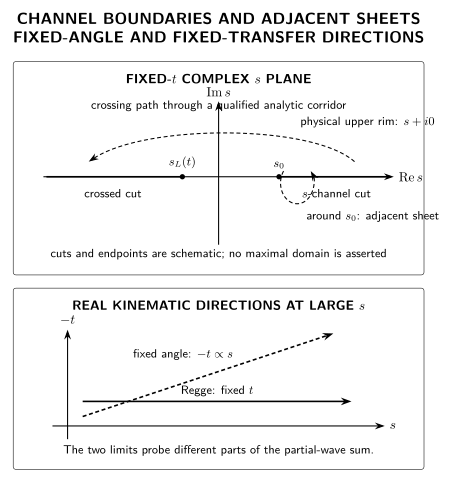
Fixed-angle and fixed- limits are different asymptotic directions. The schematic also records that crossing and sheet choices remain part of any high-energy continuation; it does not assert a universal Regge form.
From integer partial waves to complex angular momentum
Section titled “From integer partial waves to complex angular momentum”Start from the crossed-channel partial-wave sum. Under assumptions that permit an analytic continuation of the -channel coefficients and sufficient falloff, a Sommerfeld–Watson transform replaces the sum over nonnegative integers by a contour integral with poles from . Deforming the contour then exposes additional singularities of .
If has a simple Regge pole at , its contribution has the schematic fixed- form
where is crossing signature and is the associated signature factor. The pole trajectory relates exchanged spins and masses when it crosses physical integer , but neither linearity of nor dominance of a single pole is automatic.
On the upper physical bank, a common convention is
Analytic factors, signs, or powers of may be moved between and . What must remain invariant is the crossing parity, physical-bank phase, trajectory, and residue. At integer , the numerator selects even for and odd for ; a zero of the residue may cancel an apparent signature-factor pole.
Regge introduced the complex-angular-momentum continuation for potential scattering in Il Nuovo Cimento 14 (1959), pp. 951–976. Mizera presents the Watson transform, trajectories, and cut-plane qualifications in Mizera 2023, open lecture-note PDF, § 4.2, pp. 107–113.
Regge cuts, signature, and growth
Section titled “Regge cuts, signature, and growth”Multi-particle exchange and more complicated dynamics can generate branch cuts in the complex -plane rather than isolated poles. Such Regge cuts can add powers of logarithms or competing asymptotics. Crossing-even and crossing-odd amplitudes carry different signature factors and phases, so a power without its boundary-value and signature prescription is incomplete.
At , the optical theorem relates forward growth to the total cross section. Under the mass-gap and polynomial-boundedness hypotheses of a Froissart–Martin theorem, an isolated contribution with intercept and nonzero residue cannot remain the ultimate asymptotics without unitarization or other modifications. This inference does not apply unchanged to long-range massless theories and does not show that a fitted finite-energy intercept equals the true asymptotic intercept. The relevant growth and Regge qualifications are summarized in Mizera 2023, open lecture-note PDF, § 5.3.2, pp. 144–145.
Legitimate and illegitimate conclusions
Section titled “Legitimate and illegitimate conclusions”Regge behavior may legitimately organize fixed-transfer power laws, relate families of exchanged states, and expose crossing signature. It does not by itself:
- determine fixed-angle hard-scattering behavior;
- prove that the rightmost -plane singularity is a simple pole;
- exclude Regge cuts, logarithms, or multiple competing trajectories;
- justify extrapolating a finite-energy hadronic fit to arbitrarily large ; or
- establish QCD Reggeization, BFKL dynamics, conformal Regge theory, or holographic high-energy scattering.
High-energy QCD and small- physics develops QCD Reggeization and BFKL evolution, while Regge limits, eikonal scattering, and causality develops the holographic and gravitational setting. Current empirical and recent research results are discussed in Research.
Check your understanding
Section titled “Check your understanding”For fixed nonzero angle, show that grows with ; for fixed negative , show that . Then state how a -plane pole and a -plane cut differ in the resulting -dependence. The check fails if a Regge prediction is carried into the fixed-angle limit without a separate argument.
Solution
At large , . A fixed nonzero angle therefore makes , while fixed negative gives and hence . A simple pole of the continued partial wave at produces a pure power times its signature and residue. A local behavior instead produces ; noninteger is a Regge cut. None of these fixed- statements controls the fixed-angle ray.
References
Section titled “References”- Mizera, Sebastian. “Physics of the Analytic S-Matrix.” Physics Reports 1047 (2024): 1–92. DOI. Open PDF, §§ 4.2 and 5.3.2, pp. 107–113 and 144–145.
- Regge, Tullio. “Introduction to Complex Orbital Momenta.” Il Nuovo Cimento 14 (1959): 951–976. doi:10.1007/BF02728177.