

Partial-Wave Unitarity
Angular-momentum projection diagonalizes two-body rotational kinematics. With a declared normalization, -matrix unitarity then becomes a separate circle condition for each elastic partial wave and an inequality when inelastic channels open. The circle’s radius, center, and threshold powers are normalization-dependent; the eigenvalue is the invariant object.
Required background. S-Matrix Unitarity supplies the operator relation. Relativistic Scattering Kinematics supplies center-of-mass variables and thresholds.
Fix the four-dimensional scalar normalization
Section titled “Fix the four-dimensional scalar normalization”For equal-mass spinless scattering, let
and expand
Orthogonality gives
The coefficients are fixed rather than guessed: multiplying the expansion by and using
leaves . Projecting the two-body part of the unitarity state sum with the same identity makes different values orthogonal and yields when no other channel is open.
Define
Below the first inelastic threshold, unitarity requires
Consequently,
Weinberg derives the relativistic partial-wave decomposition, phase shifts, and threshold behavior in Weinberg 1995, § 3.7, printed pp. 151–159.
The Argand circle and inelastic interior
Section titled “The Argand circle and inelastic interior”Introduce the dimensionless amplitude . In the elastic region,
When additional channels open, write
Then
so lies inside the elastic circle. The distance of from the unit circle, not a change of plotting convention, measures lost elastic probability. The same diagonal-channel parametrization and its multichannel interpretation are stated in Particle Data Group 2025, review 50, § 50.1.3, printed pp. 8–9, PDF.
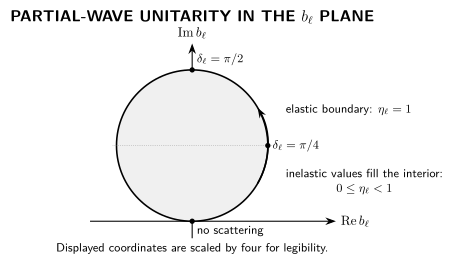
For , elastic unitarity is the circle ; the full range fills the interior disk, rather than a distinguished inner circle or universal inward trajectory. The plot is dimensionless and schematic; any energy-dependent path inside the disk is model dependent.
The equivalent semantic data are:
| Regime | constraint | |
|---|---|---|
| No scattering | ||
| Elastic | On the circle, | |
| Inelastic | , | Inside the circle; deficit |
With several two-body channels, the scalar becomes a matrix in channel space. Unitarity is when all open channels in that sector are retained. Diagonalizing this matrix gives eigenphases on the unit circle; looking only at one elastic entry gives , with its deficit supplied by transitions to . The single-channel parametrization is therefore a projection of multichannel unitary evolution, not a new source of nonunitarity.
For identical particles, form normalized symmetrized or antisymmetrized two-body states before importing these equations. For identical spinless bosons in a symmetric internal state, only even occur. One may integrate the full labeled sphere with exactly one final-state factor , or one representative half-sphere without it. A common normalized-channel convention uses rather than in the identical-boson expansion; the corresponding relation changes. Preserving the eigenvalue is the safe translation check.
Cross sections and threshold scaling
Section titled “Cross sections and threshold scaling”For distinguishable elastic scalars,
In the purely elastic region this equals the total cross section obtained from the optical theorem. The maximum contribution of one elastic partial wave follows from :
This is a partial-wave bound at fixed energy, not a statement that the full cross section saturates it.
For a short-range interaction and no threshold singularity,
near threshold. Long-range massless exchange and finely tuned near-threshold states can invalidate this simple scaling. Higher-dimensional harmonic analysis, conformal partial waves, and phenomenological coupled-channel fits use related ideas but different bases and normalizations. Continue to resonance poles and sheets for the analytic meaning of a partial-wave pole; a fitted Argand trajectory alone does not turn an unstable state into an asymptotic particle.
Translate another convention safely
Section titled “Translate another convention safely”Some sources absorb into the partial amplitude or use rather than in the expansion. Do not compare their circles by eye. Compute in each convention and demand the same eigenvalue. The phase shift, inelasticity, pole positions, and partial cross section then provide convention-independent checks.
Check your understanding
Section titled “Check your understanding”Starting from , impose and complete the square to recover the Argand circle. Then set and derive the inelastic deficit. If your result places outside the circle, a sign or normalization is wrong.
Solution
Writing , the equation becomes . More generally, gives
so every lies in the disk. For fixed , varying traces a circle of radius centered at ; allowing the full inelasticity range fills the disk.
References
Section titled “References”- Particle Data Group. “Resonances.” In Review of Particle Physics, 2025 Update, review 50, § 50.1.3, printed pp. 8–9. Official PDF.
- Weinberg, Steven. The Quantum Theory of Fields, Volume I: Foundations. Cambridge University Press, 1995, § 3.7, printed pp. 151–159. doi:10.1017/CBO9781139644167.