

Analyticity and Crossing of Amplitudes
Amplitudes in different physical channels can be boundary values of one analytic function of complexified Mandelstam invariants. Poles encode isolated states or exchanges; thresholds generate branch points and cuts; crossing is an analytic continuation between channel regions with the external particle, spin, and statistics assignments transformed. The statement is always domain-, sheet-, and path-dependent.
Required background. Mandelstam Channels and Tree-Level Crossing supplies the all-incoming convention and perturbative crossing rule.
Helpful background. Branches, Sheets, Analytic Continuation, and Monodromy supplies the mathematical sheet language.
Boundary values on the physical sheet
Section titled “Boundary values on the physical sheet”For equal-mass scalar scattering,
At fixed real in a domain where the continuation is justified, regard as a function of complex . The physical sheet is the sheet connected to a nonsingular Euclidean region without crossing a cut. The physical -channel amplitude above threshold is the upper-rim value
The right-hand cut starts at the lightest allowed -channel threshold. Crossed-channel thresholds produce left-hand cuts in the -plane; for equal masses at , the condition becomes . Bound-state poles may occur on the real physical sheet below threshold, whereas resonance poles occur only after continuation to an unphysical sheet. The cut-plane construction and continuation around thresholds are reviewed in Mizera 2023, open lecture-note PDF, § 3.3, pp. 81–88.
For equal-mass self-conjugate scalars in at least three spacetime dimensions, the three real physical regions land on different banks:
| Channel | Real physical region | Boundary value of the common analytic germ |
|---|---|---|
| , | ||
| , | ||
| , , | at fixed |
The last sign follows from . Thus an upper-half-plane path in does not automatically arrive on the physical bank; the path and the variable whose energy is continued must be named.
The general reflection property keeps the process labels visible. Hermitian analyticity gives
where the initial and final states, including their spin and internal labels, are reversed on the right. Only for an elastic scalar amplitude in a basis where the reversed process is the same does this reduce to the shorthand
and on a real cut
This equality is not a definition valid on every sheet; it uses the reflected boundary values.
A one-loop branch check
Section titled “A one-loop branch check”The finite nonlocal part of an equal-mass scalar bubble may be represented by
with the principal logarithm and a cut on . For , the logarithm’s argument is negative for , where . On the upper bank it approaches that negative axis from below, so
In theory the -channel term therefore has , matching the two-identical-particle state sum on the unitarity page. The calculation checks the upper-bank sign, the branch point, and the distinction between a discontinuity and an imaginary part Schwartz 2014, § 24.1.1, pp. 455–456.
Crossing is a continuation, not a relabeling slogan
Section titled “Crossing is a continuation, not a relabeling slogan”In the all-incoming convention, crossing changes the sign of the crossed physical momentum and replaces the particle by its antiparticle. At tree level a rational diagram makes this transparent. In an interacting amplitude, one must additionally specify a path through complex momentum space that avoids singularities and arrives at the correct boundary value.
Mizera’s 2023 open lecture-note PDF, § 5.2, pp. 131–140 distinguishes the channel kinematics, the available analyticity domains, and the continuation of energy signs. In particular, known proofs are qualified by mass gaps, external masses, multiplicity, and domain; the presence of massless particles makes general crossing statements substantially harder. This page therefore does not claim a universal maximal domain.
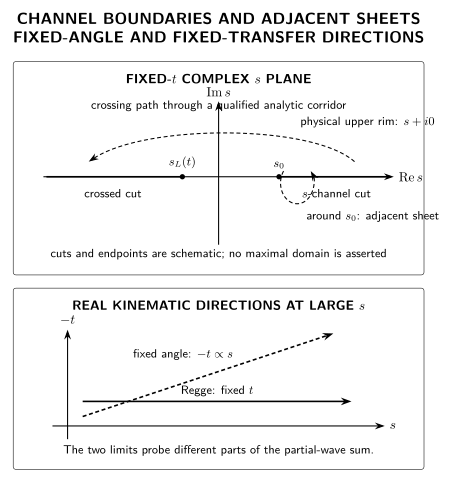
Channel regions are boundary values on a cut Mandelstam plane. Crossing requires a named path and sheet, while causal and high-energy conclusions require additional hypotheses. The diagram is schematic, uses equal-mass two-body thresholds for orientation, and is not a maximal analyticity theorem.
The nonvisual map is:
| Feature | Location in the fixed- -plane | Meaning |
|---|---|---|
| -channel threshold | Right-hand branch point and cut | On-shell -channel multiparticle states |
| Crossed threshold | Left-hand cut | On-shell states in the or channel after crossing |
| Stable bound state | Real pole on the physical sheet below threshold | Isolated normalizable state in the channel |
| Resonance | Complex pole on a channel-adjacent unphysical sheet | Unstable state, not an LSZ external particle |
| Upper/lower rim | Boundary values whose difference is the discontinuity |
The one- and multichannel sheet labels used in this classification are spelled out in Particle Data Group 2025, review 50, §§ 50.1.1–50.1.2, printed pp. 3–8, PDF.
What analyticity alone does not give
Section titled “What analyticity alone does not give”Analyticity does not determine subtraction constants, the number of subtractions, pole residues, or high-energy growth. A dispersion relation requires a domain and a bound strong enough to discard the large contour after any necessary subtractions. Unitarity supplies discontinuities but does not by itself reconstruct the amplitude without those inputs. Likewise, permutation symmetry of identical fields is not the same logical statement as analytic crossing between distinct particle processes.
The exact causal and growth hypotheses are treated in Causality, Growth, and Analytic Domains. Resonance sheet continuation is treated in Resonance Poles, Riemann Sheets, and Unstable States.
Check your understanding
Section titled “Check your understanding”At , draw the equal-mass -plane cuts and label the upper-rim physical -channel value. Continue around the branch point and state which channel momentum changes sign. The check fails if the same point is called both physical and second sheet without a continuation path.
Solution
At , the right cut is and the crossed cut is . The physical amplitude is . Circling the threshold once reverses the sign of the channel momentum and reaches the adjacent sheet; returning along the inverse path restores it. Physical kinematics instead has , equivalently at fixed , so reaching it requires the corresponding crossed continuation rather than merely renaming the upper rim.
References
Section titled “References”- Mizera, Sebastian. “Physics of the Analytic S-Matrix.” Physics Reports 1047 (2024): 1–92. DOI. Open PDF, §§ 3.3 and 5.2, pp. 81–88 and 131–140.
- Particle Data Group. “Resonances.” In Review of Particle Physics, 2025 Update, review 50, §§ 50.1.1–50.1.2, printed pp. 3–8. Official PDF.
- Schwartz, Matthew D. Quantum Field Theory and the Standard Model. Cambridge University Press, 2014, § 24.1.1, printed pp. 455–456. DOI.