

Resummation and Fixed-Order Matching
When an observable contains a small ratio , fixed-order coefficients can be dominated by logarithms . Resummation organizes the towers to all orders, while matching restores the nonsingular fixed-order information and the correct behavior away from the logarithmic region. A matched prediction is credible only if its expansion reproduces the claimed fixed order and its transition to ordinary kinematics is controlled.
Required background. Sudakov Logarithms and Resummation supplies the origin and evolution of logarithmic towers. Fixed-Order Organization and Scale Dependence supplies the truncation and scale conventions used in matching.
Logarithmic and fixed-order accuracy
Section titled “Logarithmic and fixed-order accuracy”For a cumulative observable
a Sudakov form often has the schematic structure
controls leading logarithms, next-to-leading logarithms, and so on, with convention-dependent details for cumulative versus differential counting. contains matching constants. A label such as NLL must therefore state which anomalous dimensions, fixed-order boundary terms, running-coupling order, and matching coefficients are included.
Fixed-order and logarithmic accuracy are independent axes. “NLO+NLL” means that the expansion through NLO is complete and the declared NLL tower is resummed. It does not mean that every ingredient is known to the same loop order.
For the representative thrust-like SCET-I dijet observable shown below, the natural scales obey , , and . Each sector is evolved to a common scale, overlap subtraction prevents double counting, and matching joins the resummed region to fixed-order kinematics. Other observables can have different modes and scale hierarchies.
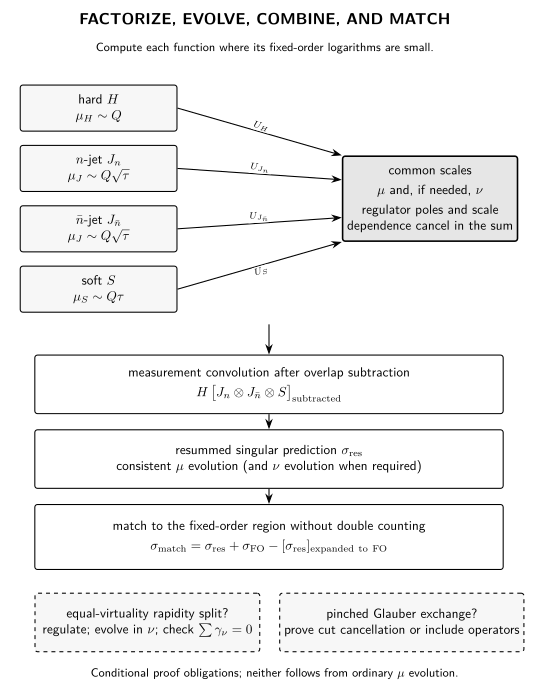
Scale separation and matching for a representative thrust-like SCET-I dijet observable. Hard, jet, and soft functions are computed near , , and , evolved consistently, combined with overlap subtraction, and matched to the fixed-order description. If rapidity divergences or Glauber exchange are present, additional evolution or cancellation arguments are required. The hierarchy is observable-dependent; the diagram is schematic and not to scale.
Cancellation of the common evolution-scale dependence is an essential check: the sum of anomalous dimensions must vanish in the factorized cross section to the stated order.
Additive matching
Section titled “Additive matching”Let be the fixed-order result through order , the resummed result, and its expansion through the same order. Additive matching is
The last term removes double counting. Expanding gives
while in the singular region the difference is nonsingular. This expansion equality should be checked analytically coefficient by coefficient and numerically at representative phase-space points.
Additive matching can become negative in a differential tail when the resummed and nonsingular pieces are separately large. Negativity can signal a transition or truncation problem, but a finite-order differential prediction is not itself a probability density in every bin.
Multiplicative matching
Section titled “Multiplicative matching”When the leading resummed term is nonzero, a multiplicative form can be written schematically as
The bracketed ratio is expanded to the matching order. This form can preserve a Sudakov suppression and transfer some higher-order products into the transition region, but it can be unstable near zeros of the expanded resummed denominator. Additive and multiplicative schemes agree through the claimed accuracy and differ by higher-order terms; their difference is a useful matching diagnostic, not an independent statistical sample.
For event-shape resummation, exponentiation, multiple-emission effects, and automated checks of continuously global observables are developed in Banfi, Salam, and Zanderighi 2005, §§ 2.2.3–2.2.4, pp. 24–33; § 3.1, pp. 39–43; § 4.1.2, pp. 55–56. The hypotheses matter: non-global measurements and clustering effects can introduce logarithms not captured by a simple global Sudakov exponent. A current survey of logarithmic counting, applications through high logarithmic accuracy, and the separate uncertainty from switching resummation off appears in Huston, Rabbertz, and Zanderighi 2024, review PDF, § 9.2.3.3, pp. 14–16; § 9.2.4, p. 18.
Transition profiles and endpoints
Section titled “Transition profiles and endpoints”Resummation should turn off when is no longer large. One may replace canonical scales by smooth profile scales that follow their natural scaling in the resummation region and merge to a common fixed-order scale in the tail. A valid profile must:
- remain in a perturbative range;
- preserve the hierarchy where factorization applies;
- merge smoothly enough not to create artificial derivatives;
- recover the fixed-order expansion in the tail;
- respect the physical endpoint or use an explicit endpoint correction.
Profile variations probe resummation and transition choices. They should be kept conceptually distinct from ordinary fixed-order scale variation. Correlating or combining them requires a stated rule, especially across bins where a coherent shape change is expected.
Expansion and limit checks
Section titled “Expansion and limit checks”A matched result should pass at least four analytic tests:
- expand in and reproduce every singular and nonsingular coefficient through the stated fixed order;
- take and verify the correct Sudakov boundary, then check the inclusive endpoint normalization separately;
- enter the tail and verify recovery of the fixed-order result up to higher-order terms;
- differentiate or integrate between cumulative and differential forms and account for endpoint distributions and profile derivatives.
Numerically, scan the matching region under profile and scheme variations, locate zeros or shoulders, and separate Monte Carlo noise from a genuine instability. A smooth central curve can hide a failed expansion check.
Common pitfalls
Section titled “Common pitfalls”Adding resummed and fixed-order results without subtracting the overlap. This double counts every logarithmic term already present at fixed order. Always expand the resummation in the same conventions and remove it.
Using a logarithmic-accuracy label without an ingredient list. Different communities count constants and primed accuracies differently. State the anomalous dimensions, boundary terms, running order, and matching order.
Freezing scales abruptly. A kink in a profile produces artificial structure in the differential spectrum. Verify profile smoothness and endpoint behavior.
Combining all variations into one envelope without correlations. Fixed-order, resummation, matching-scheme, and numerical variations probe different effects. Record them separately before adopting a combination model.
Check your understanding
Section titled “Check your understanding”Take and . Perform additive matching through NLO and verify that the matched expansion contains the full fixed-order coefficient while retaining any higher-order logarithms carried by .
Where to continue
Section titled “Where to continue”- Jets and Event-Shape Observables supplies measurements in which endpoint logarithms and non-global restrictions arise.
- Validation and Theory Uncertainties separates profile, matching, scale, and integration variations.
- Hard, Jet, and Soft Factorization develops the factorized ingredients summarized in the figure.
References
Section titled “References”- Banfi, Andrea, Gavin P. Salam, and Giulia Zanderighi. “Principles of General Final-State Resummation and Automated Implementation.” Journal of High Energy Physics 03 (2005): 073. DOI. Open preprint.
- Huston, Joey, Klaus Rabbertz, and Giulia Zanderighi. “Quantum Chromodynamics.” In S. Navas et al. (Particle Data Group), Review of Particle Physics, Physical Review D 110 (2024): 030001, rev. August 2023. Review PDF.