

Color Decomposition and Partial Amplitudes
Color decomposition separates gauge-group tensors from kinematic functions. The resulting partial amplitudes carry a cyclic ordering, have only ordering-compatible poles, and can be computed from planar color-stripped trees. The separation is a change of basis in the full gauge-invariant amplitude: neither the color tensors nor the partial amplitudes alone are basis-independent observables.
Required background. Vector External States and Ward Checks supplies the complete gauge-consistency test for external gluons.
Helpful background. Lie Groups, Lie Algebras, and Exponential and Adjoint Maps supplies generators, commutators, and invariant tensors. Compact Lie Groups, Roots, Weights, and Weyl Structure supplies representation data used in other color bases.
Trace basis and ordered amplitudes
Section titled “Trace basis and ordered amplitudes”For definiteness use the amplitude-friendly generators in the fundamental representation,
Here are the structure constants associated with the more common generators , for which and .
Define the tree-level color-ordered partial amplitudes by
The equation above defines the coupling-stripped used throughout this chapter. In the conventional normalization, each length- trace acquires the factor
Thus a translation must rescale the color tensors and coefficient convention together; changing only the two-generator trace silently changes the reconstructed amplitude.
The quotient by removes cyclic duplicates because both the trace and the partial amplitude are cyclic:
For pure-gluon trees in this convention,
These relations reduce redundancy but do not make all remaining orderings independent; photon-decoupling, Kleiss–Kuijf, and BCJ relations can reduce the basis further under their hypotheses. The trace decomposition and planar color-ordering construction are derived in Schwartz 2014, § 27.4, pp. 548–550 and Elvang and Huang 2014, § 2.5, pp. 21–26, PDF.
What ordering changes
Section titled “What ordering changes”A partial amplitude receives only graphs that can be drawn in a disk with external legs in that cyclic order. Consequently a factorization channel is allowed only when the momenta in the channel form a consecutive block of the ordering.
For , the allowed channel momenta are
equivalently the and channels. The crossed pairing is nonconsecutive and does not appear as a pole of this partial amplitude, although it occurs in a different ordering and therefore in the full color-dressed amplitude.
This is why color ordering is valuable for recursion: it reduces both the graph set and the factorization partitions. It is not a large- approximation at tree level. The full tree amplitude is exactly reconstructed by the color sum. Planarity here refers to the ordered color-stripped representation, not to discarding all subleading-color physics in a loop or cross section.
The figure shows the separation to inspect: the same color-dressed amplitude may be expanded in trace tensors or in structure-constant chains, while the ordered kinematic functions carry poles, helicities, and Ward checks.
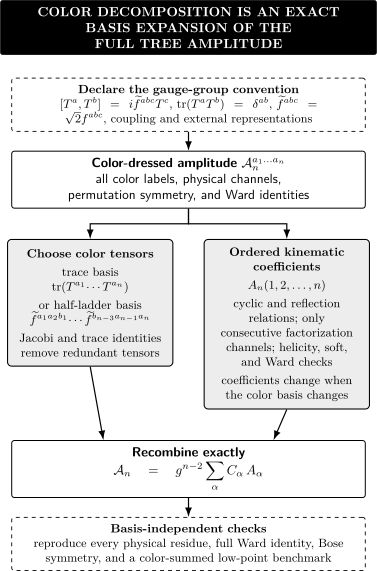
Color–kinematics separation at tree level. With , a trace basis makes cyclic order explicit; a half-ladder basis uses products of . Partial amplitudes contain only ordering-compatible poles and must pass physical Ward and factorization checks. The expansion is exact in the declared basis; the individual basis tensors and coefficients are not observables. Schematic, not to scale.
Structure-constant and half-ladder bases
Section titled “Structure-constant and half-ladder bases”The same tree amplitude can be expanded in a basis built from the antisymmetric cubic color tensor. Fix legs 1 and at the ends and define the half-ladder chain
where permutes . A corresponding decomposition is
This equation defines the coefficient convention ; factors of inherited from cubic Feynman rules are absorbed into it. The Jacobi identity
relates other cubic color factors to the chosen half ladders. Transforming between the trace and half-ladder descriptions is linear and depends on generator normalization. A valid conversion reproduces the same color-dressed amplitude for arbitrary external color labels. The fixed-end half-ladder construction is established in Del Duca, Dixon, and Maltoni 2000, § 2, pp. 3–6, PDF.
More generally, if is an invertible change of color basis, invariance of requires
The coefficients transform contragrediently; copying the same coefficient vector into a new basis changes the amplitude. If the proposed tensors are redundant, becomes invertible only after the declared Jacobi, cyclic, reflection, or other relations are imposed.
The distinction becomes essential in the later discussion of color–kinematics duality: a Jacobi relation among color factors is exact, while arranging kinematic numerators to obey an analogous relation is an additional representation problem.
Four-gluon example
Section titled “Four-gluon example”At four points, a convenient trace expansion contains cyclically inequivalent orderings. The MHV partial amplitude is
where the overall is kept outside in the boxed trace decomposition. If a source includes in its partial amplitude, remove the separate prefactor when reconstructing the color-dressed result; never count it twice.
The ordered amplitude has adjacent collinear poles and the correct little-group weights. Replacing any external polarization by its momentum gives zero. Recombining it with all required trace orderings restores the , , and channel structure of the full amplitude and its Bose symmetry, even though one ordering contains only two adjacent channel families.
Basis and normalization checks
Section titled “Basis and normalization checks”Before using a color decomposition, record:
| Item | Declaration | Check |
|---|---|---|
| Gauge group and representations | for example with gluons in the adjoint | dimensions and available invariant tensors match the process |
| Generator normalization | here; relative to the conventional QCD generators | a two-generator trace and the -generator trace rescaling agree |
| Coupling placement | outside the tree partial amplitude here | no coupling is counted twice after sewing |
| Color basis | single traces or half ladders, with fixed legs if applicable | basis spans the tree color space and redundancies are removed consistently |
| Ordering convention | all external momenta outgoing and a declared cyclic order | only consecutive factorization channels appear |
| Reconstruction | sum color tensors times partial amplitudes | full Ward identity, crossing, and color-summed benchmark agree |
At loop level, multi-trace structures enter and planar/nonplanar distinctions acquire different meanings. The single-trace tree formula is not a complete loop color decomposition.
Common pitfalls
Section titled “Common pitfalls”Calling a partial amplitude an observable. It depends on the color basis and ordering. Physical rates require the reconstructed color-dressed amplitude and the appropriate color sums or averages.
Equating color ordering with a large- limit. Ordered planar trees are an exact basis for the tree amplitude. Large- power counting is a separate approximation, especially at loops.
Mixing generator normalizations. A formula copied in the conventional normalization carries different trace factors from the convention here. Apply to every generator and reconstruct a low-point color-dressed amplitude.
Expecting every Mandelstam channel in one ordering. Only consecutive sets factorize in that partial amplitude. Missing crossed channels live in other orderings.
Exercises
Section titled “Exercises”For , list the consecutive two-particle channels and then reverse the ordering.
Solution
The consecutive partitions give and ; is nonconsecutive. Reversal gives because and preserves the same two channel families. Other cyclic orderings carry the missing channel, and their color-weighted sum restores the three-channel color-dressed amplitude.
Where to continue
Section titled “Where to continue”- BCFW Recursion uses the reduced set of ordered factorization channels.
- Soft Limits as On-Shell Constraints shows how color ordering localizes adjacent soft factors.
- Color–Kinematics Duality asks when cubic kinematic numerators can mirror color Jacobi relations.
References
Section titled “References”- Del Duca, Vittorio, Lance J. Dixon, and Fabio Maltoni. “New Color Decompositions for Gauge Amplitudes at Tree and Loop Level.” Nuclear Physics B 571 (2000): 51–70. DOI. Open PDF.
- Elvang, Henriette, and Yu-tin Huang. Scattering Amplitudes in Gauge Theory and Gravity. Cambridge: Cambridge University Press, 2015. Open prepublication version. Open PDF.
- Schwartz, Matthew D. Quantum Field Theory and the Standard Model. Cambridge: Cambridge University Press, 2014. DOI.