

Subtracted Dispersion Relations
Cauchy’s theorem reconstructs an amplitude from its poles, discontinuities, and finitely many subtraction constants whenever the amplitude is analytic in a stated cut domain and decreases sufficiently after the chosen subtractions. The subtraction polynomial is independent low-energy data: analyticity alone does not determine it.
Required background. Analyticity and crossing of amplitudes supplies the cut structure and crossed channel; causality, growth, and analytic domains supplies the domain and asymptotic questions; boundary values, discontinuities, and dispersion integrals supplies the one-variable dispersion theorem. Helpful background. Laurent series, poles, and residues reviews the residue calculation used below.
An N-subtracted amplitude at fixed momentum transfer
Section titled “An N-subtracted amplitude at fixed momentum transfer”Fix a real in a domain where is analytic in the complex -plane except for isolated poles , a right-hand cut , and a left-hand cut . Choose a real subtraction point between the cuts and away from all poles. Assume real analyticity,
and the large-circle condition
inside the cut domain. The integer is not cosmetic: if , a sufficient condition is . A different asymptotic estimate can require a different or leave a nonzero arc contribution. Weinberg derives the corresponding subtraction-polynomial structure for a forward one-variable amplitude Weinberg 1995, § 10.8, pp. 465–469.
Separate the displayed meromorphic pieces,
and apply the residue theorem to
Removing finitely many simple poles does not worsen the large- behavior. Multiplication by and expansion at therefore give
Here
is the subtraction polynomial of the pole-subtracted amplitude. Because isolated pole terms have no cut discontinuity, on the integration contours; with real analyticity, . The figure shows which analytic object produces each term; inspect especially the dashed arc, because dropping it is the only step controlled by the asymptotic condition.
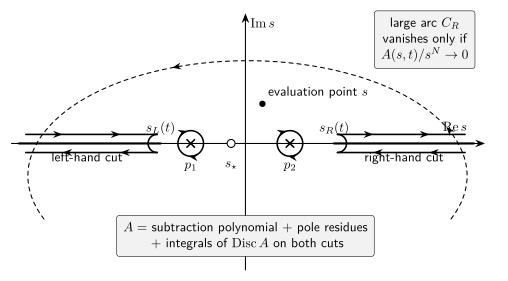
Schematic fixed- contour deformation, not to scale. The two cut lips give discontinuity integrals, isolated pole circles give residues, and the order- subtraction point gives a degree- polynomial. The dashed large arc may be discarded only when uniformly in the required directions.
| Graphic element | Equivalent analytic statement |
|---|---|
| upper and lower lips of each cut | their opposite orientations combine into |
| circles around | add the explicit meromorphic terms |
| point | stores the first regular Taylor coefficients in |
| dashed arc | tends to zero only under the displayed growth condition |
Crossing rewrites the left cut
Section titled “Crossing rewrites the left cut”For identical scalar scattering, and crossing gives . A point on the left cut in maps to a physical right-cut point in . Changing variables therefore rewrites the second integral as a crossed-channel integral. The Jacobian and the reversed endpoints must both be retained; guessing the sign from a sketch is a common source of error.
It is convenient to subtract known one-particle poles first,
and introduce the crossing variable
For a crossing-even amplitude, , so odd regular Taylor coefficients vanish. This symmetry does not remove the even subtraction constants. It only organizes them and combines the two cuts into an even kernel.
How many subtractions?
Section titled “How many subtractions?”Suppose the fixed- amplitude obeys . Then suffices. After explicit pole terms are accounted for, the dispersive integral determines derivatives of the pole-subtracted amplitude of order two and higher; and remain subtraction data. This is the growth used in the familiar gapped scalar positivity argument de Rham et al. 2017, pp. 1–2, PDF. More generally:
| Asymptotic information | Safe conclusion |
|---|---|
| an -subtracted relation with degree- polynomial | |
| only a bound on the real axis | insufficient by itself; the complex arc still needs control |
| exponential or unknown growth in some directions | retain an arc term or supply another theorem |
| a massless exchange or cut reaches | derive at regulated nonzero first; the forward limit is a separate question |
Subtractions improve ultraviolet convergence but do not cure an infrared singularity at the subtraction point. Nor do they prove the assumed analytic domain.
A pole-plus-cut reconstruction check
Section titled “A pole-plus-cut reconstruction check”Take a function with one stable pole and one known spectral density,
where lies below the cut. The pole residue is exactly , the subtraction value of the regular part is , and the discontinuity of the last term is because
Reinserting those three data into the once-subtracted formula returns the original function. This small model checks independently that poles are not double counted in the spectral integral, that the subtraction constant belongs to the pole-subtracted amplitude, and that the orientation of the cut gives the displayed sign.
Checks and failure modes
Section titled “Checks and failure modes”Differentiate away the polynomial. Taking derivatives with respect to annihilates . If a purported -subtracted sum rule still contains an undetermined coefficient of degree below , the differentiation or pole subtraction is incomplete.
Recover a pole exactly. For with no cuts, the discontinuity integrals vanish and the explicit pole term must reproduce the whole function. This checks the residue sign.
Do not infer positivity yet. The formula above is an equality. A sign follows only after crossing has put the relevant discontinuities into physical channels and unitarity makes their weighted sum nonnegative. Adams and collaborators make this extra step explicit in the forward scalar case Adams et al. 2006, § 4, pp. 14–19, PDF.
Exercises
Section titled “Exercises”If but does not vanish, identify the minimal safe subtraction number and the undetermined polynomial. Then verify that differentiating three times removes it.
Check
Take . The polynomial has degree at most two, , and .
Continue to the absorptive interpretation: Forward Scattering Sum Rules.
References
Section titled “References”- Adams, Allan, Nima Arkani-Hamed, Sergei Dubovsky, Alberto Nicolis, and Riccardo Rattazzi. “Causality, Analyticity and an IR Obstruction to UV Completion.” Journal of High Energy Physics 10 (2006): 014. DOI. Open PDF.
- de Rham, Claudia, Scott Melville, Andrew J. Tolley, and Shuang-Yong Zhou. “Positivity Bounds for Scalar Theories.” Physical Review D 96 (2017): 081702. DOI. Open PDF.
- Weinberg, Steven. The Quantum Theory of Fields. Volume I: Foundations. Cambridge: Cambridge University Press, 1995. DOI.