

Sudakov Logarithms and Resummation
When a prediction contains widely separated scales, fixed-order coefficients can carry powers of a large logarithm . Soft and collinear overlap can generate two logarithms per power of the coupling. Resummation does not remove these terms; it reorganizes their towers through evolution so that each factor is evaluated near a scale where its own fixed-order expansion is well behaved.
Required background. Hard, Jet, and Soft Factorization supplies the scale-separated functions, overlap subtraction, and consistency relation that make the evolution meaningful.
The double-logarithmic region
Section titled “The double-logarithmic region”For a hard particle in an exclusive configuration that vetoes resolved radiation with transverse resolution , unresolved real emission no longer cancels all of the virtual soft-collinear correction. A representative leading integral is
The integration domain is triangular in logarithmic energy and angle. One logarithm is soft and one is collinear; their boundary here is the illustrative transverse-momentum condition . A different observable changes the boundaries and coefficient while preserving the reason a double logarithm can occur.
For an infrared-regulated on-shell form factor, one common normalization has
The negative sign reflects the virtual probability not compensated by forbidden resolved emission. The coefficient depends on whether is an amplitude or a cross section, the charge normalization, and whether is a gauge-boson mass, external off-shellness, or a measurement scale. It must not be transplanted between those definitions. Sudakov first exhibited the exponential high-energy suppression of a QED vertex in Sudakov 1956, printed pp. 65–71, PDF.
Evolution exponentiates the hierarchy
Section titled “Evolution exponentiates the hierarchy”Suppose a renormalized factor obeys
Evolving from a natural hard scale to a lower scale gives
At fixed coupling, the cusp term is ; choosing the canonical boundary scale reduces it to . Expanding the exponential regenerates the towers , while running coupling and noncusp terms organize lower powers. This is the Sudakov suppression for an exclusive or endpoint configuration; sufficiently inclusive rates can have a different logarithmic structure because real radiation is retained.
Becher, Broggio, and Ferroglia derive cusp-controlled evolution and its solution in their SCET introduction, arXiv PDF §§ 5–7, printed pp. 48–90. Schwartz connects the original infrared form factor to effective-theory resummation in Schwartz 2014, §§ 20.3 and 36.4–36.6, printed pp. 366–373 and 790–810.
From natural scales to a matched prediction
Section titled “From natural scales to a matched prediction”In a factorized observable, hard, jet, and soft factors are computed near , , and and evolved to a common scale. Their anomalous dimensions must cancel in the product or convolution, even though the evolution between natural scales resums logarithms of their ratios.
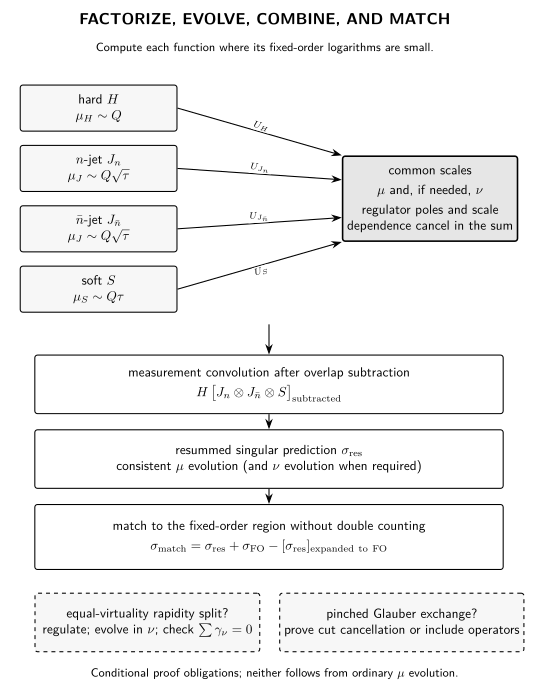
Resummation evaluates each factor near its natural scale and evolves it before combination. Additive matching restores nonsingular fixed-order terms while subtracting the fixed-order expansion already present in the resummed result. Rapidity and Glauber entries are conditional, process-dependent additions; the diagram is schematic and not to scale.
A standard additive matching formula is
The subtraction prevents double counting. In the resummation region, the singular logarithms remain exponentiated; where all scales merge, the resummed expression is turned off smoothly and the fixed-order result is recovered to the claimed order. Profile scales used for that interpolation are part of the prediction and its uncertainty analysis, not new physical parameters.
Logarithmic accuracy and checks
Section titled “Logarithmic accuracy and checks”A label such as LL, NLL, or NNLL is meaningful only with an explicit counting convention and ingredient list. Increasing accuracy requires successively higher orders of the cusp anomalous dimension, beta function, noncusp anomalous dimensions, and fixed-order boundary matching. The exact order assigned to each ingredient can differ between exponent and cross-section counting conventions, so the label alone is insufficient.
Three checks are indispensable:
- expand the resummed result and reproduce every singular logarithm known at fixed order;
- verify cancellation of the common dependence and, where present, the rapidity scale to the stated accuracy;
- take the no-hierarchy limit and recover the fixed-order prediction without double counting.
Resummation does not repair a false factorization theorem. Non-global logarithms can correlate separated angular regions, Glauber exchange can entangle sectors, and the running coupling can reach a nonperturbative scale. Power corrections become important when endpoint variables are not small or the soft scale approaches hadronic physics. Each limitation must be assessed before assigning logarithmic accuracy.
Check your understanding
Section titled “Check your understanding”Evaluate the double-logarithmic integral in two orders: integrate over first as displayed, then draw its triangular domain in and compute its area. Expand through and identify the LL terms. Finally, use the additive matching formula to verify that its fixed-order expansion equals through the matching order.
References
Section titled “References”- Becher, Thomas, Alessandro Broggio, and Andrea Ferroglia. Introduction to Soft-Collinear Effective Theory. Lecture Notes in Physics 896. Springer, 2015, §§ 5–7. doi:10.1007/978-3-319-14848-9. Open PDF.
- Schwartz, Matthew D. Quantum Field Theory and the Standard Model. Cambridge University Press, 2014, §§ 20.3 and 36.4–36.6, printed pp. 366–373 and 790–810. doi:10.1017/9781139540940.
- Sudakov, Vladimir V. “Vertex Parts at Very High Energies in Quantum Electrodynamics.” Soviet Physics JETP 3 (1956): 65–71; translated from Zhurnal Eksperimental’noi i Teoreticheskoi Fiziki 30 (1956): 87–95. Open PDF.